How high up are meteors when they begin to glow?
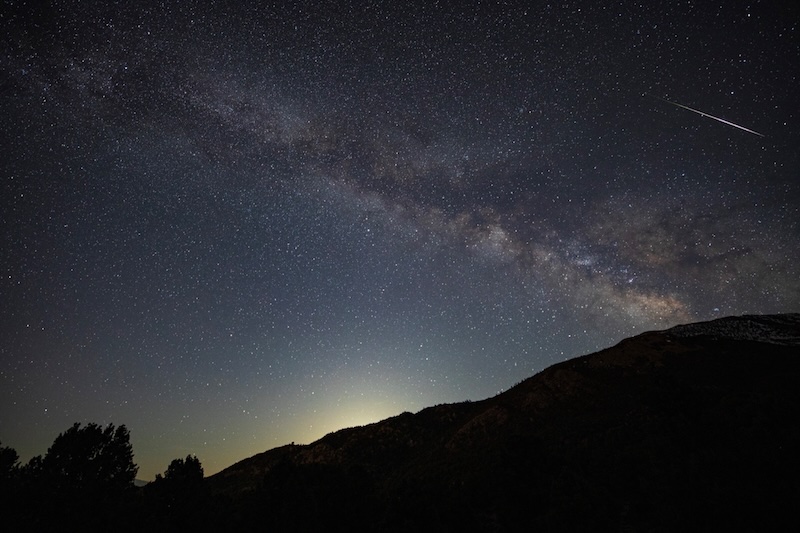
The autumn meteor showers are underway. Have you ever wondered how high up they are when they begin to glow? It can vary and depends on the radiant of the meteor shower and the current phase of the moon. Meteors – in annual showers – like the Orionids are leftover dust particles from comets. These bits of cometary debris collide with Earth’s atmosphere and vaporize. We see this collision as a streak of light across the sky – a meteor – or, more poetically, a shooting star or falling star.
But how high up are meteors when they begin to glow?
Meteors light up almost as soon as they hit Earth’s atmosphere. So, on average, when you see a meteor, you’re looking at a piece of dust burning bright about 50 to 75 miles (80 to 120 km) in altitude above Earth’s surface.
But the height at which they entirely burn up in the atmosphere varies. Some meteors, such as the Perseids in August, burn up in the atmosphere at about 60 miles (100 km) above Earth’s surface. Other meteors, such as the Draconids in October, fall to about 40 miles (65 km) before they heat up enough to glow and vaporize.
The difference is that the Draconids are much slower meteors than the Perseids. The height in the atmosphere at which a meteor begins to glow depends on its arrival speed. Meteoroids dive into the atmosphere at speeds ranging from 25,000 to 160,000 miles per hour (40,200 to 257,500 km/h).

Speeds for annual meteor showers
There are a dozen major meteor showers every year, and many more minor ones.
Here are some meteor arrival speeds:
Leonids: 44 miles per second (71 km/s)
Perseids: 38 miles per second (61 km/s)
Orionids: 42 miles per second (67 km/s)
Lyrids: 30 miles per second (48 km/s)
Geminids: 22 miles per second (35 km/s)
Fall Taurids: 19 miles per second (30 km/s)
Delta Leonids: 14 miles per second (23 km/s)
Draconids: 14 miles per second (23 km/s)
By the way, the length of a meteor’s path across the sky doesn’t depend entirely on the meteor’s arrival speed. It depends mostly on the angle at which the particle of dust slices through the atmosphere. If the particle arrives at a low angle, it enters the atmosphere more gradually, heats up more slowly, and cuts a longer swath across the sky, than if it barrels in at a steep angle.
The size, composition and density of the dust particle probably also affect the length of the path, but scientists still aren’t sure exactly how.
Bottom line: How high up are meteors when they begin to glow? Meteors start glowing almost as soon as they hit Earth’s atmosphere, but tend to vaporize at varying altitudes depending on their arrival speed.
Read more: EarthSky’s meteor shower guide