- Does lightning occur on Mars? Scientists have thought it possible, but proof has been elusive until now.
- NASA’s Perseverance rover recorded the crackling of small lightning discharges 55 times over the past two Martian years, scientists have announced.
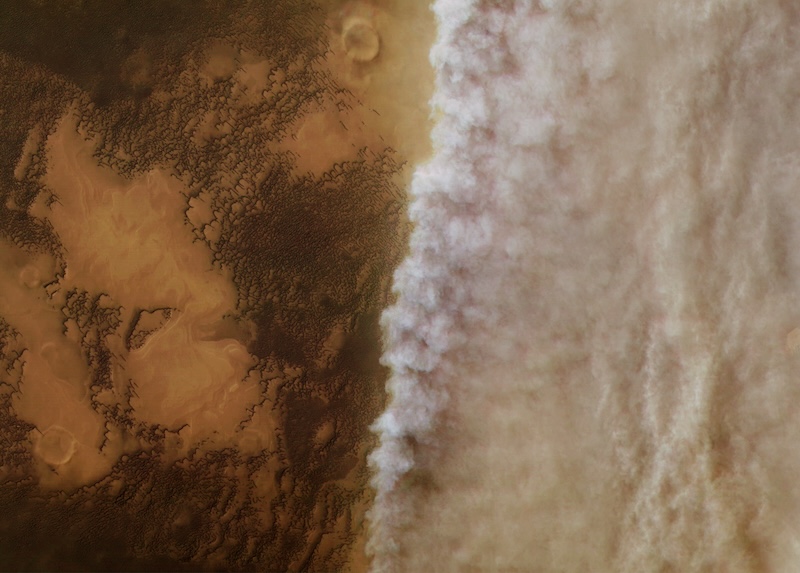
- The discharges are similar to lightning on Earth, but occur in dust storms and dust devils. Both dust and wind are needed for them to happen.
EarthSky’s 2026 lunar calendar is available now. Get yours today! Makes a great gift.
Perseverance hears lightning sparks on Mars
Scientists have theorized for decades that there could be lightning on Mars. And now, NASA’s Perseverance rover has finally gathered direct evidence of electrical sparks in Martian dust storms and dust devils.
A team of scientists, led by Baptiste Chide of the University of Toulouse in France, said on December 3, 2025, that the rover has detected the sparks – which Chide described to Reuters as ‘mini-lightning’ – no less than 55 times over about two Martian years. Perseverance heard the discharges with its onboard microphone, and you can take a listen below.
On Earth, lightning is mostly associated with storm clouds containing water vapor. On Mars, however, it seems to occur when dusty particles get jostled around in the winds. As a result, they rub together, producing static discharges.
The researchers published their peer-reviewed findings in the journal Nature on November 26, 2025.
NASA’s Perseverance rover has detected lightning on Mars. The electrical discharges were most often heard with the rover’s microphone at the leading edge of nearby dust storms as well as in dust devils. Video via NASA/ JPLRaw/ YouTube.
Electrical discharges in dust clouds
Since lightning is so common on Earth, scientists thought that maybe it could happen on Mars, too. That might sound unlikely, given Mars’ atmosphere is so much drier than Earth’s. But it’s not just water-rich storm clouds that generate electrical discharges; sand and dust storms can too.
Any such electrical discharges would likely be much smaller than the lightning storms we see on Earth. So detecting them would be difficult, unless you were right on the surface at the time. Luckily, one of NASA’s rovers – Perseverance – is equipped to be able to detect any nearby electrical discharges … and it did!
Altogether, Perseverance detected 55 mini-lightning events over the course of two Martian years, which are slightly longer than Earth years. The rover recorded the events on its onboard SuperCam microphone. In 16 of these recordings, a dust devil passed directly over the rover.
The triboelectric effect
These lightning sparks on Mars are the result of the triboelectric effect. That’s an electric charge transfer between two objects when they contact or slide against each other. It’s the same phenomenon as when someone walks over a carpet in socks and then touches a metal doorknob, generating a spark of static. In fact, it is also about the same level of discharge. As Chide explained:
Triboelectric charging of sand and snow particles is well documented on Earth, particularly in desert regions, but it rarely results in actual electrical discharges. On Mars, the thin atmosphere makes the phenomenon far more likely, as the amount of charge required to generate sparks is much lower than what is required in Earth’s near-surface atmosphere.
Lightning and thunder
Seven of the recordings captured the discharge events in full, while others were partial. The microphone first heard an electronic “blip.” This happened when the electrical discharge affected the wiring of the microphone. Then, there was a brief relaxation, or ringdown as the scientists called it, for about 8 milliseconds. A millisecond is 1/1000 of a second.
In the case of the seven full recordings, what happened next told scientists that these were indeed miniature lightning discharges. After the ringdown in each case, Perseverance detected a tiny sonic boom. In other words, tiny claps of thunder, just as how on Earth we see the lightning bolt first, and then hear the thunder clap.
Co-author Ralph Lorenz, a Perseverance scientist at the Johns Hopkins Applied Physics Lab in Laurel, Maryland, said:
We got some good ones where you can clearly hear the ‘snap’ sound of the spark. In the sol 215 dust devil recording, you can hear not only the electrical sound, but also the wall of the dust devil moving over the rover. And in the sol 1,296 dust devil, you hear all that plus some of the particles impacting the microphone.
Later, the researchers duplicated the recordings using a replica of the SuperCam instrument. They were able to duplicate the recordings, showing that the detections that Perseverance made really were miniature versions of lightning and thunder.
Wind needed for lightning on Mars
Notably, the results also showed that dust alone isn’t enough to produce lightning on Mars. You also need wind. In fact, 54 out of the 55 detections occurred when winds were strongest – in the top 30% of measured wind speeds – near the rover. Those winds were at the front edge of dust storms. So both the winds and dust were needed to produce the lightning.
Likewise, Perseverance made 16 of the detections during the two times when dust devils – also very common on Mars – were near the rover.
The electrical discharges did not seem to increase during the seasons when global dust storms are more common on Mars. This also suggests that the electrical buildup is more closely tied to the localized, turbulent lifting of sand and dust rather than high dust density alone.
Other electrifying effects
The confirmation of the electrical discharges could help explain some other mysteries of Mars, too. The results show that the Martian atmosphere can become sufficiently charged to activate chemical reactions. This could lead to the creation of highly oxidizing compounds, such as chlorates and perchlorates. These are common on Mars, but scientists aren’t sure how they formed. Those compounds can destroy organic molecules as well as other atmospheric compounds.
They might also help explain why the methane on Mars seems to vanish so quickly after being released into the atmosphere.
Bottom line: NASA’s Perseverance rover has detected lightning on Mars 55 times. It heard the small electrical discharges with its microphone in dust storms and dust devils.
Source: Detection of triboelectric discharges during dust events on Mars
Via NASA
Read more: Life on Mars? Odd rings and spots tantalize scientists
Read more: Perseverance rover explores Bright Angel in ancient riverbed