EarthSky’s 2026 lunar calendar is available now. Get yours today! Makes a great gift.
- Mars has two tiny moons, Phobos and Deimos. Could it have had a larger moon in the past?
- Thin, repeating layers in sedimentary rock – found by the Curiosity rover in Gale crater – might be evidence of tides in the ancient lake that once filled the crater.
- Only a former larger moon could have created such tides, because Phobos and Deimos are much too small.
A larger, lost moon of Mars?
Mars is well-known for its two tiny moons, Phobos and Deimos. But did it ever have any larger moons? A team of researchers from Germany, India and the U.S. has found evidence for a possible lost moon in Mars’ distant past that was much larger than the moons that orbit the planet today. The researchers said on November 20, 2025, that the clues come from thin, repeating layers of sedimentary rock in a rocky outcrop called Jura in Gale crater, where NASA’s Curiosity rover has been exploring since 2012. The researchers said they are likely tidal rhythmites, sediments deposited by the regular sloshing of tides in water when Gale crater was a lake 3.8 billion years ago.
The team, led by Ranjan Sarkar at the Max Planck Institute for Solar System Research in Germany, will present its findings at the AGU25 meeting on December 17, 2025.
Damond Benningfield wrote about the intriguing findings for Eos on November 20, 2025.
Thin layers of sedimentary rock on Mars suggest that the planet once had a moon much larger than the two that orbit it today. #AGU25
— Eos (@eos.org) 2025-11-23T16:24:00.685Z
Curiosity finds intriguing layers in rocky outcrop
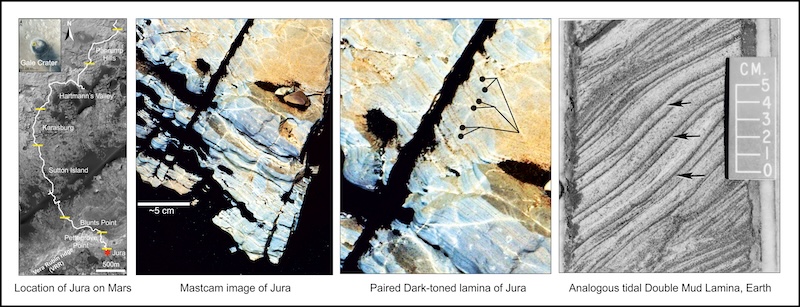
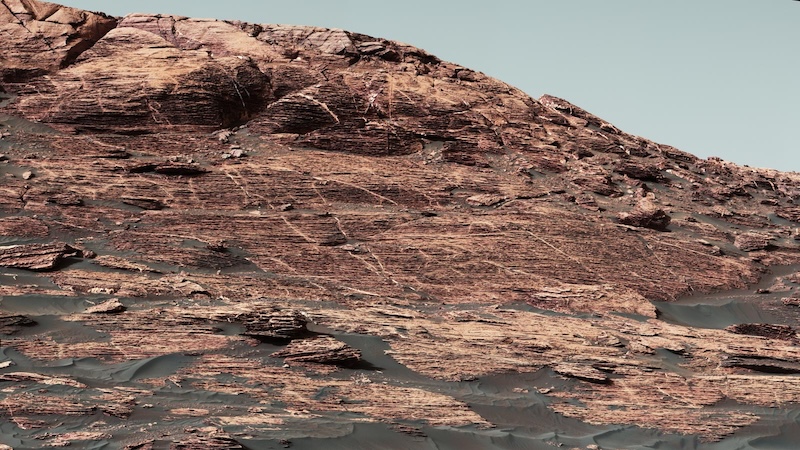
The Curiosity rover landed in 2012 and has been exploring its new home of Gale crater ever since. In late 2017 and early 2018, it studied a rocky outcrop at Vera Rubin Ridge. This ridge is on the lower flank of Mount Sharp, a massive hill in the center of Gale crater. The rover took a close look at the rocky outcrop – including with its Mars Hand Lens Imager – and found something interesting. There were very fine, repeating layers of sediments in the outcrop. They alternated between bright and dark colors.
The rover inspected an area about 14 inches (35 centimeters) long and 8 inches (20 centimeters) wide. The thickness of individual layers in the rock ranged from submillimeters to millimeters thick. There were wider, light-toned layers and darker, thinner layers.
Notably, such layers often indicate the presence of past water. In this case, however, they hinted at something more, too.
Did a lost moon of Mars create tides in ancient bodies of water?
Analysis of the thin, repeating layers suggested they were tidal rhythmites. The rhythmites are layers of sediments deposited by tides. Scientists already knew Gale crater used to be a lake a few billion years ago. And the layers were deposited about 3.8 billion years ago, the researchers said. So evidence of tides themselves wasn’t too weird. But what caused the tides?
The researchers said a larger moon was the most likely answer. Sarkar told Eos:
Our study provides sedimentary evidence for the case of tidally deposited rhythmites, hinting at a past larger moon for Mars. This, in turn, aligns with the hypothesis that Mars has repeatedly had larger moons that were tidally destroyed into rings, which then reformed into successively smaller moons.
What kind of rhythmites?
So how did the researchers conclude that tides created these rhythmites? They noted that rhythmites can form in different ways, not just tidally. Winds, seasonal variations in climate and melting glaciers can also create them. As the saying goes, the devil is in the details.
Bob Craddock, a geologist at the National Air and Space Museum, who was not involved in the study, suggested that the rhythmites in Gale crater were probably formed through seasonal changes in climate. As quoted in Eos, he said:
The finely laminated rhythmites in this crater are most likely varves, or deposits that reflect seasonal changes in the climate.
More water would have flowed into Gale crater lake during the warmer summer months. This would produce thicker sediment layers with larger grains compared to those formed during winter.
As this continues through time, you get rhythmites.
Making the case for tidal rhythmites
But Sarkar disagreed, saying:
Annual varves usually show simple light-dark couplets, but we observe alternating thick-thin bands showing paired dark laminae.
Those kinds of patterns …
are commonly used as markers of tidal sedimentary signatures on Earth.
As the presentation abstract also stated:
Notably, the paired dark-toned laminae closely resemble slackwater mud drapes and double mud layers typical of tidal rhythmites on Earth.
Determining the actual cause of the rhythmites far away on Mars isn’t necessarily easy, to be sure. Co-author Suniti Karunatillake at Louisiana State University added:
It’s very tricky. We can’t be decisive, so our argument is one of consistency. We felt that the observations are generally more consistent with a tidal setting.
A monthly cycle
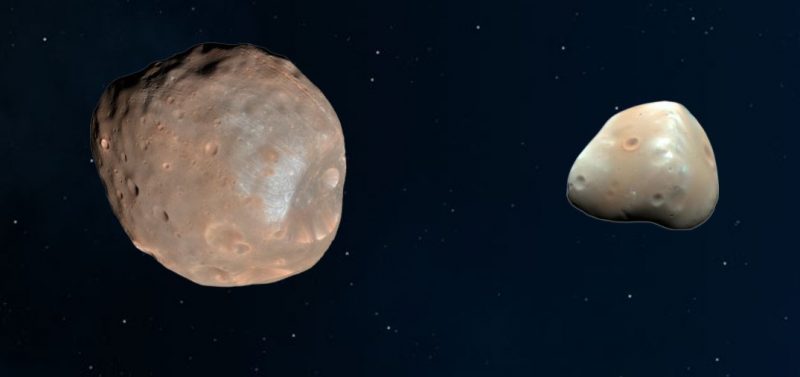
The data also suggest the layers were deposited in cycles of about 30 days. But there’s a problem if they were tidal cycles. Both Phobos and Deimos are far too tiny to be able to create such tides. So, if these really are tidal rhythmites, then there must have been a moon that was much larger. The researchers calculated that it would have to be at least 18 times the mass of Phobos. It also would have orbited at a distance about three times the radius of Mars. Karunatillake said:
That’s our back-of-the-envelope calculation. Anything smaller and it would be difficult to induce this type of tidal activity, especially when you consider that Gale crater is quite small as a water body on the planetary scale.
If there was indeed a larger moon, that would fit with the longstanding hypothesis that Mars had more than one larger moon in its past. Mars’ gravity destroyed those moons, forming temporary rings around Mars. The resulting debris then gradually formed smaller moons, including Phobos and Deimos. Scientists think that cycle could have happened many times during Mars’ history. As Sarkar noted:
Our study provides actual (ground) evidence, from measured laminae periodicities, for the predicted/hypothesized past larger moon.
Similar layers elsewhere in Gale crater
The existence of a prior larger moon isn’t proven yet, so the researchers are being cautious in their analysis of the data. With this in mind, they are now examining two other sites in Gale crater that have similar fine layering. Karunatillake noted that if it turns out there are inconsistencies among the three sites, then that would …
dispute our model, and possibly falsify it. But any agreement would take us toward a stronger argument for an ancient large moon.
Bottom line: Thin, repeating sedimentary layers examined by the Curiosity rover suggest that a large, lost moon of Mars created tides in the ancient lake of Gale crater.
Source: Possible Tidal Rhythmites in Gale Crater, Mars: Traces of a Lost Moon?
Via EOS
Read more: Lakes on Mars had ripples! They must have been ice-free
Read more: Corals on Mars? NASA rover finds more remarkably weird rocks