EarthSky’s 2026 lunar calendar is available now. Get yours today! Makes a great gift.
- Is there a methane-rich atmosphere on exoplanet TRAPPIST-1e? Recent results from the Webb space telescope hinted there might be.
- But the tentative methane detection might be from the planet’s star instead, a new paper suggests.
- There could still be a thin atmosphere – without methane – but more observations are needed to know for sure.
Is there a methane atmosphere on TRAPPIST-1e?
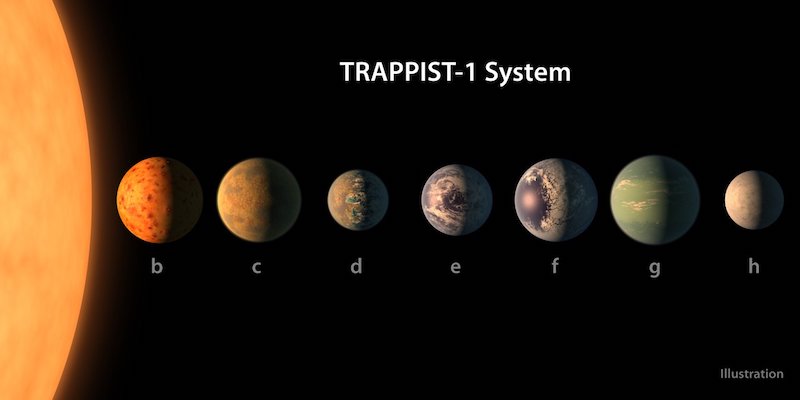
Last September, astronomers published two papers that said the Earth-sized exoplanet TRAPPIST-1e might have a thin atmosphere of methane and nitrogen. On December 4, 2025, researchers released a 3rd paper that urges caution about TRAPPIST-1e’s possible atmosphere. The researchers said the new results from the James Webb Space Telescope suggest the preliminary hint of a methane-rich atmosphere might be erroneous. But that doesn’t necessarily mean the planet has no atmosphere at all. It does, however, show that characterizing that atmosphere – if it exists – isn’t easy.
Sukrit Ranjan at the Lunar and Planetary Laboratory at the University of Arizona is the lead author of the new paper and was involved with the previous two papers as well. The new paper focuses on “warm exo-Titans” and uses TRAPPIST-1e as a test case. Such planets are hypothesized to be warmer versions of Saturn’s moon Titan, with nitrogen and methane atmospheres. That’s because they orbit close to their stars, unlike Titan in our outer solar system.
The researchers published the new peer-reviewed paper in The Astrophysical Journal Letters on November 3, 2025.
A New Look At TRAPPIST-1e, An Earth-sized, Habitable-zone Exoplanetastrobiology.com/2025/12/a-ne… #astrobiology #exoplanet
— Astrobiology (@astrobiology.bsky.social) 2025-12-05T18:15:36.516Z
Does TRAPPIST-1e have an atmosphere?
Using Webb, scientists had already determined that TRAPPIST-1e doesn’t have a thick primordial atmosphere. That is the original atmosphere a planet develops when it first starts forming. TRAPPIST-1e could, however, now have a secondary thin atmosphere more like that of Earth. But that depends on whether intense solar bursts from the planet’s red dwarf star have eroded any existing atmosphere or not.
As reported last September, analysis of the Webb results hinted at a possible thin atmosphere of methane. A methane atmosphere would also likely require nitrogen to be maintained. It might, therefore, be similar to Titan’s atmosphere, which is primarily nitrogen but also rich in methane. It could also be similar to Earth’s nitrogen atmosphere, since it would be warmer than Titan’s frigid atmosphere.
The researchers used Webb’s Near-Infrared Spectrograph (NIRSpec) instrument to analyze TRAPPIST-1e’s electromagnetic spectrum, or wavelengths of light, as it passed in front of its star. If there is an atmosphere, the starlight will pass through it, which Webb can analyze. And the more of these passes in front of its star – or transits – it can observe, the better.

Is methane on the planet or the star?
Webb observed four transits in all, so far. That’s when the tentative detection of methane was made. But it’s possible that the star itself could also have methane molecules in its atmosphere. As Ranjan explained:
While the sun is a bright, yellow dwarf star, TRAPPIST-1 is an ultracool red dwarf, meaning it is significantly smaller, cooler and dimmer than our sun. Cool enough, in fact, to allow for gas molecules in its atmosphere. We reported hints of methane, but the question is: Is the methane attributable to molecules in the atmosphere of the planet or in the host star?
TRAPPIST-1e probably not an exo-Titan
The researchers tested various scenarios to try to determine if the possible methane was in the planet’s atmosphere or the star’s.
As it turned out, the most likely planetary scenario was the warm exo-Titan one. But that possibility is still less likely than the methane signal coming from the star. Yet that doesn’t necessarily mean there’s no atmosphere on TRAPPIST-1e at all. There could still be a thin atmosphere, just without any methane. Ranjan said:
Based on our most recent work, we suggest that the previously reported tentative hint of an atmosphere is more likely to be ‘noise’ from the host star. However, this does not mean that TRAPPIST-1e does not have an atmosphere; we just need more data.
As the paper notes:
While they did not find a direct solar system analog, they noted that the favored atmospheric scenario was most comparable to a warm Titan, with other possible explanations for the signal being stellar activity or random noise. Here, we have performed a deeper investigation to determine the plausibility of the warm exo-Titan scenario through detailed photochemical modeling, which reveals that a warm exo-Titan TRAPPIST-1e is a priori unlikely due to the short methane lifetime.
More observations needed
As Ranjan noted above, more observations of TRAPPIST-1e will be required to know for sure if it has a methane atmosphere, or any atmosphere. More transits seen by Webb will help. And NASA’s upcoming Pandora space telescope, scheduled to launch in 2026, will also be able to characterize the planet’s atmosphere in more detail. Ranjan said:
These observations will allow us to separate what the star is doing from what is going on in the planet’s atmosphere, should it have one.
Bottom line: Previous hints of a methane atmosphere on TRAPPIST-1e might not be accurate, a new paper suggests. But the tantalizing exoplanet could still have an atmosphere.
Source: The Photochemical Plausibility of Warm Exo-Titans Orbiting M Dwarf Stars
Via The University of Arizona
Read more: Exoplanet TRAPPIST-1e: New hints of a habitable world?
Read more: Some TRAPPIST-1 exoplanets could have stable atmospheres