Originally published by NASA on December 11, 2025. Edits by EarthSky.
EarthSky’s 2026 lunar calendar is available now. Get yours today! Makes a great gift.
NASA’s Parker Solar Probe spies solar wind ‘U-turn’
Images captured by NASA’s Parker Solar Probe as the spacecraft made its record-breaking closest approach to the sun in December 2024 have now revealed new details about how magnetic fields responsible for space weather escape from the sun … and how sometimes they don’t.
Like a toddler, our sun occasionally has disruptive outbursts. But instead of throwing fits, the sun spews magnetized material and hazardous high-energy particles across the solar system. These outbursts, called coronal mass ejections (CMEs) can impact our daily lives, from disrupting technologies like GPS to triggering power outages, and they can also imperil voyaging astronauts and spacecraft.
But the images taken by Parker Solar Probe in December 2024 and published on December 11, 2025, in the Astrophysical Journal Letters, have revealed that not all magnetic material in a CME escapes the sun. Some of it makes it back, changing the shape of the solar atmosphere in subtle but significant ways. And these changes can set the course of the next CME exploding from our star.
Joe Westlake, heliophysics division director at NASA Headquarters in Washington, said:
These breathtaking images are some of the closest ever taken to the sun and they’re expanding what we know about our closest star. The insights we gain from these images are an important part of understanding and predicting how space weather moves through the solar system, especially for mission planning that ensures the safety of our Artemis astronauts traveling beyond the protective shield of our atmosphere.
Parker Solar Probe reveals solar recycling in action
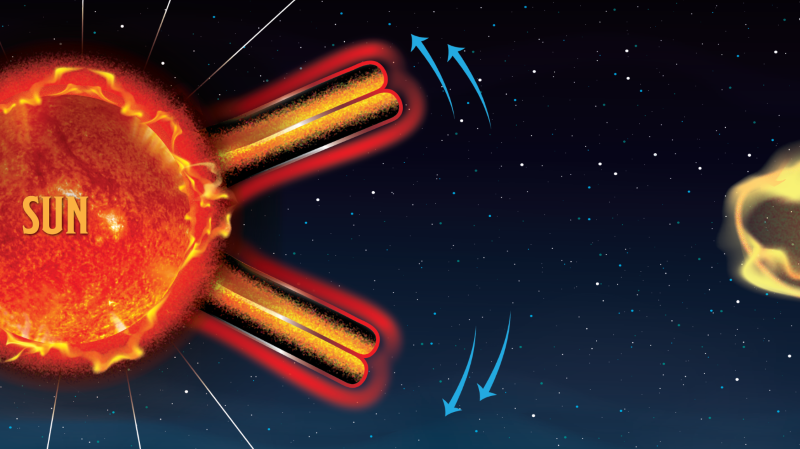
As Parker Solar Probe swept through the sun’s atmosphere on December 24, 2024, just 3.8 million miles (6 million km) from the solar surface, it observed a CME erupt. In the CME’s wake, elongated blobs of solar material were seen falling back toward the sun.
Other NASA missions, including SOHO and STEREO, have seen this type of feature, known as “inflows”. But Parker Solar Probe’s extreme close-up view from within the solar atmosphere has revealed details of material falling back toward the sun and on scales never seen before.
Nour Rawafi, Parker Solar Probe project scientist, said:
We’ve previously seen hints that material can fall back into the sun this way, but to see it with this clarity is amazing. This is a really fascinating, eye-opening glimpse into how the sun continuously recycles its coronal magnetic fields and material.
The inflow process visualized


Insights on inflows
For the first time, the high-resolution images from Parker Solar Probe allowed scientists to make precise measurements about the inflow process, including measurements of the speed and size of the blobs of material pulled back into the sun. These previously hidden details provide scientists with new insights into the physical mechanisms that reconfigure the solar atmosphere.
The CMEs are often triggered by twisted magnetic field lines that explosively snap and realign in a process called magnetic reconnection. This magnetic explosion kicks out a burst of charged particles and magnetic fields: a CME.
As the CME travels outward from the sun, it expands, in some cases causing nearby magnetic field lines to tear apart like the threads of an old piece of cloth pulled too tight. The torn magnetic field quickly mends itself, creating separate magnetic loops. Some of the loops travel outward from the sun, and others stitch back to it, forming inflows.
Angelos Vourlidas, project scientist for Parker’s WISPR instrument, said:
It turns out, some of the magnetic field released with the CME does not escape as we would expect. It actually lingers for a while and eventually returns to the sun to be recycled, reshaping the solar atmosphere in subtle ways.
Reconfiguring the solar wind and the solar atmosphere
An important result of this magnetic recycling is that as the inflows contract back into the sun, they drag down blobs of nearby solar material and ultimately affect the magnetic fields swirling beneath. This interaction reconfigures the solar magnetic landscape, potentially altering the trajectories of subsequent CMEs that may emerge from the region. Vourlidas said:
The magnetic reconfiguration caused by inflows may be enough to point a secondary CME a few degrees in a different direction. That’s enough to be the difference between a CME crashing into Mars versus sweeping by the planet with no or little effects.
Scientists are using the new findings to improve their models of space weather and the sun’s complex magnetic environment. Ultimately, this work may help scientists better predict the impact of space weather across the solar system on longer timescales than currently possible. Rawafi said:
Eventually, with more and more passes by the sun, Parker Solar Probe will help us be able to continue building the big picture of the sun’s magnetic fields and how they can affect us. And as the sun transitions from solar maximum toward minimum, the scenes we’ll witness may be even more dramatic.
Bottom line: NASA’s Parker Solar Probe images have revealed solar material blasted out from the sun returning to our star, rather than escaping as solar wind.
Via NASA
Read more: Parker Solar Probe peers into coronal hole, sees source of solar wind
Read more: Astronomers create 1st map of the sun’s outer boundary