EarthSky’s 2026 lunar calendar is available now. Get yours today! Makes a great New Year’s gift.
- A huge spider-like formation on Jupiter’s moon Europa appears in a shallow crater. How did it form?
- Briny (salty) water coming to the surface after the impact that made the crater probably created the unusual feature.
- The “spider” is similar to features on Mars and Earth, even though the conditions it formed in are quite different. It could provide clues about habitability in pockets of water within the icy crust.
A giant ‘spider’ on Europa
Did you know there is a huge ‘spider’ on Jupiter’s moon Europa? A team of researchers from the Planetary Science Institute, the University of Central Florida, NASA’s Jet Propulsion Laboratory (JPL) and other institutions has recently completed a new study into the unusual feature, located in Manannán crater.
The researchers said earlier this month that the odd formation likely formed from brines – salty water – that erupted to the surface due to the impact that created the crater. And while this spider is not an actual lifeform of course, it could provide valuable clues about subsurface conditions within the ice crust, including lakes or other pockets of liquid water.
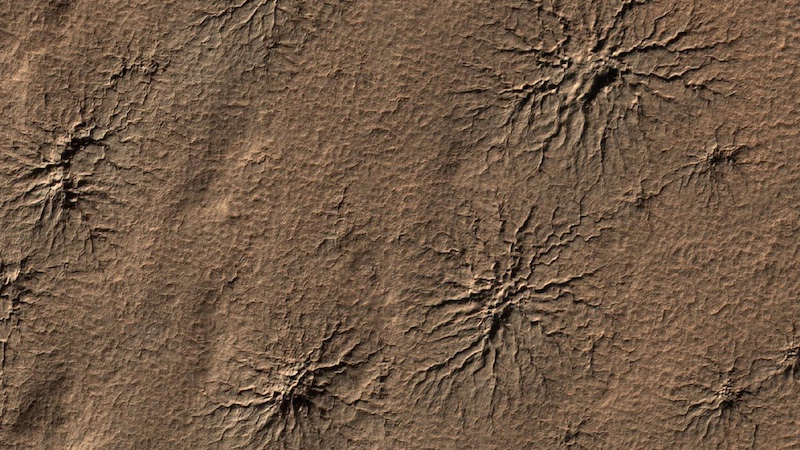
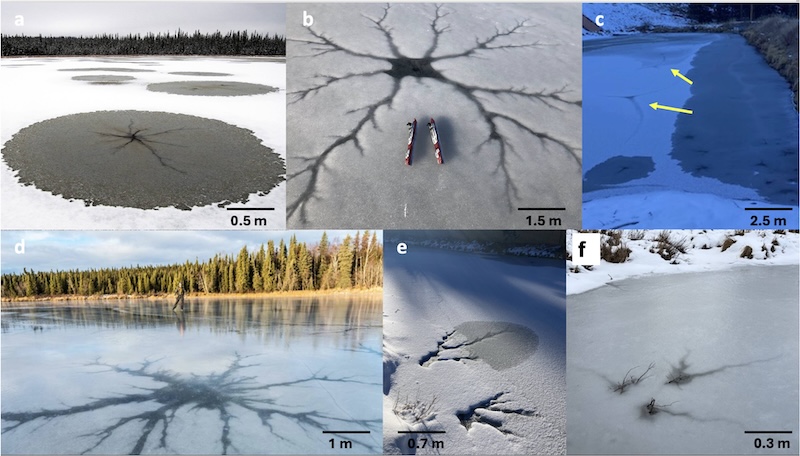
There are similar features on both Earth and Mars, too. The Europa spider differs from the ones on Mars in that the Martian ones form when carbon dioxide gas escapes from underground. The gas then erodes the dust and sand on the surface into the spider-like shapes. On Earth, similar features on frozen lakes and ponds are called lake stars.
The unusual spider-like formation – nicknamed Damhán Alla, Irish for “spider” – is in Manannán crater. The crater is about 21-23 kilometers (13-14 miles) in diameter, making it one of the largest craters on Europa. The spider sits in the middle of the crater.
Spacecraft have previously mapped the crater in infrared, finding ice and hydrated water minerals concentrated around the crater. The crater is quite shallow, suggesting the impact occurred in a warmer, soft icy crust over the subsurface ocean.
The researchers published their peer-reviewed findings in The Planetary Science Journal on December 2, 2025.
“This spider-like feature might have formed through the eruption of melted brines following the Manannán impact,” said Elodie Lesage, PSI research scientist and study co-author. Read the full story: buff.ly/J8YWM1P
— Planetary Science Institute (@psi.edu) 2025-12-02T18:37:07.728Z
‘Spider’ on Europa born in an ancient impact
So, how did the intriguing spider form? Co-author Elodie Lesage at the Planetary Science Institute said it was probably the result of briny water coming to the surface:
This spider-like feature might have formed through the eruption of melted brines following the Manannán impact. This would mean that it can inform us on subsurface properties and brine composition at the time of the impact.
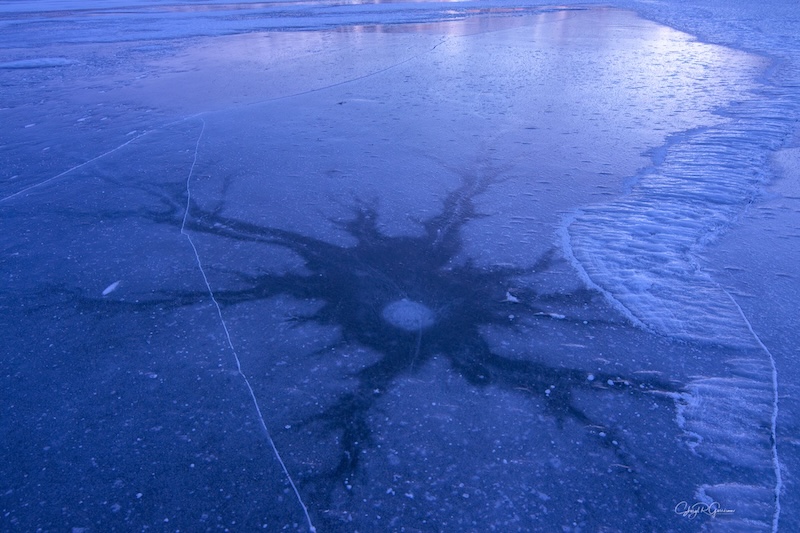
The researchers tested the hypothesis by observing earthly lake stars in Breckenridge, Colorado, and recreating the process in a cryogenic glovebox at NASA’s Jet Propulsion Laboratory (JPL), using Europa ice simulants cooled with liquid nitrogen. Lead author Lauren Mc Keown, a planetary geomorphologist at the University of Central Florida, said:
We flowed water through these simulants under different temperatures and found that similar star-like patterns formed even under extremely cold temperatures (-100 degrees Celsius/ -148 degrees Fahrenheit), supporting the idea that the same mechanism could occur on Europa after impact.
This animation depicts how the spider might have formed in the crater on Europa. Video via Mc Keown et al./ Planetary Science Institute (CC BY 4.0).
Spiders on Mars
Even though the formation process might be a bit different, the spider on Europa does resemble the spiders on Mars.
On Mars, carbon dioxide gas escapes to the surface from underground at the south pole. The gas erupts through a layer of frozen carbon dioxide (dry ice) in the Martian spring when temperatures warm up a bit. The gas erodes the surrounding dust and sand into the spider-like shapes.

Lake stars on Earth
There is also a similarity to lake stars on Earth. Lake stars form when snow falls on frozen lakes. As Mc Keown explained:
Lake stars [on Earth] are radial, branching patterns that form when snow falls on frozen lakes and the weight of the snow creates holes in the ice, allowing water to flow through the snow, melting it and spreading in a way that is energetically favorable. On Europa, we believe a subsurface brine reservoir could have erupted [after an impact] and spread through porous surface ice, producing a similar pattern.
As the researchers note, lake stars on Earth can provide clues about similar formations on Europa. But the conditions they form in are quite different from those on our planet. Mc Keown said:
While lake stars have provided valuable insight, Earth’s conditions are very different from Europa’s. Earth has a nitrogen-rich atmosphere, while Europa’s environment is extremely low in pressure and temperature. In this study, we combined field observations with lab experiments to better simulate Europa’s surface conditions.
Clues about habitability
While the spider on Europa doesn’t seem to be directly associated with the subsurface ocean, it can still provide clues as to possible habitability within the ice crust on top of the ocean. Some studies suggest there are lakes in the crust. And the brine that was exposed on the surface by the crater impact might have originated from one of those lakes or another reservoir of salty water. Lesage said:
Using numerical modelling of the brine reservoir, we obtained constraints on the reservoir potential depth (up to 3.7 miles or 6 km) below the surface) and lifetime (up to a few thousands of years post-impact). This is valuable information for future missions looking for habitable environments within icy shells.
NASA’s upcoming Europa Clipper mission, due to arrive in 2030, will be able to take a closer look at this and possibly other spiders on Europa. Scientists could then better understand just how they form and whether the briny water might be habitable for microbes.
Bottom line: Researchers say that a huge ‘spider’ on Europa likely formed when a crater-creating impact caused briny water to spill out onto the surface.
Source: Lake Stars as an Earth Analog for Europa’s Manannán Crater Spider Feature
Via Planetary Science Institute
Read more: Juno images of Europa reveal a complex, active surface
Read more: Scientists recreate exotic Martian ‘spiders’ for 1st time