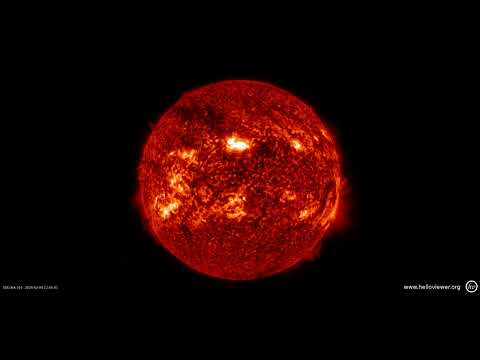
A major X4.2 solar flare erupted from geoeffective Active Region 4366 at 12:13 UTC on February 4. The event began at 12:12 UTC and ended at 12:18 UTC. No coronal mass ejection (CME) signatures have been detected thus far.
AR 4366 is a magnetically complex beta-gamma-delta region currently dominating solar activity on the Earth-facing disk. The region has produced dozens of M-class flares since February 1 and five previous X-class flares, including X8.1 — the third strongest flare of Solar Cycle 25. The CME it produced is expected to reach Earth late February 5.
During February 4 alone, AR 4366 generated M1.2 at 01:10 UTC, M1.4 at 01:39 UTC, M1.4 at 01:39 UTC, M4.9 at 02:39 UTC, M2.1 at 03:55 UTC, and M1.8 at 09:20 UTC, M1.5 at 10:55 UTC, and M1.1 at 11:35 UTC.

No coronagraph imagery or official CME analysis was available at the time of press, but CME seems unlikely. Given the source region’s near-central position on the solar disk, any ejection associated with this flare would have a higher likelihood of being Earth-directed.
Radio frequencies were forecast to be most degraded over the South Atlantic Ocean and parts of Africa at the time of the flare.

SWPC forecasters expect moderate to high solar activity for the next three days, with a high chance for
X-class flares due to expected further activity from AR 4366.
The >10 MeV proton flux at geosynchronous orbit remained at background levels over the past 24 hours while the >2 MeV electron flux reached high levels, peaking at 10 479 pfu at 17:20 UTC on February 3. The >2 MeV electron flux is expected to remain at moderate to high levels through February 6.
The >10 MeV proton flux has a chance of exceeding S1 – Minor levels during February 4–6 due to the high eruptive potential of AR 4366. The probability of a proton event is expected to increase as the region moves into a more favorable magnetic connection point in the Sun’s western hemisphere.
Solar wind conditions were nominal before a clear disturbance developed around 18:35 UTC on February 3. The interplanetary magnetic field strength remained near 5–6 nT over the past 24 hours before increasing sharply to a peak of 9 nT at 20:54 UTC on February 3.
Solar wind speed stayed within a slow-wind regime, gradually rising from about 290 km/s to near 340 km/s near 12:30 UTC today. Plasma density showed a modest enhancement during the disturbance, while temperature increased from around 20 000 K early in the period to nearly 100 000 K.
The phi angle transitioned from a negative (toward) to a positive (away) orientation beginning near 18:35 UTC, consistent with a solar sector boundary crossing.
Solar wind conditions are expected to remain slightly enhanced before returning to nominal levels until around mid-day on February 5.
A renewed disturbance is likely following the expected arrival of complex CME ejecta associated with the aforementioned X8.1 flare.

The geomagnetic field is currently at quiet levels and expected to remain quiet through February 4. Geomagnetic activity is likely to increase to unsettled to G1 – Minor storm levels on February 5 due to the anticipated arrival of the CME associated with the X8.1 flare.
Active to G1 – Minor geomagnetic conditions are expected to continue through February 6.
References:
1 Forecast Discussion – NOAA/SWPC – Issued at 12:30 UTC on February 6, 2026