EarthSky’s 2026 lunar calendar shows the moon phase for every day of the year. Get yours today!
- Scientists have found ammonia compounds on the surface of Jupiter’s moon Europa. Why is this significant?
- The compounds likely came up from the ocean below, through cracks in the icy surface. They could be evidence for active geology in the crust and habitable conditions in the ocean.
- New analysis of old images from the Galileo mission revealed the ammonia deposits near large fractures in the crust.
Ammonia on Europa: Active geology and life?
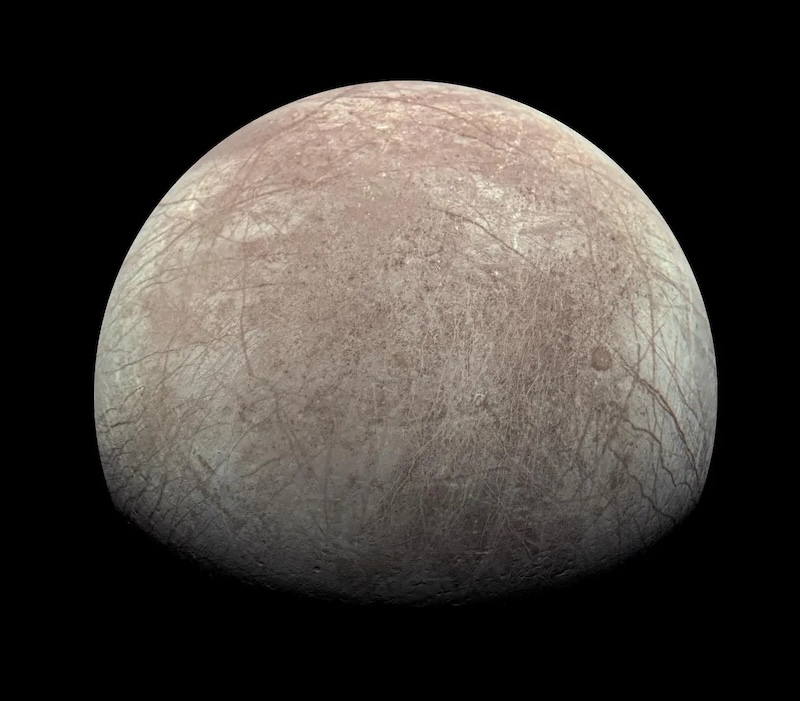
The debate about whether Jupiter’s moon Europa could support life in its hidden ocean continues. One key is active geology, which might serve as an life-engine on a world like Europa by connecting this world’s internal chemistry to its ocean. But one recent study said Europa’s seafloor might not be geologically active enough to support life. And then another study found the chemical nutrients needed could still come from Europa’s icy crust. Maybe they seep down into the ocean, and life gets a boost that way. Now, there’s a new piece of evidence. NASA said on January 29, 2026, that new analysis of data from the old Galileo mission has found, for the first time, ammonia-bearing compounds on Europa’s surface. Ammonia is a nitrogen-bearing molecule, and nitrogen is a foundational building block for life.
The ammonia deposits are located near large fractures on the surface. This is where liquid water – either from the ocean itself or smaller lakes within the ice crust – could come up to the surface.
Al Emran at NASA’s Jet Propulsion Laboratory in California is the author of the new peer-reviewed paper, published in The Planetary Science Journal on November 7, 2025.
NASA’s Galileo Mission Points to Ammonia at Europa, Recent Study Showsastrobiology.com/2026/01/nasa… #Astrobiology @NASAScience_
— Astrobiology (@astrobiology.bsky.social) 2026-01-29T20:38:40.483Z
Old images from Galileo reveal ammonia on Europa
Emran found the ammonia-bearing compound deposits in old images from the Galileo mission. Galileo explored Jupiter and its moons from 1995 to 2003. No one had noticed the ammonia (NH3) deposits before. But now, new advanced reanalysis of the images revealed the deposits. The image at the top zooms in on an area about 250 miles (400 km) wide. Galileo obtained it during its 11th orbit of Jupiter in 1997.
The pixelated shapes are representations of data from Galileo’s Near-Infrared Mapping Spectrometer (NIMS) instrument. The red pixels show locations of the ammonia (aka NH3) compounds, while the purple pixels indicate no detections.
The paper states:
The presence of NH3-bearing components on icy planetary bodies has important implications for their geology and potential habitability. Here, I report the detection of a characteristic NH3 absorption feature on Europa, identified in an observation from the Galileo Near Infrared Mapping Spectrometer. Spectral modeling and band position indicate that NH3 hydrate and NH4 chloride are the most plausible candidates.

Is the ammonia from the subsurface ocean?
The paper suggests the most likely source of the ammonia compounds is the subsurface ocean or other water reservoirs within the ice crust. The compounds could reach the surface through cryovolcanism, a form of volcanism with icy materials instead of hot magma. Ammonia can’t last long in space – or exposed on Europa’s virtually airless surface – so its presence suggests it came up to the surface relatively recently geologically. The paper says:
I posit that ammonia-bearing materials were transported to the surface via effusive cryovolcanism or similar mechanisms during Europa’s recent geological past.
The transport of ammonia-bearing material from subsurface sources provides insight into the composition and chemistry of Europa’s interior, suggesting a chemically reduced high-pH and thicker subsurface ocean beneath a comparatively thinner ice shell. Nonetheless, the detection of ammonia-bearing components in this study provides the first evidence of nitrogen-bearing species on Europa, an observation of considerable astrobiological significance due to nitrogen’s foundational role in the molecular basis of life.

Implications for habitability
The discovery of ammonia provides another important clue about the potential habitability of Europa’s ocean. Ammonia contains one nitrogen and three hydrogen atoms. It can be produced both biologically and abiotically (without life).
The fact that it contains nitrogen makes it even more interesting. Nitrogen is one of the key molecules required for life as we know it. It assists in the formation of amino acids, DNA, chlorophyll and proteins.
Ammonia also lowers the freezing point of water. This means that water containing ammonia can stay liquid at lower freezing temperatures than usual. This could be important in the case of Europa or other moons with subsurface oceans, even though scientists have found ammonia on quite a few other icy bodies in the solar system, both with oceans and without.
It will be interesting to see what NASA’s Europa Clipper finds when it reaches Europa in 2030. It will study both Europa’s surface and interior in unprecedented detail. Will it show that Europa is a habitable world?
Bottom line: A new analysis of images from the Galileo mission has revealed deposits of ammonia on Jupiter’s moon Europa. It could mean a geologically active crust and habitable ocean.
Source: Detection of an NH3 Absorption Band at 2.2 um on Europa
Via NASA
Via NASA
Read more: Strange ‘spider’ on Europa hints at water lurking below
Read more: Juno images of Europa reveal a complex, active surface