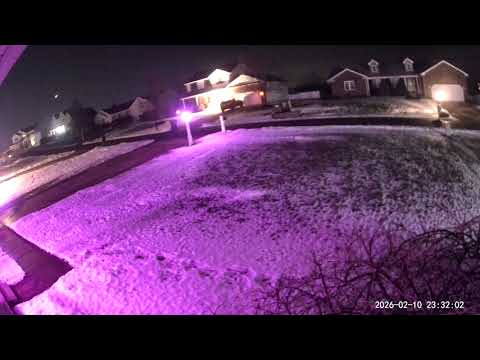
A bright fireball was observed over the Indiana–Ohio border region at 04:31 UTC on February 11, 2026 (23:32 local time on February 10), generating more than 120 eyewitness reports across five U.S. states. The meteor was first detected at an altitude of 76 km (47 miles) near Trinity, Indiana, and disintegrated at 43 km (27 miles) above Laura, Ohio. The object traveled approximately 77 km (48 miles) through the atmosphere at a speed of 13 km/s (29 000 mph).
A bright fireball was recorded at 23:32 LT on February 10 over the Indiana–Ohio border region, producing more than 120 eyewitness reports submitted to the American Meteor Society (AMS). Observations came from Illinois, Indiana, Kentucky, Ohio, and Wisconsin.
According to AMS trajectory analysis, the meteor first became visible at an altitude of 76 km (47 miles) above Trinity, Indiana, near the Indiana–Ohio border. It traveled southeast along an atmospheric path of approximately 77 km (48 miles) before disintegrating at 43 km (27 miles) above Laura, Ohio, northwest of Dayton.
The object’s calculated velocity was about 47 000 km/h (29 000 mph). Typical meteoroid entry speeds range from about 40 000 km/h (24 000 mph) to 260 000 km/h (160 000 mph), placing this event in the lower part of that range and consistent with asteroidal material rather than higher-velocity cometary debris.
Fragmentation occurred at high altitude, with the terminal point more than 40 km (25 miles) above ground level. Events ending at such elevations generally indicate complete disintegration in the upper atmosphere.



This fireball was not associated with any active meteor shower. In February, most observed meteors are sporadics, isolated particles not linked to an established meteor stream, while late winter is also commonly referred to as the start of the Northern Hemisphere’s “fireball season,” when bright events are reported more frequently. The season lasts from February to April.
Fireballs are exceptionally luminous meteors produced when small meteoroids, often centimeter- to decimeter-scale fragments, enter the atmosphere at high velocity. Rapid compression and heating of air in front of the object generate intense light, while mechanical stresses cause fragmentation as the body descends.
References:
1 Event: 20260211-043200 – NASA – February 11, 2026
2 Fireball event 968-2026 – AMS – Accessed February 12, 2026