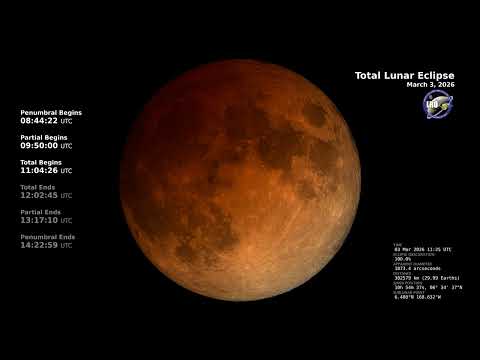
A blood moon total lunar eclipse occurring on March 3, 2026, will peak at 10:57 UTC, after the Moon enters totality at 10:29 UTC and remains fully immersed in Earth’s shadow for approximately 56 minutes. The event will be visible from much of Asia and Oceania, with live streams providing real-time views as totality unfolds.
The Virtual Telescope Project, working with astro-imagers worldwide, has been providing live coverage of the eclipse since 08:30 UTC:
A total lunar eclipse is occurring on March 3, with the Moon fully entering Earth’s umbra between 10:29 and 11:25 UTC and reaching maximum eclipse at 10:57 UTC.
The penumbral phase began at 08:32 UTC, followed by the partial phase at 09:27 UTC. The eclipse concludes at 13:23 UTC when the Moon exits Earth’s penumbral shadow.
The eclipse’s totality will last for around 56 minutes, and the Moon appears red or copper-colored, a phenomenon commonly known as the “blood moon.”
The rusty color comes from the sunlight refracting through the atmosphere. Shorter blue wavelengths are scattered, while longer red wavelengths are bent into Earth’s shadow, lighting up the lunar surface with red.
The eclipse will be fully visible across Asia, Australia, and the Pacific region, with observers in eastern Asia and Australia seeing the entire sequence from penumbral onset to conclusion.
Meanwhile, totality occurs high in the night sky, across the central Pacific. In western North America, the eclipse will coincide with moonrise, meaning observers may see the Moon already partially eclipsed as it rises above the horizon.
Unlike solar eclipses, lunar eclipses are safe to observe with the naked eye and require no protective equipment. Binoculars or small telescopes enhance contrast and surface detail but are not necessary.

The eclipse belongs to Saros series 133 and is the 27th of 71 eclipses in that cycle. Saros cycles repeat at intervals of approximately 18 years and 11 days, producing eclipses with closely similar geometry.
The gamma value of −0.3765 indicates that the Moon’s path through Earth’s shadow passes slightly south of center. An umbral magnitude of 1.1526 confirms full immersion within the umbra, allowing for a sustained total phase, while the penumbral magnitude is 2.1858.
Lunar eclipses occur only during a full Moon when the lunar orbit intersects Earth’s orbital plane at a node, allowing the Moon to pass directly through Earth’s shadow.
Because lunar eclipses are visible from the entire nighttime hemisphere of Earth, millions of observers across multiple continents can view this event simultaneously under clear sky conditions.
Today’s event is the only total lunar eclipse of this year. The next total lunar eclipse is scheduled for December 31, 2028.
References:
1 Total Lunar Eclipse of 2026 March 03 – EclipseWise/Fred Espenak – Accessed February 25, 2026
2 Total Lunar Eclipse — NASA Science — January 29, 2026