- Uranus has a deep atmosphere composed of mostly hydrogen. There is still a lot to learn about it.
- The James Webb Space Telescope took a close look at Uranus’ mysterious upper atmosphere for the first time with its near-infrared NIRSpec instrument.
- The observations revealed new clues about Uranus’ ionosphere and powerful auroras.
You deserve a daily dose of good news. For the latest in science and the night sky, click here to subscribe to our free daily newsletter.
Upper atmosphere of Uranus
Uranus has a deep atmosphere composed mostly of hydrogen. For the first time, scientists have mapped the vertical structure of the upper part of its atmosphere in three dimensions. Researchers in the U.S. and U.K. said on February 19, 2026, that they used the James Webb Space Telescope to measure how temperature and charged particles vary with altitude in this region. In addition, the observations also revealed auroras shaped by the planet’s strong but tilted magnetic field.
The new peer-reviewed results were published in Geophysical Research Letters on February 19, 2026.
Seeing Uranus’ upper atmosphere in 3 dimensions
Webb used its Near InfraRed Spectrograph (NIRSpec) instrument to observe the upper regions of Uranus’ atmosphere. It observed the planet for nearly a complete rotation. It saw the faint glow of molecules high above the uppermost clouds.
In addition, Webb mapped the temperature and density of ions in the upper atmosphere. This region extends up to about 3,000 miles (5,000 km) above the highest clouds. This is where the atmosphere becomes ionized. As a result, it interacts with the planet’s magnetic field to produce the auroras, just like on Earth. In fact, scientists have seen auroras on every planet in the solar system except for Mercury.
Webb found that temperatures in the upper atmosphere peak between 1,900 and 2,500 miles (3,000 and 4,000 km) in altitude. Meanwhile, the ions are densest at around 600 miles (1,000 km) in altitude.
Paola Tiranti at Northumbria University in the U.K. led the new study of Uranus’ upper atmosphere. She said:
This is the first time we’ve been able to see Uranus’s upper atmosphere in three dimensions. With Webb’s sensitivity, we can trace how energy moves upward through the planet’s atmosphere and even see the influence of its lopsided magnetic field.
The observations provide new clues about how Uranus’ auroras form and how the planet’s oddly tilted magnetic field affects them.
Time-lapse rotation of Uranus’ upper atmosphere as seen by Webb. Video via ESA/ Webb/ NASA/ CSA/ STScI/ P. Tiranti/ H. Melin/ M. Zamani (ESA/Webb).

Atmosphere of Uranus is still cooling
Notably, Webb also found that Uranus’ atmosphere is still cooling. Scientists first noticed temperatures starting to decrease in the early 1990s. Now, Webb’s measurements indicate the atmosphere is about 426 kelvins cooler than the previous measurements by both ground-based telescopes and the Voyager 2 spacecraft.
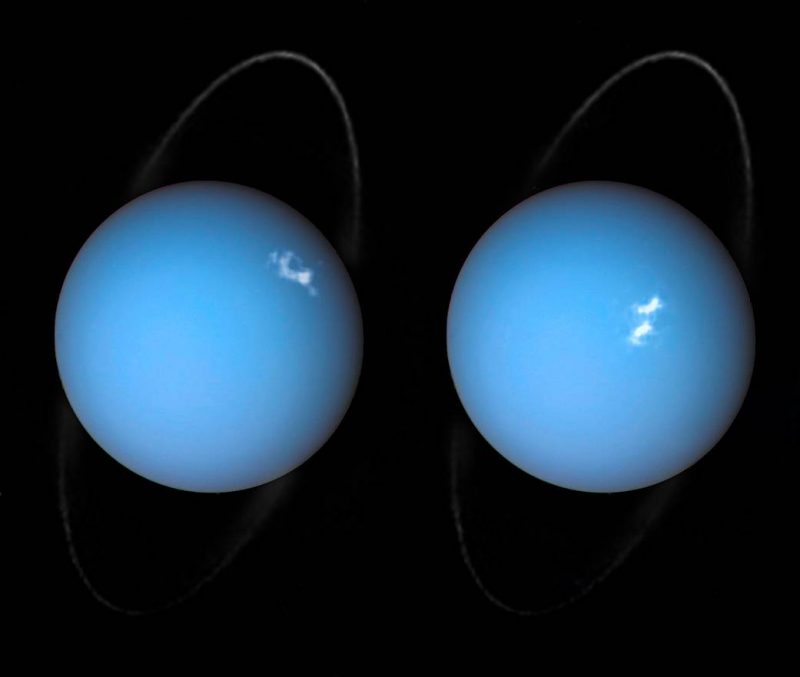
In addition, Webb mapped the auroras in Uranus’ upper atmosphere. It saw two bright auroral bands, near the planet’s magnetic poles. Webb also saw “darkened regions” between the two auroral bands. These regions have a distinct depletion in emission and ion density. The researchers said this is likely linked to transitions in magnetic field lines. Jupiter also has similar dark regions, with powerful auroras at its poles. And Earth has similar magnetic field lines, like a gigantic magnet. They emanate from the poles – even though you can’t see them – and wrap around the planet.

Strange magnetosphere
Overall, the new observations reveal just how unusual and complex Uranus’ upper atmosphere is, the magnetosphere in particular. Tiranti said:
Uranus’s magnetosphere is one of the strangest in the solar system. It’s tilted and offset from the planet’s rotation axis, which means its auroras sweep across the surface in complex ways. Webb has now shown us how deeply those effects reach into the atmosphere. By revealing Uranus’s vertical structure in such detail, Webb is helping us understand the energy balance of the ice giants. This is a crucial step towards characterising giant planets beyond our solar system.
Bottom line: The James Webb Space Telescope has mapped the upper atmosphere of Uranus for the 1st time. It found clues about Uranus’ ionosphere and powerful auroras.
Source: JWST Discovers the Vertical Structure of Uranus’ Ionosphere
Via ESA
Read more: Are Uranus and Neptune rock giants and not ice giants?
Read more: New moon discovered orbiting inside distant Uranus’ rings