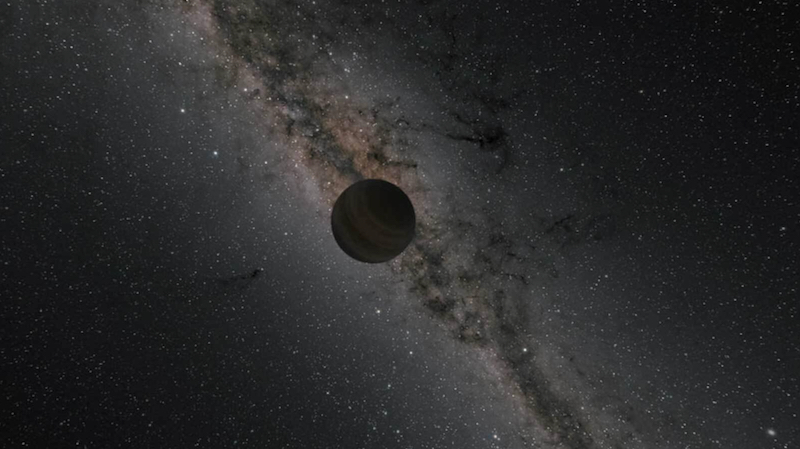
- Rogue planets float free in space, not bound to any stars. Some of them might have moons. Could those moons be habitable?
- A moon of a rogue planet could be habitable if it has a hydrogen atmosphere. That’s what a team of researchers led by Ludwig Maximilian University of Munich said in a new study.
- The hydrogen atmosphere could create a greenhouse effect, keeping the moon warm enough for oceans or perhaps even life. And that’s even without the heat of a nearby star.
Science news, night sky events and beautiful photos, all in one place. Click here to subscribe to our free daily newsletter.
Moons of rogue planets could be habitable
Astronomers have found a growing number of exoplanets that don’t orbit any stars. They are rogue – or free-floating – worlds in the ocean of space. So could any of them be habitable? Or any of their moons? A team of researchers led by Ludwig Maximilian University of Munich in Germany said it’s possible. On March 11, 2026, the researchers said that moons orbiting large free-floating planets could maintain water if they have hydrogen atmospheres. And they could stay habitable for billions of years.
These moons would likely have highly elliptical orbits. That’s due to the planets being ejected from their planetary system out into interstellar space. But those orbits could generate enough internal heating for water to exist on the moons. Plus, a hydrogen atmosphere would create a greenhouse effect. That would also help keep the surfaces of the moons warm enough for water, maybe even oceans. And if there’s water, then there’s the possibility for habitability and even life. Incredibly, all of this is possible without any stars being nearby to heat the moons.
Lead author David Dahlbüdding at Ludwig Maximilian University of Munich said:
Our collaboration with the team of Professor Dieter Braun helped us recognize that the cradle of life does not necessarily require a sun.
The study follows an earlier one in 2021, also from Ludwig Maximilian University of Munich.
The researchers published their intriguing peer-reviewed findings in the Monthly Notices of the Royal Astronomical Society on February 24, 2026.
A Hydrogen Atmosphere Could Keep Exomoons Habitable For Billions Of Yearsastrobiology.com/2026/03/a-hy… #Astrobiology #exoplanet
— Astrobiology (@astrobiology.bsky.social) 2026-03-12T20:58:37.331Z
Ejected planets could keep their moons
Astronomers have discovered a surprising number of free-floating planets in recent years. How did they become starless? Scientists think some might just form that way. But sometimes if a “regular” planet gets too close to its star, the star’s gravity could fling it out of the planetary system. They could also go rogue due to gravitational interactions between the planet and other planets.
Now, the new study shows that if a large planet – like Jupiter, for example – is ejected into interstellar space, it might not lose all its moons in the process. If it has any, of course.
But the orbits of those moons would likely be significantly affected by the ejection. They would become highly elliptical instead of more circular. That might be a good thing, however.
David Dahlbüdding: “We discovered a clear connection between these distant moons and the early Earth, where high concentrations of hydrogen through asteroid impacts could have created the conditions for life.” www.labroots.com/trending/spa…
— Labroots Space & Astronomy (@space-lr.bsky.social) 2026-03-17T20:34:36.271Z
Tidal forces and oceans on moons of rogue planets
A moon with a highly elongated orbit around its planet would be subject to strong tidal forces. As the moon gets close to the planet and then far away again, the planet’s gravity squeezes and pulls at its interior. And that can generate a lot of heat inside the moon.
That’s what happens with Jupiter’s volcanic moon Io. It also happens to the moons with oceans beneath their icy crusts.
The deformation caused by these tidal forces creates wet-dry cycles. That’s when water evaporates and then later recondenses in an on-going cycle. This helps complex molecules to form, including those essential to life.

Hydrogen atmospheres and habitability
If a moon was fairly large and still had a primordial (original) hydrogen atmosphere, it could maintain an ocean. Indeed, there are some hints of large moons – even as large as Earth – orbiting giant exoplanets, although scientists are still trying to confirm them.
A hydrogen atmosphere could create a greenhouse effect on the moon. So the greenhouse effect would keep heat in the moon’s atmosphere. And that’s even without the help of a nearby star. Also, a hydrogen atmosphere should remain stable.
Unlike hydrogen, a carbon dioxide atmosphere can trap heat but not indefinitely. On Venus, this leads to a runaway greenhouse effect on the surface. In space, the carbon dioxide would eventually condense in the surrounding cold, allowing heat to escape.
Astronomers now estimate there are billions of rogue planets in our galaxy, at least as many rogue planets as there are planets bound to stars. If so, then there could be an enormous number of rogue moons out there as well!

An analogy to the early Earth
The postulated conditions on moons of rogue planets have similarities to the early Earth several billion years ago as well. Dahlbüdding said:
We discovered a clear connection between these distant moons and the early Earth, where high concentrations of hydrogen through asteroid impacts could have created the conditions for life.
Bottom line: Could moons of rogue planets support life? A new study led by researchers in Germany shows they could, if they have hydrogen atmospheres.
Source: Habitability of Tidally Heated H2-Dominated Exomoons around Free-Floating Planets
Via Ludwig Maximilian University of Munich
Read more: Moons of rogue planets could have water and life
Read more: Astronomers discover 6 possible new exomoons