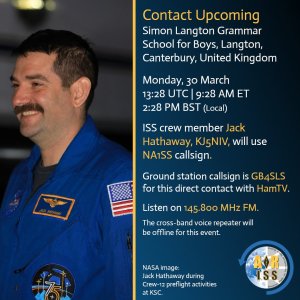
 Students at Simon Langton Grammar School for Boys will use amateur radio to speak to astronaut Jack Hathaway, KJ5NIV, on the International Space Station (ISS). The ARISS contact, between NA1SS on the ISS and GB4SLS at the school, will take place on Monday, March 30, 2026 at 2:28 PM BST (13:28 GMT). You can listen in on 145.800 MHz (plus/minus 3 kHz Doppler shift) FM.
Astronaut Jack Hathaway, KJ5NIV, will answer questions from Simon Langton Grammar School for Boys, The Langton, Canterbury, U.K.
The space and ground teams will attempt to use the HamTV transmitter during this contact. The HamTV DATV frequency is 2395 MHz.
The event will be streamed live:
The HamTV downlink will be streamed: hamtv/
Questions:
1. What are the purposes of the experiments you do in space?
2. Why do we go to space to do some experiments rather than do them on Earth?
3. How does the ISS stay in orbit around the earth?
4. How does it feel to see so many sunsets and sunrises each day from the ISS
5. What food do you eat on the ISS?
6. Why is there no air in space?
7. How does rocket fuel work when there is no air for combustion?
8. What do you do for entertainment on the ISS?
9. How hard do you have to train to go into space?
10. What is it like launching into space?
11. What is like to be in zero gravity for a long period of time?
12. Without weight pulling things down onto the ground there must be a lot less friction to help you move, how do you compensate for that?
13. Do you have any source of internet in space?
14. What is the most amazing thing that you have seen from space?
15. What ordinary daily tasks are the most difficult to do in space?
16. How does being in space affect the human body?
17. Is there a lot of noise on the ISS or is it quite quiet?
18. How do you clear up spills in space?
19. Do you ever feel lonely from the isolation in space?
20. How do you prepare for space walks?
The ARISS program is aimed at students and enthusiasts and aims to inspire them in the study of sciences with this amateur radio activity. The demonstration of amateur radio communication from space invites schools and universities to make use of these educational technical resources. We invite radio amateurs and space enthusiasts to tune in to this exciting moment.
Follow ARISS International on X
Follow AMSAT-UK on X
The latest information on the ARISS operation mode can be found at
How to hear the ISS
What is Amateur Radio?
Free UK amateur radio Online Training course