Science news, night sky events and beautiful photos, all in one place. Click here to subscribe to our free daily newsletter.
- Jupiter is known for its gigantic storms, with some raging continuously over centuries.
- Lightning in these storms can be over 100 times the strength of Earth’s lightning, a new study has found.
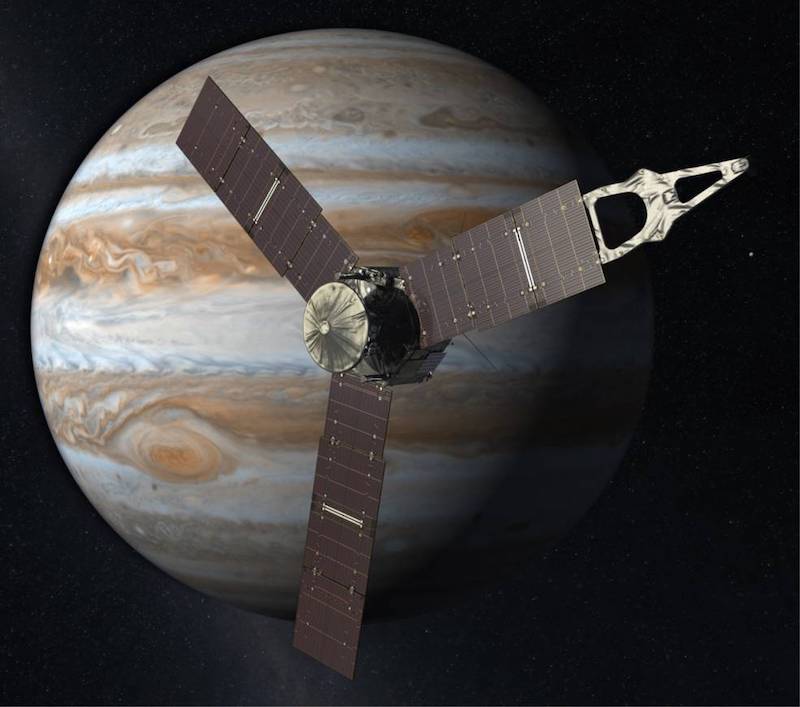
- The data comes from the Juno spacecraft, which has been orbiting the gas giant since 2016.
Storms and lightning on Jupiter
Jupiter has lightning storms in its atmosphere, like Earth. But just as Jupiter is much larger than our planet, so are its storms. Researchers at the University of California, Berkeley, said on March 23, 2026, that their new study shows lightning bolts on Jupiter can be 100 times more powerful than those on Earth, and perhaps much stronger.
The researchers used data from NASA’s Juno mission for the study. Juno has been orbiting Jupiter since 2016.
The results help scientists better understand these storms. Not only on giant planets like Jupiter, but on our planet as well.
Michael Wong at UC Berkeley led the new peer-reviewed study. He and his team published the study in AGU Advances on March 20, 2026.

Storms on Jupiter and Earth
Jupiter is well-known for its huge storms. Some of them, like the Great Red Spot, can last for centuries. And those storms often pack lightning, just as they do on Earth.
The storms provide clues about how convection works in Jupiter’s atmosphere. Convection is the transport of heat upward from below. Wong explained that the lightning:
… tells us about convection, which is how the atmosphere churns and transports heat from below. Convection operates a little bit differently on Earth and Jupiter because Jupiter has a hydrogen-dominated atmosphere, so moist air is heavier and harder to bring upward.
The composition of Jupiter’s atmosphere also makes a difference. Jupiter’s atmosphere is mostly hydrogen, while Earth’s is primarily nitrogen. The moist air on Earth is more buoyant than the heavier moist air on Jupiter. This means Jupiter’s storms require more energy to rise upward. But then, when the storms reach the top of the atmosphere, they unleash much more energy than on Earth. This creates high wind speeds and intense lightning.

Spacecraft detections of lightning on Jupiter
The lightning on Jupiter is easy to detect. In fact, almost every spacecraft that has passed by or orbited Jupiter has seen it. This is particularly true for the night side of Jupiter. In the darkness, the lightning flashes stand out like lightning bugs.
The most powerful lightning bolts are the easiest to detect, of course. But Juno has been able to see weaker flashes as well. Those are more like lightning flashes on Earth. Juno used its microwave radiometer to measure the lightning flashes even more precisely. Since it points downward toward Jupiter’s atmosphere, it can detect microwave emissions from lightning storms, even though it wasn’t designed to do that.
It isn’t always easy to tell which storm a lightning flash came from, however. That’s because there are typically multiple storms occurring at the same time in the planet’s atmospheric belts. Those are the distinct bands in the atmosphere that you can see even in a small telescope.
How strong is the lightning on Jupiter? Researchers turned to radio wave data from the Juno orbiter to find out.eos.org/research-spo…
— Eos (@eos.org) 2026-03-23T13:43:00.047Z
University of California, Berkeley: Lightning Bolts on Jupiter Pack More than 100 Times the Power of Earth’s Flashes news.berkeley.edu/2026/03/23/l…
— AAS Press Office (@press.aas.org) 2026-03-23T17:24:34.559Z
Lightning in stealth superstorms
Some of Jupiter’s storms, known as “stealth superstorms,” resemble the planet’s most powerful storms but do not grow as tall. Unlike the largest storms on Jupiter — which can exceed 62 miles (100 kilometers) in height — these have lower cloud tops.
Researchers focused on several of these storms because they were easier to study individually. This was possible in 2021 and 2022, when there was a period of reduced storm activity in the North Equatorial Belt, allowing scientists to isolate each storm and more accurately measure the energy of their lightning. Wong said:
Because we had a precise location, we were able to just say, ‘Ok, we know where it is. We’re directly measuring the power.’
Juno passed over those storms 12 times. During four of them, it detected microwave static from lightning. There were three flashes per second on average. Altogether, Juno measured 613 microwave pulses. And 206 of them were during one flyover.
Lightning on Jupiter is powerful
And those bolts were powerful. They ranged from about the same as a typical lightning bolt on Earth to over 100 times stronger. There is still some uncertainty, however. It’s possible that some of Jupiter’s bolts are up to 1 million times more powerful than those on Earth, the researchers said.
In terms of gigajoules – a measurement of energy equivalent to 1 billion joules – one lightning bolt on Earth releases 1 gigajoule of energy. But on Jupiter, the bolts can contain anywhere from 500 to 10,000 times that amount.

Lightning on Jupiter and Earth
The lightning itself on both Jupiter and Earth is generated largely the same way. Water vapor rises upward in the atmosphere. Then, it condenses into droplets and ice crystals. Those droplets and crystals become electrically charged. This creates large differences in voltage between the clouds and the ground (or lower, deeper atmosphere on Jupiter).
The fact that lightning on Jupiter can be so much more powerful suggests that the voltage differences are higher than on Earth. But scientists aren’t quite sure how that happens. As Wong noted:
This is where the details start to get exciting, where you can ask, ‘Could the key difference be hydrogen versus nitrogen atmospheres, or could it be that the storms are taller on Jupiter and so there’s greater distances involved?’
Or could it be that greater energy is available because with moist convection on Jupiter, you have a bigger buildup of heat needed before you can generate the storm to create lightning? It’s an active area of research.
Bottom line: Researchers using data from the Juno spacecraft have found that lightning on Jupiter can be 100 times more powerful than on Earth, and maybe even much more.
Source: Radio Pulse Power Distribution of Lightning in Jupiter’s 2021–2022 Stealth Superstorms
Via UC Berkeley
Read more: More moons for Jupiter and Saturn! New totals here
Read more: Jupiter and Io: New insights into stormy, volcanic worlds