- Is there alien life elsewhere in our galaxy? Where are the best places to search for it?
- 45 of the most potentially habitable exoplanets known so far have been identified by researchers at Cornell University. They all orbit in their stars’ habitable zones.
- The study is dubbed ‘Project Hail Mary,’ after the movie and book of the same name. The film depicts how alien life might be diverse and versatile.
Real-life ‘Project Hail Mary’ identifies 45 best planets for life
Our Milky Way galaxy is immense, with some 100 billion to 400 billion stars. And we now know that most of those stars have planets. So where are the best places to search for alien life? Which exoplanets could support life? With this in mind, researchers at Cornell University in Ithaca, New York, said on March 19, 2026, that they have identified the 45 rocky worlds – out of the 6,100 exoplanets known so far – that are most likely to be potentially habitable.
The researchers refer to the new study as Project Hail Mary. It’s an analogy based on the new movie Project Hail Mary, which contemplates that life might be common in the universe and more versatile than previously thought.
The study focuses on rocky planets similar to Earth in the habitable zones of their stars. That’s the region where temperatures could allow liquid water to exist. In addition, it also identifies 24 more planets in a narrower habitable zone. That zone is based on a more conservative assumption of how hot a planet can be before it becomes uninhabitable.
The research team published its peer-reviewed findings in Monthly Notices of the Royal Astronomical Society on March 19, 2026.
Where to go to find alien life
In the Project Hail Mary film, the main character, portrayed by Ryan Gosling, travels to the exoplanet system Tau Ceti, 11.9 light-years away. He is on a mission to save humankind because our sun is dying. But unfortunately, recent studies suggest that the possible planets of Tau Ceti aren’t really there.
There are still many possible candidates out there, however. And now the new study narrows these down to the 45 most likely planets to be potentially habitable. That’s out of the 6,000-plus we’ve found so far.
The film also implies that alien life might be a lot more diverse and versatile than we think. Lisa Kaltenegger, director of the Carl Sagan Institute at Cornell University, said:
As Project Hail Mary so beautifully illustrates, life might be much more versatile than we currently imagine, so figuring out which of the 6,000 known exoplanets would be most likely to host extraterrestrials such as Astrophage and Taumoeba – or Rocky – could prove critical, and not just to Ryan Gosling.
Our paper reveals where you should travel to find life if we ever built a ‘Hail Mary’ spacecraft.
Astrophage, Taumoeba and even Rocky are different lifeforms Ryan Gosling encounters in his quest to save Earth.

Science news, night sky events and beautiful photos, all in one place. Click here to subscribe to our free daily newsletter.
45 best planets for life
The 45 planets are all rocky worlds. And they all orbit in the habitable zones of their stars. Some of them are well-known, such as Proxima Centauri b, TRAPPIST-1f and Kepler 186f. But others, like TOI-715 b, are less well-known.
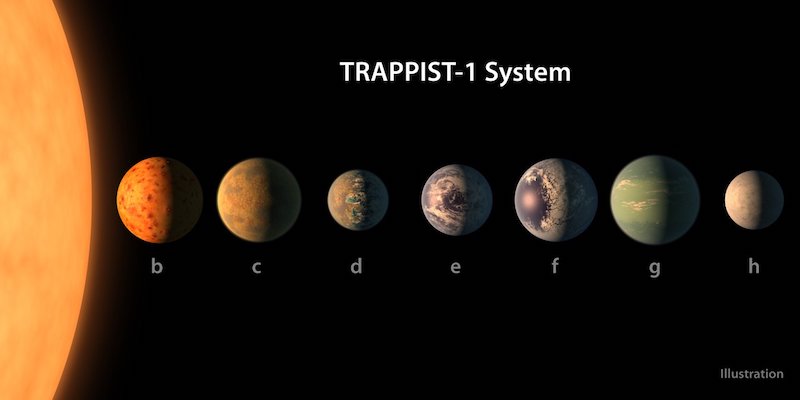
Notably, the list includes four of the intriguing TRAPPIST-1 planets: TRAPPIST-1 d, e, f and g. They are 40 light-years from Earth. All seven of the planets are rocky and nearly Earth-sized. There’s also LHS 1140 b, which is 48 light-years away.
Some of the planets receive similar amounts of light from their stars as Earth does from the sun. These include TRAPPIST-1 e, TOI-715 b, Kepler-1652 b, Kepler-442 b, Kepler-1544 b, Proxima Centauri b, GJ 1061 d, GJ 1002 b and Wolf 1069 b.
Most of the planets are well within their habitable zones. But some are right near the inner edge of the habitable zone. These are K2-239 d, TOI-700e, K2-3d, Wolf 1061c and GJ 1061c. Others are at the outer edge of the habitable zone, where temperatures are colder. These are TRAPPIST-1 g, Kepler-441b and GJ 102.

Figuring out where to look
Searching for evidence of alien life on distant planets is not an easy task, to be sure. But “Project Hail Mary” is a good first step. Co-author Gillis Lowry, a graduate student at San Francisco State University, said:
While it’s hard to say what makes something more likely to have life, identifying where to look is the first key step, so the goal of our project was to say ‘here are the best targets for observation.’
Co-author Lucas Lawrence at the University of Padua in Italy, added:
We wanted to create something that will enable other scientists to search effectively and we kept discovering new things about these worlds we wanted to investigate further.
Researchers led by Cornell University have pinpointed 45 of the most promising Earth-like worlds. ?? Find out more and read the paper here: ras.ac.uk/news-and-pre… (Don’t worry, no spoilers!)
— Royal Astronomical Society (@royalastrosoc.bsky.social) 2026-03-19T20:03:39.391Z
Understanding habitability
There is still a lot we don’t know about what might make an alien world habitable. And not only that, but how long it could be habitable, or lose its habitability. As lead author Abigail Bohl at Cornell University also noted:
We know Earth is habitable, while Venus and Mars are not. We can use our solar system as a reference to search for exoplanets that receive stellar energy between what Venus and Mars get. Observing these planets can help us understand when habitability is lost, how much energy is too much, and which planets remain habitable … or maybe never were. The same idea applies to eccentric planets: how much orbital eccentricity can a planet have while still holding onto its surface water and habitable conditions?
We identified planets at the inner and outer edges of the habitable zone, as well as those with the highest eccentricities, to test our understanding of what it takes for a planet to be and remain habitable. We also identified the targets that are most observable with the James Webb Space Telescope and other telescopes.
Future observations
Now, scientists can use this catalog of 45 planets to help observe them better, for example, with the current James Webb Space Telescope. But they’ll also use future telescopes like the upcoming Nancy Grace Roman Space Telescope (launching in 2027), the Extremely Large Telescope (first light in 2029), the Habitable Worlds Observatory (launching in the 2040s) and the proposed Large Interferometer For Exoplanets (LIFE) project. Astronomers will also be able to use different techniques for different planets. This improves the chances of finding possible life signs, if they exist.

All the planets!
Want to see the full list of the 45 “Project Hail Mary” planets? Here it is:
GJ 1002 b
GJ 1002 c
GJ 1061 c
GJ 1061 d
GJ 251 c
GJ 273 b
GJ 3323 b
GJ 667 C c
GJ 667 C e
GJ 667 C f
GJ 682 b
K2-239 d
K2-288 B b
K2-3 d
K2-72 e
Kepler-1229 b
Kepler-1410 b
Kepler-1544 b
Kepler-1606 b
Kepler-1649 c
Kepler-1652 b
Kepler-186 f
Kepler-296 e
Kepler-296 f
Kepler-441 b
Kepler-442 b
Kepler-452 b
Kepler-62 e
Kepler-62 f
L 98-59 f
LHS 1140 b
LP 890-9 c
Proxima Centauri b
Ross 508 b
TOI-1266 d
TOI-700 d
TOI-700 e
TOI-715 b
TRAPPIST-1 d
TRAPPIST-1 e
TRAPPIST-1 f
TRAPPIST-1 g
Teegarden’s Star c
Wolf 1061 c
Wolf 1069 b
Bottom line: Where should we look for possible alien life? Researchers at Cornell University have identified the 45 best planets for life in a real-life ‘Project Hail Mary.’
Source: Probing the limits of habitability: a catalogue of rocky exoplanets in the habitable zone
Via Royal Astronomical Society
Read more: Project Hail Mary is packed with hard science
Read more: Moons of rogue planets habitable for billions of years?