- NASA’s Webb space telescope was used to find signs of water-ice clouds on the giant exoplanet known as Epsilon Indi Ab. It’s about 12 light-years away.
- The discovery was a surprise. Jupiter has ammonia gas in the upper atmosphere. But astronomers found less ammonia for Epsilon Indi Ab than anticipated. They surmise there must be water-ice clouds there instead.
- The presence of water-ice clouds on Epsilon Indi Ab would “break” existing computer models of Jupiter-like exoplanets. Is it back to the drawing board for models of these worlds?
You deserve a daily dose of good news. For the latest in science and the night sky, click here to subscribe to our free daily newsletter.
A Jupiter-like exoplanet with water-ice clouds
Astronomers have found many hot Jupiters. These are gas giant exoplanets, similar to giant Jupiter in our own solar system, but orbiting their stars closely. So they are much hotter than Jupiter. But now, researchers at the Max Planck Institute for Astronomy (MPIA) in Heidelberg, Germany, have made an interesting discovery. They used the James Webb Space Telescope (JWST) to examine a cooler Jupiter-like exoplanet, orbiting far from its star. The researchers said on April 22, 2026, that the planet, Epsilon Indi Ab, appears to have water-ice clouds in its atmosphere.
If they are indeed present, the clouds high in the atmosphere of this exo-Jupiter will be similar to high-altitude cirrus clouds on Earth.
Epsilon Indi Ab is about 12 light-years away. It orbits its star at about Neptune’s distance from our sun, or about 30 AU. It takes 180 Earth-years to make a single orbit (in contrast to 12 years for Jupiter orbiting our sun, or 165 years for Neptune). It’s massive, some 7.6 times the mass of Jupiter. But its diameter is about the same as that of Jupiter.
The researchers published their new peer-reviewed results in The Astrophysical Journal Letters on April 22, 2026.
Here’s why it’s a surprise
The new findings highlight the limits of current theoretical modeling of exoplanet atmospheres. Scientists had expected ammonia gas to dominate the upper atmosphere of Epsilon Indi Ab. They found ammonia, but less than anticipated. The best explanation – based on their analysis of the atmosphere – is the presence of water-ice clouds, they said.
So the evidence for water-ice clouds came as a surprise to the researchers. The team used the Webb space telescope to analyze this distant world.
The findings reveal a problem. Most current theoretical models of exoplanet atmospheres don’t include clouds of any sort. That’s because clouds make computing the data more complicated. So – because astronomers might not be looking for them – clouds could be missed in observations, even if they are there. As co-author James Mang at the University of Texas at Austin explained:
It’s a great problem to have, and it speaks to the immense progress we’re making thanks to the James Webb Space Telescope. What once seemed impossible to detect is now within reach, allowing us to probe the structure of these atmospheres, including the presence of clouds.
This reveals new layers of complexity that our models are now beginning to capture, and opens the door to even more detailed characterization of these cold, distant worlds.
1/4 New insights into a cold “Super-Jupiter”: Using #JWST, we found evidence of water-ice clouds on Epsilon Indi Ab! This discovery shows that even cold gas giant atmospheres are far more complex than our current models suggest. ?Full press release: www.mpia.de/news/science…
— Max-Planck-Institut für Astronomie (@mpi-astro.bsky.social) 2026-04-22T13:48:04.184Z
It’s a step toward finding earthlike planets
The results are exciting not only in regards to exo-Jupiters. They are also a big step toward being able to find exoplanets that are more earthlike and might support life. Scientists have only recently been able start analyzing the atmospheres of these distant earthlike worlds more in-depth.
This is easier for larger Jupiter-like planets. And in that group, it is the hot Jupiters that are easier to study. Cooler planets, more like Jupiter itself, require more sensitive instruments and longer observation times. So finding water-ice clouds on an exo-Jupiter is a great step. But finding such clouds on smaller earthlike planets might require more powerful telescopes. Lead author Elisabeth Matthews at the Max Planck Institute for Astronomy said:
JWST is finally allowing us to study solar-system analog planets in detail. If we were aliens, several light years away, and looking back at the sun, JWST is the 1st telescope that would allow us to study Jupiter in detail. For studying Earth in detail, we would need much more advanced telescopes, though.

What about cooler exo-Jupiters?
Even finding cooler exo-Jupiters is a challenge. By far most of the Jupiter-like worlds found so far are hot Jupiters. Those are gas giants like Jupiter, but orbit very close to their stars. As a result, they are extremely hot. That makes them easier to detect and study.
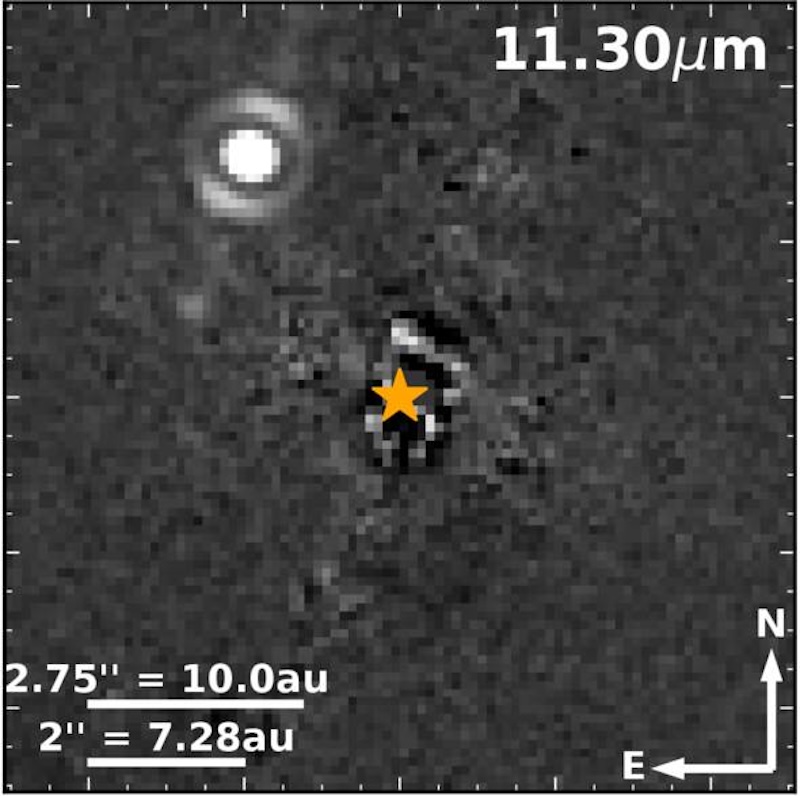
But Jupiters farther from their stars are cooler, which makes them harder to find since they don’t give off nearly as much heat or light. But in the case of Epsilon Indi Ab, the Webb telescope’s Mid-Infrared Instrument (MIRI) was able to obtain direct images of the planet (albeit still just a bright dot). The coronagraph of the MIRI instrument blocks out the central star’s light, enabling the fainter planet to be seen.
Epsilon Indi Ab is about four times farther from its star than Jupiter is from the sun. It’s also just a bit warmer than Jupiter, at 200 to 300 Kelvin (between –70 and +20 degrees Celsius or -94 to 68 Fahrenheit). Jupiter is around 140 K (-133 degrees C or -207 F). Why is Epsilon Indi Ab warmer? It’s because there is still a lot of heat remaining inside it from when it 1st formed. But it’s still much, much cooler than hot Jupiters.
NASA’s upcoming Nancy Grace Roman Space Telescope will also be able to observe Epsilon Indi Ab. Roman will launch either later this year or in 2027.

Bottom line: A Jupiter-like exoplanet with water-ice clouds? NASA’s Webb space telescope has found the 1st signs of cirrus-like clouds on exoplanet Epsilon Indi Ab.
Source: A second visit to Eps Ind Ab with JWST: new photometry confirms ammonia and suggests thick clouds in the exoplanet atmosphere of the closest super-Jupiter
Via Max Planck Institute for Astronomy