- Powerful flares of radiation are frequent on small, low-mass stars. They could be dangerous for potential life on rocky planets.
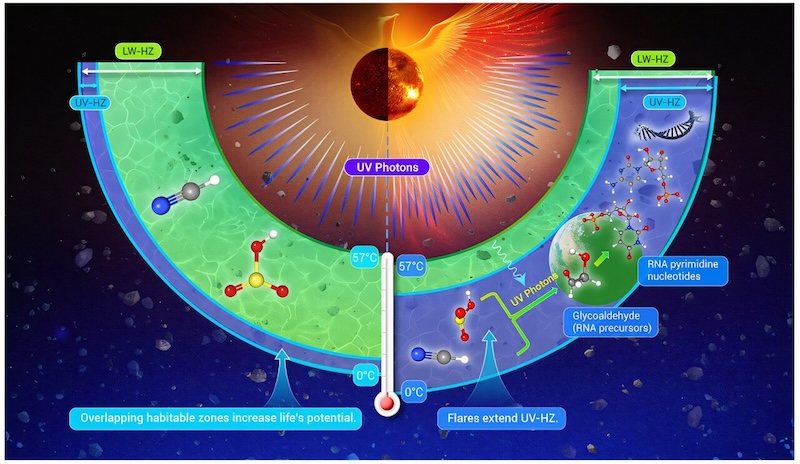
- But those same flares could also make these planets more habitable, by extending a region around the star where ultraviolet radiation works to life’s advantage.
- This so-called ultraviolet habitable zone sometimes overlaps with the region around a star where liquid water can exist. These regions could provide great conditions for life to develop.
You deserve a daily dose of good news. For the latest in science and the night sky, click here to subscribe to our free daily newsletter.
Could violent stellar flares make planets more habitable?
Small, low-mass stars such as red dwarfs are well-known for blasting out powerful flares. And when they do, they send waves of radiation rippling out into space. It’s long been suspected these flares might prevent the development of life on surrounding planets. But on April 6, 2026, researchers said these flares could actually improve the habitability of planets orbiting small stars.
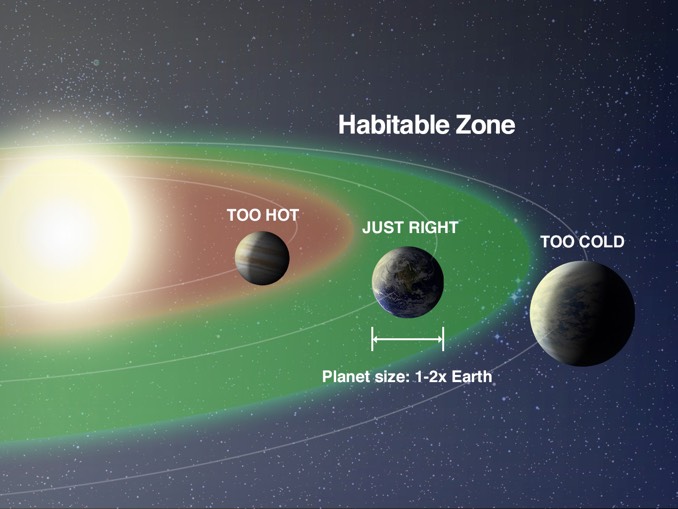
The research centers on the idea of habitable zones. This term usually refers to the region around a star where liquid water can exist. But scientists also talk of an ultraviolet habitable zone. That’s the region around a star where there’s enough ultraviolet radiation to potentially kick-start life-forming chemical reactions, but not so much that it will destroy any DNA.
The new paper suggests that solar flares from a small star could expand this ultraviolet habitable zone. Plus, it reveals that the ultraviolet habitable zone can sometimes overlap with the liquid water habitable zone, creating a promising region for habitable worlds.
Laurence Tognetti wrote about the intriguing new findings in Universe Today on April 22, 2026.
The researchers published their peer-reviewed findings in the journal The Innovation on April 6, 2026.
Stellar flares may expand habitable zones around small stars The search for life beyond Earth has traditionally focused on exoplanets orbiting sun-like stars, which is a G-type star. However, low-m…#Planetary #SciencesOrigin | Interest | Match
— Exoplanets (@exoplanets.activitypub.awakari.com.ap.brid.gy) 2026-04-22T19:00:05.000Z
There’s more than 1 kind of habitable zone
Most studies have focused only on the “traditional” habitable zone: the region around a star where liquid water can exist. But now this new study incorporates both kinds. The paper says:
The traditional definition of the circumstellar habitable zone focuses on liquid water, but neglects the crucial role of ultraviolet radiation in prebiotic chemistry.
In other words, the researchers think astronomers are overlooking the fact that ultraviolet radiation could potentially drive chemical reactions that lead to life sparking.
For this study, the researchers considered both types of habitable zone. They wanted to see if increased solar flare activity could affect the size of the ultraviolet habitable zone. That would let them evaluate how much the stellar activity of low-mass stars contributes to this region. They could then compare this to the size of liquid water habitable zones, and see if the two often overlap.
Stellar flares could provide life-giving radiation
Flares are typically thought of as dangerous for habitable planets, and rightly so. If a planet is too close to its star, flares and the stellar wind could strip the planet of its atmosphere if it has one.
But it seems that – in the right circumstances – flares could actually help habitability by extending what’s known as the ultraviolet habitable zone. Generally, low-mass stars don’t emit enough ultraviolet radiation to help drive the early chemistry of life. But periodic increased flare activity could provide enough radiation, the researchers found.
The study focused on 9 exoplanets
Altogether, the researchers applied the model to nine exoplanets. Eight are rocky, and one is a Neptune-type planet. All orbit M-type or K-type stars. M-type stars (red dwarfs) are low-mass red stars, while K-type stars are low-mass orange dwarf stars.
The M-types comprise about 70% of all the stars in our galaxy. Perhaps the most well-known planetary system around an M-type red dwarf star is the TRAPPIST-1 system. No less than seven rocky, near-Earth-sized planets are known to orbit that star. Three of the planets orbit within the liquid water habitable zone.
The 2 habitable zones can overlap
Notably, the researchers found that the two kinds of habitable zones can overlap. And three of the nine planets in the study – KOI-8012.01, KOI-8047.01 and KOI-7703.01 – orbited within both zones. That’s promising, although it doesn’t guarantee that any of those planets are habitable. Only further observations can help determine if they are capable of supporting life or not.

A step toward finding habitable exoplanets
Habitability can depend on various factors, including water, temperature, active geology, atmospheric composition, and internal composition of the planet. But identifying the characteristics of both habitable zones is a good step toward finding habitable exoplanets.
The paper states:
Although many exoplanets have been studied statistically, assessing the habitability of individual planets in the habitable zone is still challenging from both astrobiological and observational perspectives. Evaluating habitable zones around stars in various aspects helps us better understand exoplanet habitability. By reevaluating the habitable zones and creating a comprehensive catalog of planets within them, we can infer that terrestrial planets in both liquid water and UV radiation habitable zones are more likely to support life.
Bottom line: Could violent stellar flares actually make planets more habitable? A new study into ultraviolet habitable zones around small, low-mass stars says yes.
Source: Flare-driven habitability: Expanding life’s potential around low-mass stars
Via Universe Today
Read more: Small planets are common around small stars, says new study
Read more: New survey of nearest stars reveals best spots for life