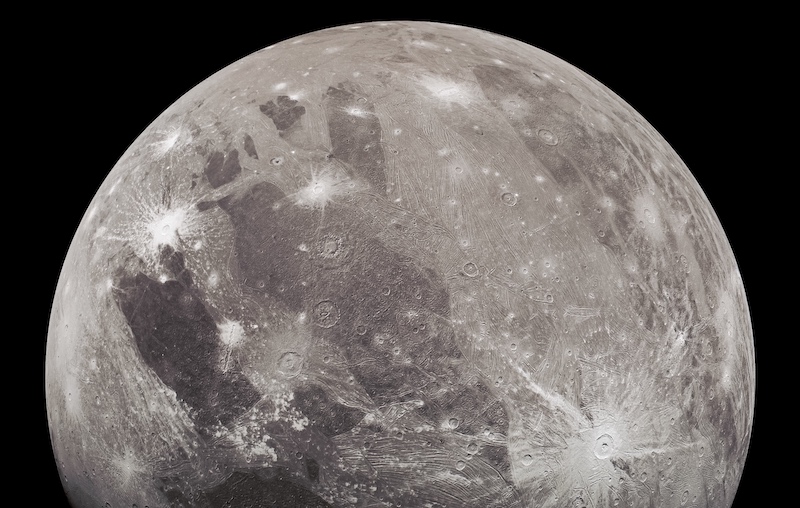
- Ganymede is Jupiter’s largest moon. It has a deep ocean beneath its outer icy surface. Does it also have ice volcanoes?
- A new international study has identified several good candidates on Ganymede’s frozen surface.
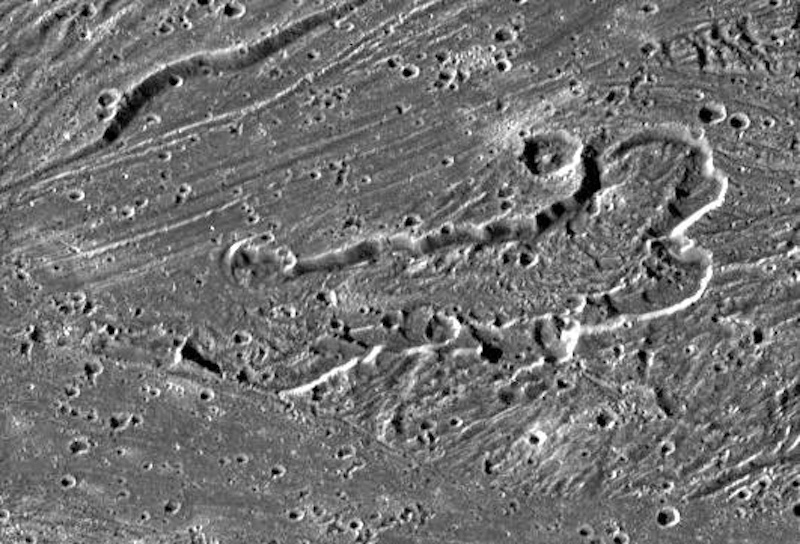
- These are depressions in the surface surrounded by flow-like formations, where water could have erupted to the surface from below.
You deserve a daily dose of good news. For the latest in science and the night sky, click here to subscribe to our free daily newsletter.
Possible ice volcanoes on Ganymede
Does Jupiter’s largest moon Ganymede have ice volcanoes? We don’t know for sure yet, but a new international study has identified some promising candidates.
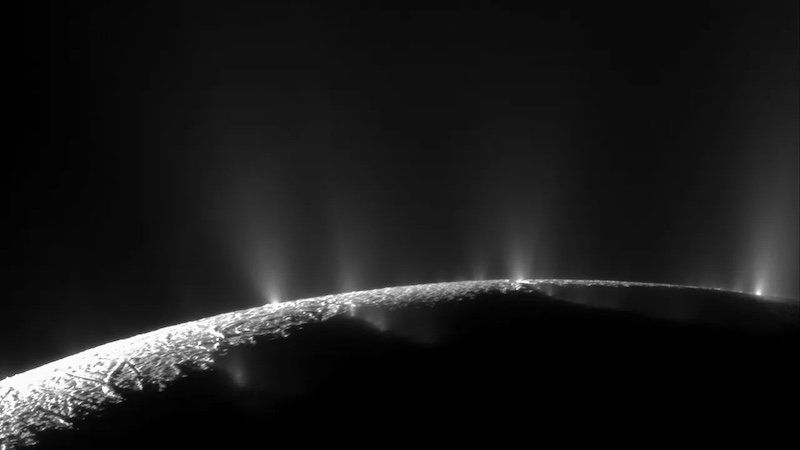
Ganymede has a deep ocean hidden beneath its icy crust. That’s led scientists to speculate it could have ice volcanoes similar to the explosive geysers on Saturn’s ocean moon Enceladus. And on May 9, 2026, researchers said they have identified four primary locations where water and other volatile materials might have erupted to Ganymede’s surface.
Anezina Solomonidou at the Hellenic Space Center (HSC) in Greece led the new study. The study also includes researchers from France, Italy, Germany, the United States, the Czech Republic, ESA and NASA’s Jet Propulsion Laboratory.
The new peer-reviewed paper is accepted for publication in the Planetary Science Journal.
Most promising locations for ice volcanoes
Ganymede has unusual depressions – called paterae – and flow-like structures on its surface. Could upwelling water have formed them?
It certainly seems possible, since Ganymede has a deep, dark ocean beneath its outer icy crust. But it depends on whether the water could get through the crust in cracks or by other means. Scientists estimate Ganymede’s crust to be about 90-95 miles (145-153 km) thick. And they estimate the ocean below to be 60 miles (96 km) deep.
Intriguingly, the flow-like structures would have been formed by flowing icy watery material. And the paterae depressions would have been the volcanic vents. It’s similar to regular volcanism, but involving icy fluids rather than molten rock.
Implications for life
If there were – or perhaps still are – active ice volcanoes on Ganymede, that could provide clues about the conditions in the ocean below. And those conditions could determine whether Ganymede’s ocean might be habitable or not.
Solomonidou said:
Ganymede is one of the most fascinating worlds in the solar system. Understanding possible cryovolcanic activity can help us better understand how ocean worlds evolve and whether they may host conditions suitable for life.

Future observations by JUICE
The candidate ice volcanoes will be of great interest for the European Space Agency’s upcoming Jupiter Icy Moons Explorer (JUICE) mission. JUICE was launched in 2023 and will arrive at Jupiter in 2031. It will focus on exploring the largest moons of Jupiter: Ganymede, Callisto, Io and Europa. JUICE will use its MAJIS imaging spectrometer and the JANUS camera system to take a closer look at these potential ice volcanoes.
In 2023, scientists found that Ganymede is coated in salts and organics; and in 2021, they found water vapor in Ganymede’s thin atmosphere.
Also in 2021, NASA released new closeups of Ganymede from its Juno spacecraft. Juno obtained the images on June 7, 2021.
Bottom line: Are there ice volcanoes on Ganymede? A new international study reveals several good candidates on Jupiter’s large ocean moon.
Via Hellenic Space Center
Read more: Jupiter’s moon Ganymede is coated in salts and organics
Read more: Why do Jupiter’s large moons outnumber Saturn’s?