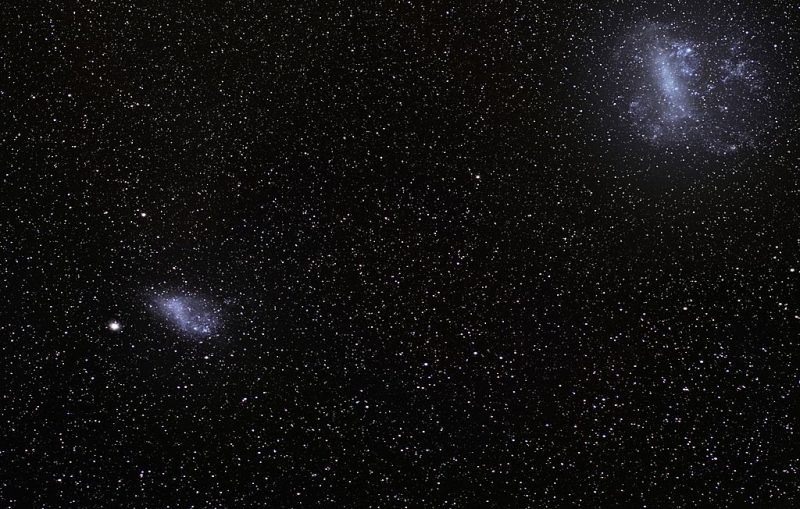
- The Small and Large Magellanic Clouds are dwarf satellite galaxies of our Milky Way galaxy.
- Scientists had thought the Small Magellanic Cloud was rotating, but a new study has found that its stars are racing outwards.
- It seems it’s being ripped apart by the gravity of its neighbor, the Large Magellanic Cloud.
You deserve a daily dose of good news. For the latest in science and the night sky, subscribe to EarthSky’s free daily newsletter.
Our galactic neighbor is slowly coming apart
The Small and Large Magellanic Clouds are dwarf satellite galaxies orbiting our Milky Way galaxy. Visible with the unaided eye from the Southern Hemisphere, these galaxies appear serene neighbors in southern skies. But on June 2, 2026, scientists from the Leibniz Institute for Astrophysics Potsdam in Germany said that the gravitational pull from the Large Magellanic Cloud is actually ripping the Small Magellanic Cloud apart.
Scientists looked at more than 10 years of observations from the VISTA Survey of the Magellanic Clouds. This allowed them to measure the motions of millions of stars inside the Small Magellanic Cloud. These movements showed the dwarf galaxy was not rotating as once thought. Instead, the galaxy’s stars are racing away from the center. Even the inner stars appear to be heading toward the exit.
Lead author Sreepriya Vijayasree of AIP said:
The results reveal large-scale tidal expansion throughout the Small Magellanic Cloud galaxy and challenge long-standing assumptions that the Small Magellanic Cloud behaves like a rotating disk. The study shows that the internal motions of stars in the Small Magellanic Cloud are dominated not by orderly rotation, but by gravitational disturbances caused by repeated encounters with the Large Magellanic Cloud over billions of years.
The researchers submitted their study in the Letters to the Editor section of the journal Astronomy & Astrophysics. The journal accepted it for publication on May 21, 2026.
More on the Large and Small Magellanic Clouds
The Large Magellanic Cloud is one of the closest galaxies to us at about 160,000 light-years away. Meanwhile, the Small Magellanic Cloud is a bit farther at about 200,000 light-years away. As some of the closest galaxies to our home galaxy, they stand out as big, misty blobs of light under dark skies.
Scientists estimate the Small Magellanic Cloud contains around 3 billion stars, while the Large Magellanic Cloud houses some 30 billion stars. The Large Magellanic Cloud is in the constellations of Dorado and Mensa. And Tucana the Toucan is home to the Small Magellanic Cloud.
A disruptive galactic neighbor
The idea that the Large and Small Magellanic Clouds have influence over each other isn’t new. Their interactions have given them distorted shapes, bursts of star formation and streams of gas trailing away from the galaxies.
But the infrared observations spanning more than a decade have allowed astronomers to see a clearer picture of the stellar movements. In fact, the astronomers can see that the stars of the Small Magellanic Cloud are moving outward along a southeast–northwest axis. They said that motion was consistent with the gravitational pull exerted by the neighboring Large Magellanic Cloud.
And it’s not just the outer fringes of stars closest to the Large Magellanic Cloud that are heading outward. The stars even at the Small Magellanic Cloud’s center are heading outward and not rotating around a midpoint.
When might the Small Magellanic Cloud disperse entirely? Well, the stars are moving at an average speed of about 38,000 miles per hour (17 km per second). At that pace, the stars would travel several thousand light-years over the course of a few hundred million years. So while the dwarf galaxy will look distorted sooner rather than later, it still won’t look noticeably different anywhere within our lifetimes.
Past disruptions
Beyond the motions of the stars heading outward from the galaxy, the study also uncovered another distinct motion. This additional motion was northward, and astronomers only found it in the older red giant stars.
The researchers think this motion is leftover from an interaction that occurred more than 2 billion years ago. Life isn’t easy when you have pushy neighbors.
Bottom line: Astronomers have found the stars of our galactic neighbor, the Small Magellanic Cloud, are heading outward. This dwarf galaxy is not rotating, but is in the act of slowly coming apart.
Source: The VMC survey. LV. The coherent expansion of the SMC
Via Leibniz Institute for Astrophysics Potsdam