You deserve a daily dose of good news. For the latest in science and the night sky, subscribe to EarthSky’s free daily newsletter.
Are dark galaxies hiding in the nearby universe?
When we look at the night sky, all the light we see – from planets to stars to nebulae and galaxies – comes from of ordinary matter. Yet astronomers say that ordinary matter makes up just 5% of the universe. The rest is a mysterious substance called dark matter at 27% and an equally mysterious force called dark energy at 68%.
Recently, astronomers found evidence of a dark-matter-dominated galaxy without stars, or what they called a failed galaxy. And researchers at the Institute of Astrophysics of the Canary Islands and the University of La Laguna said on June 10, 2026, that their simulations show these dark galaxies may be hidden all around us.
The researchers published their study in the peer-reviewed journal Astronomy & Astrophysics on June 12, 2026.
What are dark galaxies?
Dark galaxies are galaxies that contain abundant neutral hydrogen but no stars. They are gas-rich and dominated by dark matter. In January 2026, researchers using the Hubble Space Telescope said they made the first confirmed detection of an object of this type in the universe. The researchers dubbed the galaxy Cloud-9.
Astronomers consider dark galaxies a relic of early galaxy formation. One astronomer described the failed galaxies as “abandoned houses” in our neighborhood.
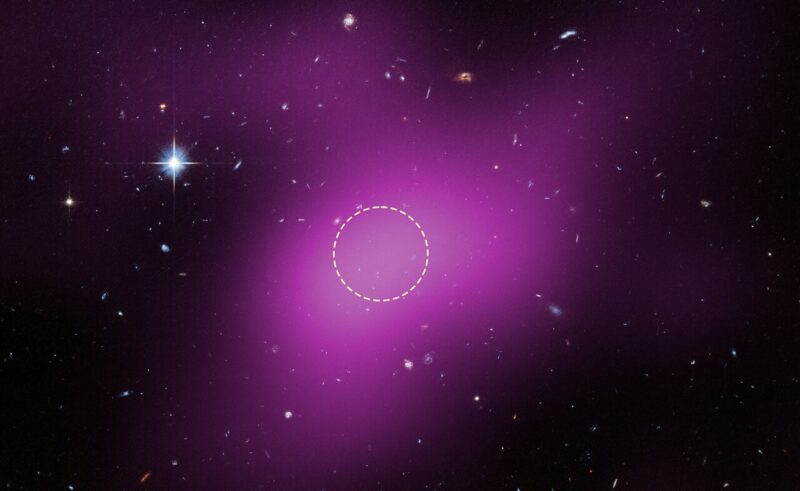
Dark galaxies hiding nearby
The researchers used a few different cosmological simulations to determine how dark galaxies form and evolve. In all the simulations they ran, the researchers found dark galaxies. They even found a favored area for such dark galaxies. The paper stated:
Dark galaxies are typically found in low-density regions at the outskirts of the Local Group.
PhD student and lead author Guacimara García Bethencourt of University of La Laguna said:
The results show that these galaxies form in dark matter halos with specific properties, in which the gas never reaches the densities required to trigger star formation.
The team concluded from the simulations that it could be possible to detect up to eight dark galaxies in our immediate neighborhood (within about 8 million light-years). Using observatories such as the FAST radio telescope in China, astronomers could detect the neutral hydrogen of these dark galaxies, similar to how Cloud-9 was discovered.
The standard model of cosmology predicts the existence of dark galaxies. So finding more in our nearby universe would help confirm that the favored model that describes our universe is on the right track.
García Bethencourt said:
The universe could be full of invisible galaxies … and we are closer than ever to finding them.
Bottom line: New simulations suggest that our nearby universe could contain numerous dark galaxies, or galaxies containing dark matter but no stars. And our radio telescopes could detect them.
Source: H I-bearing dark galaxy predictions from constrained Local Group simulations: How many and where to find them
Via Institute of Astrophysics of the Canary Islands
Read more: Dark matter, not a black hole, could power Milky Way’s heart
Read more: Milky Way and Andromeda held together by dark matter sheet