You deserve a daily dose of good news. For the latest in science and the night sky, click here to subscribe to our free daily newsletter.
NASA to save Swift spacecraft from plunging back to Earth
The Neil Gehrels Swift Observatory, better known as Swift, has been orbiting Earth since 2004. Swift has been studying the most powerful explosions in the universe: gamma-ray bursts. Now, its orbit is now rapidly decaying. Swift is falling back to Earth, and if nothing stops it, it will burn up in our atmosphere this fall in a spectacular, fiery show.
But Swift is still doing great science, so NASA wants to extend the life of the mission. In order to do so, it will have to boost the spacecraft back into a stable orbit.
Enter the U.S. company Katalyst Space. In late 2025, Katalyst Space won a contract with NASA to push Swift back into nearly its original orbit.
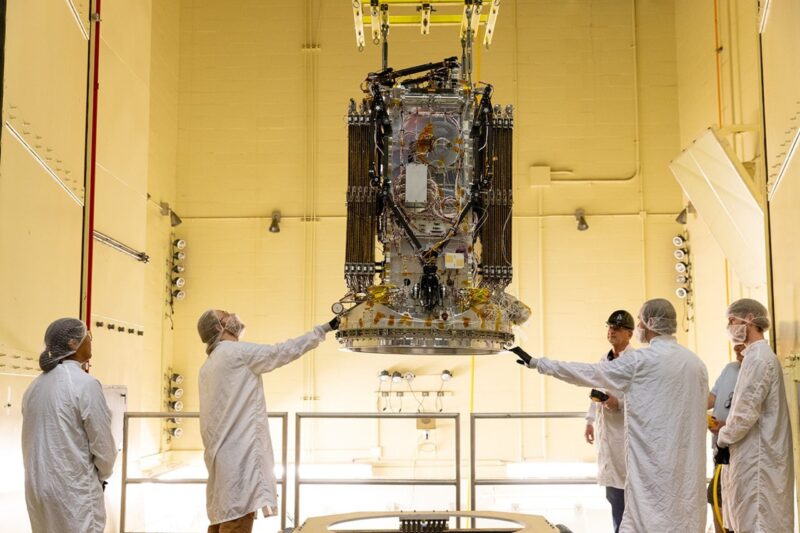
The current plan is that the Katalyst robotic servicing spacecraft – LINK – will launch toward Swift on June 27, 2026. The launch will take place atop Northrop Grumman’s Pegasus XL rocket from Kwajalein Atoll in the South Pacific. From this location close to the equator, the rocket will get an extra boost from Earth’s rotation.
NASA hopes to deliver LINK directly into Swift’s orbit. From there, LINK will grab Swift with extendable arms and carry it to a higher altitude. The team is aiming for an average altitude higher than about 185 miles (about 300 kilometers) above Earth.
On June 22, 2026, NASA said:
This month, a first-of-its-kind mission will launch to boost our Swift observatory before it reenters Earth’s atmosphere. Follow along with this daring, rapid-response effort to advance American spacecraft servicing technology.
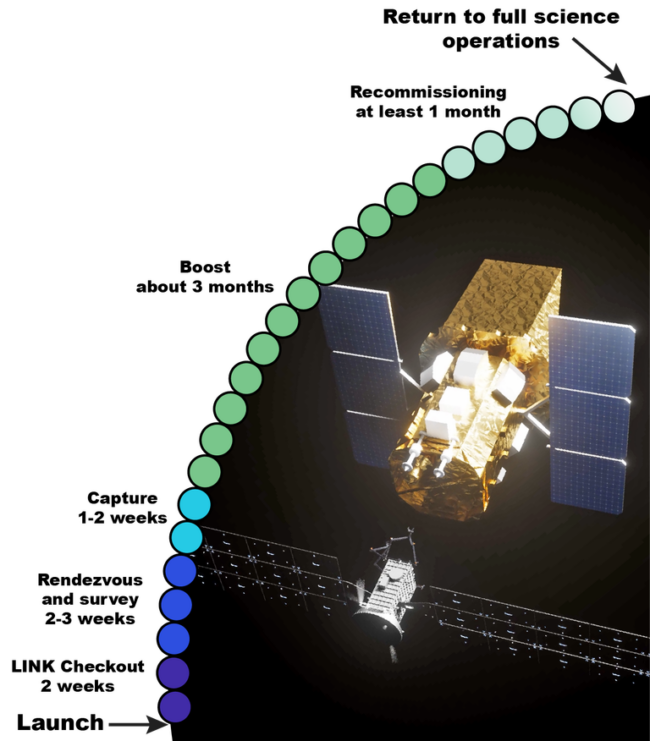
Boost timeline
Below is a timeline from launch through the boost steps and until Swift returns to science operations. NASA has temporarily suspended science operations on Swift until the boosting mission is complete.
More about the Swift spacecraft
The Swift spacecraft has three telescopes that watch the night sky. They are the Burst Alert Telescope, X-Ray Telescope and Ultraviolet/Optical Telescope.
The Burst Alert Telescope (BAT) is Swift’s wide-field gamma-ray detector. This telescope continuously monitors a large portion of the sky, watching for sudden flashes of high-energy gamma rays from gamma-ray bursts. When it detects a burst, it quickly calculates the object’s position and sends the coordinates to astronomers worldwide. It also directs the Swift spacecraft to rapidly turn toward the event for closer study.
Once Swift has slewed toward a newly detected gamma-ray burst, the X-Ray Telescope (XRT) takes over. It observes the burst’s fading X-ray afterglow. And it measures how its brightness changes over time and analyzes the energies of the emitted X-rays. Also, the XRT can pinpoint a burst’s location better than BAT and can continue tracking the event for days or even weeks. So the XRT helps scientists understand the physics of these powerful explosions and their environments.
Finally, the Ultraviolet/Optical Telescope studies gamma-ray bursts and other cosmic objects in ultraviolet and visible light. It provides Swift’s most precise positions for newly discovered bursts. It also captures details about their brightness, color and evolution. Overall, these observations help astronomers determine distances, identify host galaxies and better understand the nature of the explosions and other transient events Swift observes across the universe.
Bottom line: The Swift spacecraft is rapidly falling back to Earth. But NASA has a plan to boost the telescope back into orbit, beginning this week.
Via NASA