- About 5 billion years from now, in an advanced stage of its evolution, our sun will expand into a red giant.
- Earlier studies had suggested Earth won’t survive the swelling red giant sun. But now a new study suggests it just might.
- Even if Earth escapes the red giant sun, the study says, its surface will become hostile to life.
Science matters. Wonder matters. You matter. Join our 2026 Donation Campaign today.
Will Earth survive sun’s death?
A new study suggests Earth might have a fighting chance of surviving the sun’s eventual death. About 5 billion years from now, our sun will exhaust its hydrogen fuel and begin expanding outward to become a red giant star that swallows Mercury and Venus. Earlier studies had suggested Earth would meet the same fate. But new calculations from researchers in Belgium and France say it might escape.
The outcome relies on two competing factors: gravitational tidal interactions and solar mass loss. Together, they could determine whether Earth spirals inward into the expanding sun or drifts outward to safety. There’s a catch, though: even if Earth escapes, its surface would still become hostile to life.
The somewhat hopeful peer-reviewed results were published in Astronomy & Astrophysics on June 19, 2026. KU Leuven also released a statement about the study on ARGO.net.
Earth could escape the Sun’s final expansion after all. New modeling suggests lower tidal dissipation may let it drift outward instead of being swallowed in about 5 billion years. doi.org/rcbf
— Science X / Phys.org (@sciencex.bsky.social) 2026-06-19T15:40:16-04:00
2 effects will determine Earth’s fate
Earth’s fate comes down to two possibilities. Either it will spiral inward and be swallowed by the expanding sun, or its orbit will widen, allowing it to escape. The outcome has to do with two main effects: gravitational tidal interactions (tidal forces) and solar mass loss. As explained in ARGO.net:
Two forces drive the answer. The first involves tidal interactions, the same broad family of gravitational effects that links Earth and the moon today. When a planet orbits close to a giant star, its gravity can raise distortions inside the star. Those distortions dissipate energy and can shift the planet’s orbit inward over time.
The second force comes from solar mass loss. During its giant phases, the sun will shed large amounts of material through powerful outflows. As the sun loses mass, its pull on the planets weakens. A planet that once orbited at one distance can then drift into a wider path.
Lead author Mats Esseldeurs at KU Leuven in Belgium said:
Earth’s fate depends on a delicate balance between these two effects.
Gravitational tides could save Earth
Using tidal modeling, the new study shows that tidal energy doesn’t dissipate as efficiently inside giant stars as previously thought, and that changes everything for the Earth.
Gravitational tides are the same family of effects we see every day, such as the pull between Earth and the moon that drives our ocean tides. When Earth orbits close to a giant star, that same gravitational interaction creates drag that acts like a slow orbital brake. Earlier models assumed this brake would be strong enough to pull Earth inward into the expanding sun, but the new calculations suggest the brake is weaker than we thought. And that matters: a strong brake pulls Earth closer to the sun, but a weaker one allows Earth to drift outward, and potentially beyond the reach of the swelling red giant.

Solar mass loss: Earth’s second escape route
The other factor is solar mass loss. This is another possible way that Earth could escape the sun’s deadly expansion, and it has to do with the star itself.
As the sun expands, it will blow off some material outward into space, piece by piece, through stellar winds. As a result, the amount of matter that is gravitationally pulling on the planets is reduced, allowing them to move into a larger orbit. This movement could be strong enough to keep Earth in a wider orbit, thus avoiding being swallowed by the expanding sun.
But how likely is this to happen? Esseldeurs said:
If the sun’s mass loss predominates, Earth escapes into an orbit larger than the radius of its star.
What about Mercury, Venus and Mars?
According to the new study, it still doesn’t look good for Mercury and Venus. They are too close to the sun and unlikely to have their orbits widen enough to escape its red giant expansion. Both planets would at least be engulfed in the outer layers of our expanding star.
Earth is far enough that it could survive the dying sun’s expansion, but Mars?
Mars, being about twice as far from the sun than Earth is, has a good chance of surviving also. The planet could benefit from the same two effects that may help the Earth move outward.
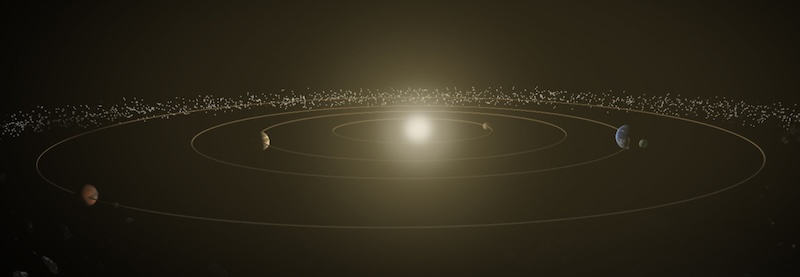
Bottom line: Will Earth survive the sun’s death, when our star becomes a red giant 5 billion years from now? A new study suggests it might, and maybe Mars too.
Source: The fate of Earth during the Sun’s giant phases
Via ARGO.net
Read more: What are red giants? Our sun will become one!
Read more: What is the fate of the Earth?