The Space Weather Prediction Center (SWPC) issued an S1 – Minor solar radiation storm warning at 16:00 UTC on June 30 after today’s M5.8 solar flare. The warning was initially valid through 23:59 UTC but was canceled at 16:36 UTC after conditions no longer justified its continuation.
While there were no radio signatures detected that would suggest a coronal mass ejection (CME) was produced, the location of the source region near the Sun’s western limb is favorable for solar energetic particles to reach Earth.
Western imb eruptions can be magnetically well connected to Earth through the interplanetary magnetic field, allowing high-energy protons accelerated during the eruption, or by a shock if a CME is later identified, to arrive even when the bulk of any associated CME is not directed toward Earth.
Although the warning was canceled, Region 4475 remains near a location favorable for particle transport toward Earth, and any further strong eruptions from the region could again raise the chance of a solar radiation storm over the next several days.
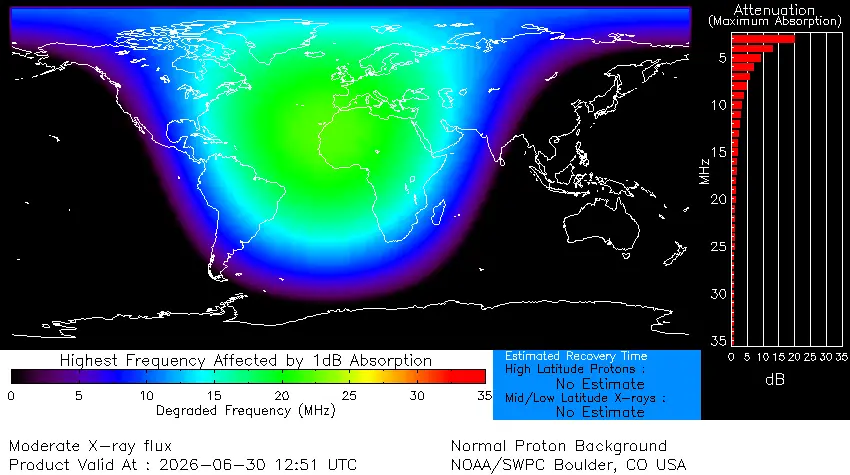
Radio frequencies were forecast to be most degraded over Europe, Africa, and the Atlantic Ocean at the time of the flare.
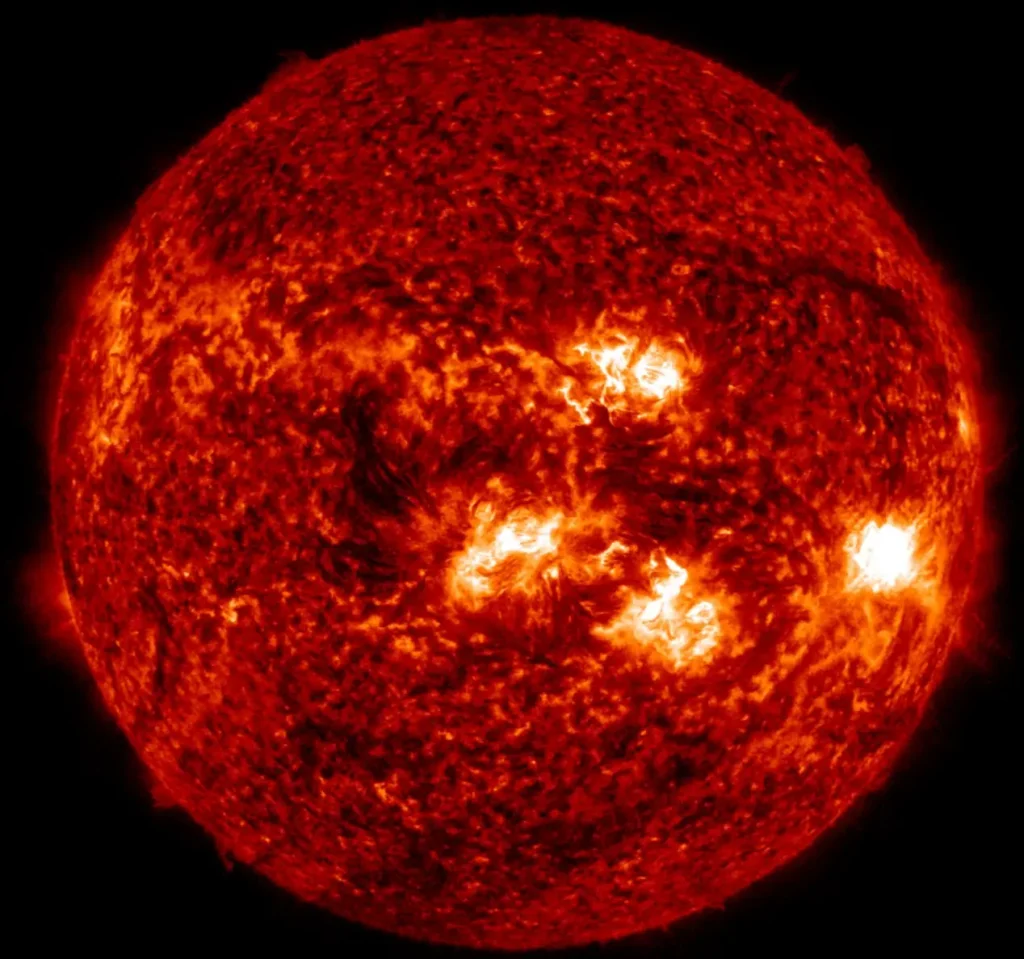
Solar activity was at moderate levels in 24 hours to 12:30 UTC on June 30, driven by frequent C-class flares and an M1.4 flare from Region 4479 — the largest flare of the period.
Region 4475 (beta-gamma-delta) showed additional growth in its trailing sunspots while retaining gamma and delta magnetic configurations in its intermediate area. The region produced a C6.1 flare at 17:40 UTC, along with several lower-level C-class events.
Region 4478 (beta-gamma-delta) produced a C4.1 flare at 03:40 UTC today and consolidated in its leading sunspot group while continuing to decay in its intermediate area.
Rapid magnetic flux emergence was observed in Region 4479 (beta-gamma-delta). The region developed a stronger mixed-polarity configuration in its intermediate area, producing the M1.4 flare and a C3.5 flare at 17:30 UTC. USAF SOON observers also reported a disappearing solar filament near N13W05 at approximately 17:37 UTC.
Solar activity is expected to remain at moderate levels through July 2, with isolated M-class flares possible from Regions 4475, 4478, and 4479.
Solar wind conditions returned to near-ambient levels during the reporting period. The total interplanetary magnetic field averaged 3 to 4 nT, while the north-south Bz component remained near neutral. Solar wind speed gradually declined from about 430 km/s to 330 km/s, while the solar wind remained predominantly within a negative magnetic sector.
A disturbed solar wind environment is expected on June 30 and July 1 due to the anticipated arrival of CMEs released on June 26 and 27. Conditions are expected to gradually weaken on July 2.
Geomagnetic activity remains quiet. G1 – Minor geomagnetic storm conditions are likely on June 30 with the arrival of a CME released on June 27, with isolated G2 – Moderate conditions possible. Unsettled to active conditions are then expected during the latter half of July 1 as a second CME arrives, although confidence in that arrival remains lower. Any remaining unsettled to active conditions could continue into early July 2 before mostly quiet conditions return.
References:
1 Forecast Discussion – NOAA/SWPC – June 30, 2026