NOAA’s Space Weather Prediction Center (SWPC) issued a G2 – Moderate Geomagnetic Storm Watch at 12:40 UTC on July 1, after an X1.1 solar flare and associated full-halo coronal mass ejection. The watch forecasts G1 – Minor, geomagnetic storm conditions on July 1, below-G1 conditions on July 2, and G2 – Moderate conditions on July 3.
The X1.1 flare peaked at 20:50 UTC on June 30 from active region 4479. It was associated with Type II and Type IV radio emissions, a Type II speed estimate of 1 496 km/s, a 410 sfu tenflare, and EUV dimming observed at 20:59 UTC. A full-halo CME was first visible in GOES-19 CCOR-1 imagery at 21:45 UTC.
Potential impacts are expected primarily poleward of 55° geomagnetic latitude and include possible power-grid fluctuations and voltage alarms in high-latitude systems, satellite orientation irregularities, increased drag on low-Earth-orbit satellites, fading of high-frequency radio propagation at high latitudes, and aurora visibility as far south as New York, Wisconsin, and Washington state.
Geomagnetic activity had already reached active to G1 – Minor levels during the previous 24 hours following the arrival of a separate CME that left the Sun on June 26.
Solar activity is forecast to remain at moderate levels, with a slight chance of further X-class flares from active regions 4475, 4478, and 4479. There is also a slight chance of an S1 – Minor solar radiation storm.
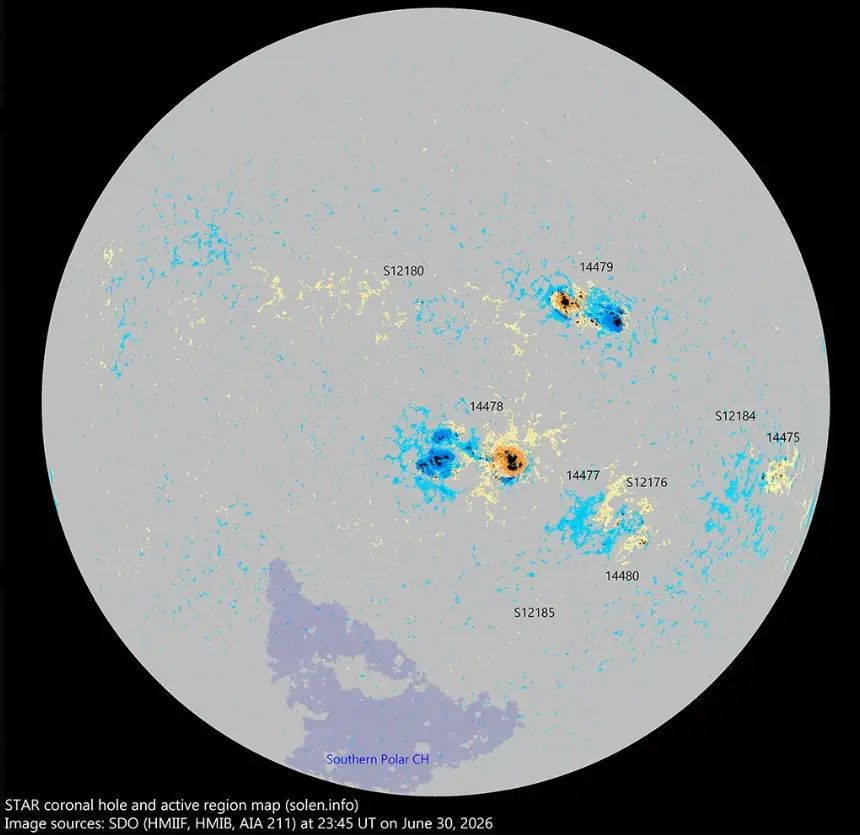
Solar activity was elevated during the past 7 days with nine events at M1.0 or stronger — M1.4 at 21:40 UTC on June 29; M1.3 at 01:16 UTC, M5.8 at 12:57 UTC, and X1.1 at 20:50 UTC on June 30; and M1.1 at 06:27 UTC, M1.0 at 06:43 UTC, M1.5 at 07:35 UTC, M2.5 at 08:17 UTC, and M1.3 at 10:08 UTC on July 1.
References:
1 Forecast Discussion – NOAA/SWPC – July 1, 2026