- Saturn’s moon Titan and dwarf planet Pluto are very different worlds. Titan has a dense atmosphere and seas of liquid methane, while Pluto has an extremely thin atmosphere and is completely frozen on the surface.
- But scientists found they have something in common: an unknown mystery molecule on their surfaces.
- Scientists don’t know what it is yet, but they have some theories about the mystery substance.
We’ve never needed good science more than we do right now. Click here to support EarthSky in 2026 and help us keep it going strong.
Titan and Pluto both have an unknown molecule
Dwarf planet Pluto and Saturn’s moon Titan are very different worlds, but it seems they share something unusual in common. Scientists said in late June that they’ve detected an unknown molecule on both Pluto and Titan. This mysterious molecule has never been identified anywhere else in the solar system … or even on any known exoplanet.
The discovery comes thanks to the James Webb Space Telescope (JWST). The researchers used Webb’s NIRSpec and MIRI instruments to study the electromagnetic radiation coming from both worlds.
And they found an unusual matching signature. To be precise, they saw that something was absorbing light at the wavelength of 0.00020 inches (5.11 micrometers). Usually, scientists would be able to map this wavelength to an existing molecule. But they found there is no known molecule that matches this absorption wavelength.
The researchers published their not-yet peer-reviewed findings on the arXiv preprint server on June 11, 2026.
A mystery molecule
The researchers found that the mystery molecule is on the surfaces of both Titan and Pluto, not in their atmospheres.
To try to identify the molecule, the research team looked at similar studies about other planetary spectra. But they didn’t find any matches.
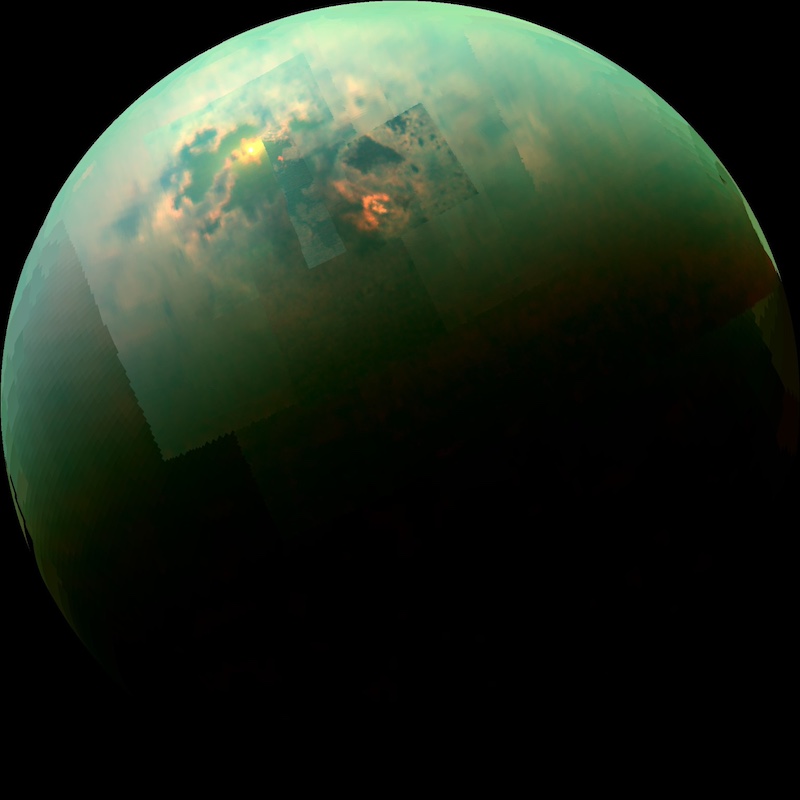
Very different worlds
It’s particularly surprising that Titan and Pluto share this unknown molecule, as they are very different worlds.
Titan has a dense atmosphere of nitrogen and methane. It has rivers, lakes and seas on its surface, composed of liquid methane and ethane. There are also vast stretches of sand dunes.
Pluto, on the other hand, is completely frozen on the surface. It also has an atmosphere of nitrogen, but it is extremely thin. The crust is composed of frozen water ice and there are glaciers of frozen nitrogen ice. Pluto’s mountains are water ice and sometimes methane ice. There are also possible ice volcanoes, where a slushy mixture of water ice, ammonia and methane erupt to the surface instead of hot magma.
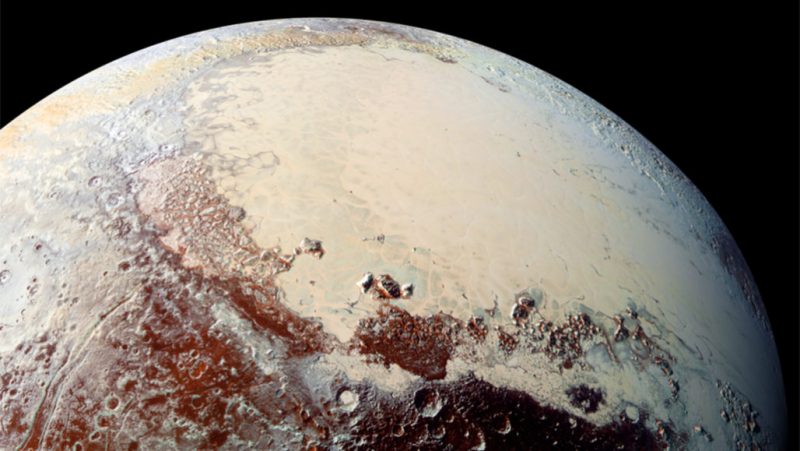
Bruno Bézard, the study lead, said:
It’s exciting because we have little information on the composition of the surface of the solid surface of Titan. [The surface of Titan] is very difficult to access due to the opacity of the atmosphere, which has a lot of methane, which is opaque at many wavelengths in the infrared.
We suspect there is water ice; there are some organic particles that settle on the ground, but no clear identification of anything, in fact.
Looking for a molecule match
As noted previously, the researchers looked for a match to the mystery molecule in the spectra of other planets, both in our solar system and beyond. They didn’t find one.
But both Titan and Pluto have substances known as tholins in their atmospheres. These compounds are composed of carbon and nitrogen. Could they lead us to the mystery molecule? It seems not. Bézard said:
We looked at many simple ices that could be present due to the condensation of all the hydrocarbons and nitrates, all the photochemical compounds that are formed in Titan’s atmosphere, and they don’t match. There are a few compounds that are not too far, as well as a whole family of compounds that [could fit]; we call them allenes.

Some differences in the molecules
Although the researchers are sure it is the same molecule, they did note some differences between the signatures on Titan and Pluto. The absorption line in the spectra on Pluto is about three times thicker than the one on Titan. That means it is more abundant on Pluto.
On Titan, the molecule is more unevenly distributed. There’s more of it on the moon’s trailing side – the side opposite its forward movement along its orbit – than on its leading side.
But what is the molecule? Some current possibilities are benzene, a ring-shaped hydrocarbon, mixed with another unknown molecule. Or it could be some form of acetylene or ketene ice, the researchers say. Or could it be a familiar molecule behaving in an unexpected way? These are truly alien worlds, after all.
Now, the researchers are collaborating with another group led by Jonathan Lunine at NASA’s Jet Propulsion Laboratory in California. They are studying the distribution of the mysterious compound on the surface of Titan. As Bézard noted:
It may be important. Maybe it will help us to see if it correlates with some geomorphological feature at the surface, like with the vast dune fields.
In the mid-2030s, NASA’s Dragonfly mission will arrive at Titan. It could help identify relevant molecules directly on Titan’s surface. But it lacks an infrared spectroscopy instrument, which will prevent direct detection of the spectral feature on the surface.
Bottom line: Scientists have discovered a unknown molecule on both Titan and Pluto. It’s a puzzle, since the 2 worlds are so different from each other.
Source: An unidentified absorption feature at 5.11 ?m on the surface of Titan and Pluto from JWST spectroscopy
Via:
Phys.org
IFL Science
Read more: Weird! Titan’s atmosphere is wobbling like a gyroscope
Read more: New Horizons visited Pluto 10 years ago