Science matters. Wonder matters. You matter. Join our 2026 Donation Campaign today.
Our galaxy flipped after a collision, say astronomers
Astronomers think that some 10 billion years ago, our Milky Way galaxy collided with another galaxy, which they’ve dubbed the Gaia Sausage. And on July 21, 2026, a team of astronomers at the Royal Astronomical Society’s National Astronomy Meeting said that this collision flipped the disk of our galaxy.
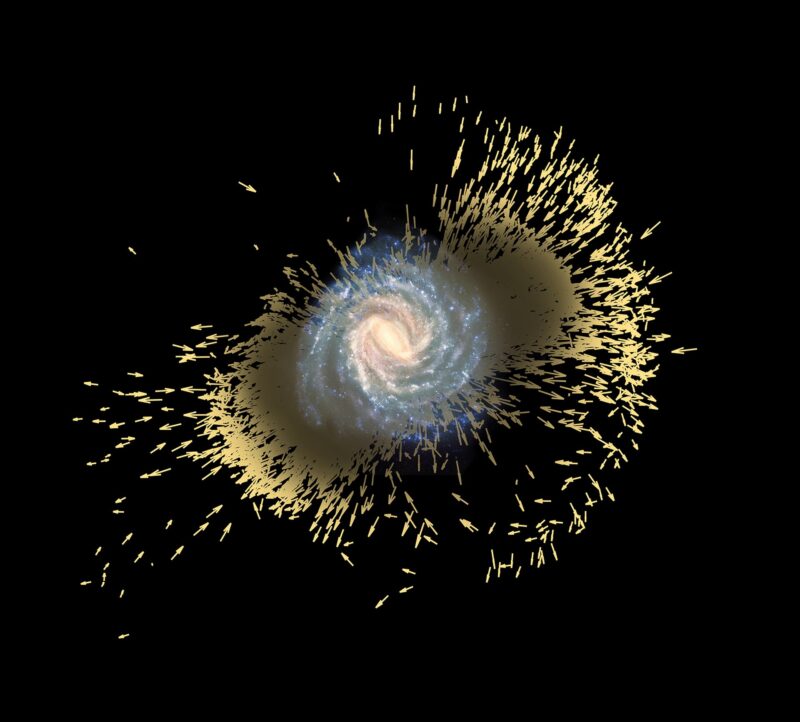
The team of astronomers, from Durham University in the U.K., used supercomputer simulations to study how 25 galaxies like our own would have evolved over billions of years. The simulations helped explain how the collision and aftermath resulted in our galaxy’s disk flipping by more than 90 degrees. And, they said, this scenario helps explain why stars in the halo around our galaxy behave the way they do.
The Milky Way galaxy and its clones
Our Milky Way is a spiral galaxy with a central bar. Most of the galaxy’s stars are in the bulge and disk, but there are other stars orbiting in a diffuse halo – a vast, much sparser sphere of stars – around the galaxy’s core and spiral arms.
These stars in the halo come from mergers, over time, with other smaller galaxies. The Gaia mission, which tracked the motions and distances of billions of stars, showed that the Milky Way’s halo is very slowly rotating. But scientists didn’t know why.
This is where the simulations came in. The researchers found that other galaxies with slowly rotating halos had a couple of things in common. First, these simulated galaxies experienced a major head-on merger with another galaxy during their evolution. And second, they experienced a disk flip. These two ingredients appeared to be the keys to creating the slowly rotating halo.
Lead researcher Kirill Batrakov at Durham University said:
We already know that the Milky Way had a massive head-on collision in the past with a galaxy known as Gaia-Sausage-Enceladus (often simply called the Gaia Sausage). So, we think that the Milky Way disk likely flipped in the past.
The Gaia Sausage hit us
This galaxy that hit us was a dwarf galaxy. It was particularly massive for a dwarf galaxy, but it was still smaller than the Milky Way.
Why do scientists call it the Gaia Sausage? Well, after the collision some 10 to 11 billion years ago, our galaxy absorbed the stars of the Gaia Sausage. The leftover stars from this galaxy now take long, elliptical paths – sausage-shaped, if you will – about the Milky Way’s center.
Simulated galaxies with and without a flip
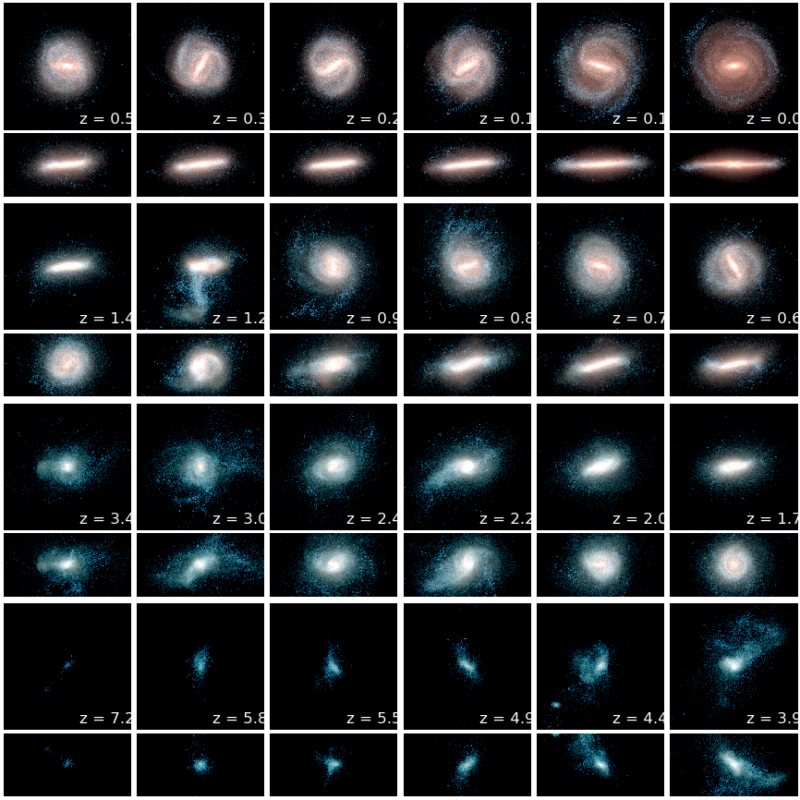
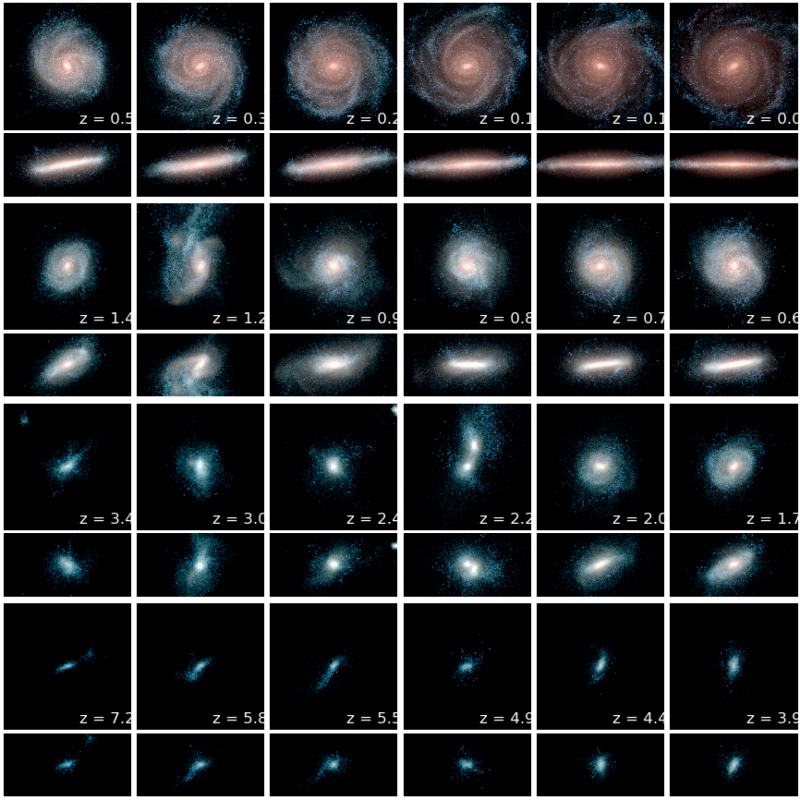
In the images below, we see two simulated galaxies. The first set of simulations are of a galaxy researchers call Halo 18. This galaxy underwent a disk flip. The one below it – simulated galaxy Halo 6 – did not have a collision or disk flip.
Insight into galactic evolution and dark matter
A collision and disk flip gives astronomers more insight into the history of our own galaxy. And it also provides insight into other galaxies similar to ours. Batrakov said:
Because we live inside the Milky Way, we can study it in more detail than any other galaxy, which makes it a key testbed for understanding galaxies more broadly.
Not every galaxy experiences a disk flip. But now it seems the Milky Way experienced at least one in the past. Batrakov said:
Finding that its disk flipped adds a new chapter to that story, one we must account for when placing the Milky Way in a broader context of other galaxies. What excites me the most is that this complex history can be reconstructed just from present-day observations.
And the insight could extend to the elusive substance astronomers call dark matter. Astronomers have already known from earlier measurements of the movements of our galaxy that an invisible dark matter halo surrounds the Milky Way. In fact, dark matter makes up 90% of the mass of our galaxy.
The new study found that the starry halo rotating around the Milky Way is closely linked to the rotation of its dark matter halo. So this suggests that the Gaia Sausage remnants, along with other smaller galaxies that collided with us, may have evolved in step with the dark matter halo.
Bottom line: Our galaxy flipped after a collision with a dwarf galaxy 10 billion years ago, changing the Milky Way’s evolution, new simulations suggest.
Via Royal Astronomical Society
Read more: Did galaxy-killing wind shape the early universe?
Read more: The black hole or galaxy: Which came 1st?