- New Horizons observed Pluto’s atmosphere in 2015 as “thin.” The spacecraft found a mostly nitrogen atmosphere for this dwarf planet.
- And now we know the atmospheric pressure on Pluto decreased by 16% between mid-2021 and July 2023.
- How do we know? Scientists detected the change while watching Pluto pass in front of distant stars, during what are called “occultations.”
Pluto’s atmosphere is thinning
On July 31, 2026, a team of scientists led by Amanda Sickafoose at the Planetary Science Institute in Tucson, Arizona, published peer-reviewed findings showing that Pluto’s atmospheric pressure decreased by 16% between mid-2021 and July 2023. The team detected the change by observing Pluto occult, or pass in front of, distant stars. The researchers might have even detected the first signs of Pluto’s coming atmospheric collapse.
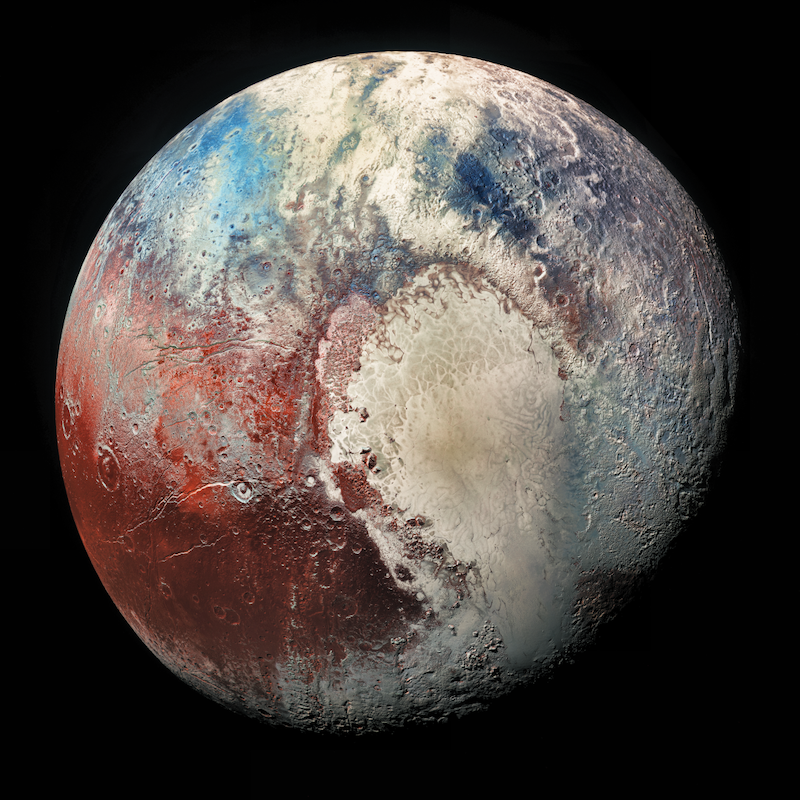
Only one spacecraft from Earth has ever visited Pluto. That was New Horizons in 2015. It found that Pluto has an extremely thin, but hazy, atmosphere made mostly of nitrogen. But we knew before New Horizons that Pluto’s atmosphere should thicken and thin in a 248-year cycle, as this tiny outer world (with its greatly elongated orbit) moves closer to and then farther from the sun.
Pluto came closest to the sun on September 5, 1989. Then it was closer to the sun than Neptune’s orbit. Now it is moving away from the sun, heading out to a colder part of the solar system. We know its atmosphere will thin out and freeze onto its surface.
Pluto won’t turn back towards the sun until the yeaer 2114. Until then, there’s lots of time for scientists to study this little world in the colder part of its orbit.
— Planetary Science Institute | Discovery & Public Education in P… (@psi.edu.web.brid.gy) 2026-07-31T18:04:54.000Z
Measuring Pluto’s thinning atmosphere
The new study examined how Pluto’s atmosphere has changed between 2017 and 2023. New Horizons‘ flyby of Pluto was in 2015. The researchers found that between the flyby and into 2021, Pluto’s atmospheric pressure remained constant. No thinning yet.
But then something changed. Between mid-2021 and July 2023, the atmospheric pressure decreased by 16%.

Occultations provide clues
How did the researchers measure the atmosphere? They can do so when Pluto occults – passes in front of – a distant star. By measuring how the starlight changes, the researchers can get clues about Pluto’s atmosphere.
Even though Pluto is extremely far away from us, it casts its shadow on Earth during an occultation. Scientists in different parts of the world create maps of the shadow’s path across Earth.
Lead author Amanda Sickafoose at the Planetary Science Institute and her colleagues have observed 10 such occultations since 2017. The researchers could confirm their observations from multiple locations on Earth. Sickafoose said:
We often prefer to observe predicted occultations that have shadow paths over large observatories because that equipment and data have proven successful. Then, we try to improve those datasets by collaborating with local observers in the shadow paths.

Brightness of the star
Pluto is extremely faint of course, since it is incredibly far away. This is why the brightness of the background star is so important. Scientists use various telescopes to measure the brightness of the star before, during and after the occultation.
Despite the faintness of Pluto, its thin, hazy atmosphere bends the star’s light enough to be detectable from Earth. Sickafoose said:
I’m constantly amazed at how the simple technique of watching starlight dim and reappear allows us to study a thin atmosphere – a few millionths of the Earth’s – on a world two-thirds the size of our moon and 30 times farther from the sun.
Sickafoose concluded:
We’re at a particularly interesting point for Pluto. Our work suggests that the atmosphere has recently started decreasing in pressure. I am hopeful that we’ll be able to get more data in the next years to decades to specifically confirm or refute this trend.
New Horizons sees Pluto’s hazy atmosphere
NASA’s New Horizons spacecraft saw Pluto’s hazy atmosphere up close when it flew past the dwarf planet on July 14, 2026. You can clearly see the haze layers in the images the probe sent back to Earth. And the famous “blue ring” , at the top of this post, is particularly amazing. It shows Pluto backlit by the sun, with its atmosphere appearing a bright blue ring in the blackness of space.
Last month, another study found that Pluto and Saturn’s moon Titan both have the same mysterious molecule on their surfaces. And scientists don’t know what it is yet. Interesting!
Bottom line: Bottom line: Scientists detected that Pluto’s atmosphere is thinning as it moves farther away from the sun in its orbit. They did so when Pluto passed in front of distant stars.
Source: Changes in Pluto’s Atmosphere Based on Stellar Occultation Data from 2017 to 2023
Via Planetary Science Institute
Read more: Titan and Pluto share same mysterious molecule: What is it?
Read more: Will Pluto become a planet again? The ongoing debate