- Could life exist on exoplanets with helium atmospheres? A new study suggests it’s possible.
- Experiments showed that helium-dominated atmospheres would be non-toxic to many types of earthly lifeforms.
- Helium atmospheres could also preserve other gases associated with life, making them easier to detect by astronomers.
Science news, night sky events and beautiful photos, all in one place. Click here to subscribe to our free daily newsletter.
Life in helium atmospheres on exoplanets?
When searching for possible signs of alien life on exoplanets, scientists tend to focus on atmospheres that might be earthlike. That is, atmospheres dominated by nitrogen, oxygen or even carbon dioxide. But there’s another possibility that has been largely overlooked. What about helium atmospheres?
Helium is the second-most abundant element in the universe. And we know there are exoplanets with helium in their atmospheres.
A new paper just released from researchers at Massachusetts Institute of Technology (MIT) in the U.S. and Wroclaw University of Science and Technology and JJ Scientific in Poland, examines the possibility of life existing in helium atmospheres. Intriguingly, the researchers found that there are no intrinsic barriers that would prevent life as we know it from being able to survive in a helium-dominated atmosphere.
The new study looks at a largely overlooked body of laboratory research on life in helium-dominated atmospheres. And the results are surprising.
The researchers published their preprint version of the paper (not yet peer-reviewed) on August 16, 2026, on arXiv.
An overlooked possibility
Scientists had largely ignored the idea that planets with helium atmospheres could support life. This was based on two key assumptions.
The first was that helium is expected to typically escape from the atmospheres of rocky planets, along with hydrogen. The second is that Earth itself doesn’t have much helium in its atmosphere. So those were the models scientists had to work with.
But the research team decided to take a closer look at the possibility of life on helium worlds. So they synthesized helium-dominated atmospheres in the laboratory. And a wide variety of organisms were subjected to that environment. These included bacteria, fungi, protozoa, microalgae, plants and animals. The results were surprising.
When the organisms had the essential metabolic requirements – the chemical processes in your body that change food into energy and build or repair cells – then they were able to tolerate and survive in the helium atmosphere.
No barriers to life
Overall, the helium did not present any barriers to life. In fact, there was no demonstrated toxicity and no fundamental barrier to metabolism, cell division, photosynthesis, nitrogen fixation or coordinated multicellular activity, including in humans. This suggests that life could survive and even thrive on planets with helium atmospheres.
And it’s seemingly because helium is chemically inert. Whether or not it would actually help life flourish is another question. But it won’t hamper or destroy it.
This is also good news for scientists trying to detect signs of life in helium atmospheres. The helium won’t destroy any biosignature gases present in the atmosphere. And it won’t obscure their spectral signatures. In fact, helium-dominated atmospheres also have low mean molecular weights and large scale heights. This actually strengthens spectral features in transmission and improves remote detectability.
Helium could help scientists find alien life
Not only does this show alien life could exist in a helium atmosphere, it could help scientists actually find it. As the paper concludes:
The possibility of helium-dominated, temperate exoplanet atmospheres asks us to widen a familiar assumption: that life-bearing atmospheres must resemble Earth’s in their bulk composition. Helium contributes little chemistry of its own, yet that very inertness allows the gases required by life to coexist within a stable atmospheric envelope, while its low molecular weight may make their spectral signatures unusually accessible.
The fact that such diverse forms of life can survive, metabolize and reproduce under helium-dominated conditions supports the inclusion of helium-dominated exoplanets among the targets in the search for life beyond Earth.
The convergence of atmospheric-evolution models, the first observations of helium around a habitable-zone rocky planet and decades of laboratory evidence establishes that helium is not an exotic obstacle to life and might in fact enable the first biosignature gas detection on a rocky world in our galaxy.
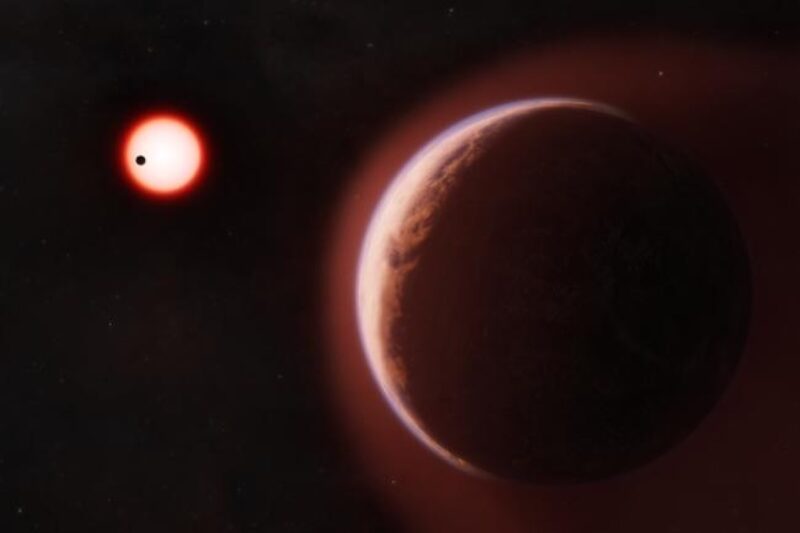
Leaking helium reveals atmosphere on rocky exoplanet
Last month, scientists found the first strong evidence for an atmosphere on a rocky planet in the habitable zone of its star. The planet, LHS 1140 b, is a super-Earth exoplanet 48 light-years away. It orbits a red dwarf star.
Scientists detected helium leaking from this world. The leaking helium means the planet must have an atmosphere. But scientists don’t know yet what the other gases are in that atmosphere.
In 2018, astronomers reported finding an exoplanet – HAT-P-11b – whose helium atmosphere is extended or puffed out, kind of like a child’s balloon.
Bottom line: Is life in helium atmospheres on exoplanets possible? A new study says that there are no barriers to life on worlds with helium-dominated atmospheres.
Source: The Viability of Life in Helium-Dominated Exoplanet Atmospheres
Via Astrobiology
Read more: 1st atmosphere detected on Earth-like, habitable-zone world
Read more: Exoplanet’s helium atmosphere is inflated like a balloon