NASA’s Nancy Grace Roman Space Telescope, perched atop a SpaceX Falcon Heavy rocket, is seen at sunrise at Kennedy Space Center in Florida.
Joel Kowsky/NASA
hide caption
toggle caption
Joel Kowsky/NASA
NASA is set to launch a new space telescope Sunday from the Kennedy Space Center in Florida that will help scientists probe the nature of dark matter, dark energy, and other mysteries of the universe.
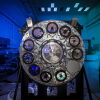
The Nancy Grace Roman Space Telescope, which is about the size of a tour bus, is set to lift off at 7:26 a.m. ET on SpaceX’s Falcon Heavy rocket. A weather forecast for the launch shows a 50% chance of favorable weather conditions. A backup window on Monday at 7:22 ET has better odds, with only a 30% risk of weather interfering with the launch.
The journey to Roman’s new home

The new telescope is named for Nancy Grace Roman, NASA’s first chief astronomer who was known as the ‘Mother of Hubble’ for her championing of the iconic Hubble Space Telescope. Her namesake observatory will have the sharpness of Hubble but a field of view that is at least 100 times larger, allowing it to image huge swaths of the sky at once.
Before it can do that, the Roman Space Telescope will have to get to its new home in the sky about a million miles away. Roman will live at the second Sun-Earth Lagrange point known as L2. There, the competing gravitational pulls of the Earth and the Sun help the telescope keep a steady orbit while using minimal fuel. The James Webb Space Telescope orbits at this point, which gives the spacecraft an unobstructed view of the sky.
“It takes us a good three-plus months to get out there, and we’re spending that time checking everything out and doing a whole bunch of calibrations and making sure everything is working the way we know it can,” said NASA’s Jeremy Perkins, an integration and test scientist on the mission. “It’s basically like our time to kick the tires and just make sure that the focus is right, the pointing is right.”
Uncovering cosmic mysteries
Roman is on a kind of ghost hunt, searching for more evidence of dark matter — mysterious, invisible stuff whose gravitational influence appears to hold galaxies together and define the overarching structure of the cosmos. Roman will study how gravity subtly affects the path of light along great distances throughout a massive survey of the sky. By doing this, the telescope will help map both normal and dark matter, giving scientists a better understanding of just what this elusive substance might be.

Astronomers will also use Roman’s observations to uncover dark energy, the strange force that is believed to drive the expansion of the universe. Scientists’ understanding of dark energy comes from observations of a kind of exploding star known as a Type Ia supernova. These supernovas appear to shine at known and predictable brightness throughout the cosmos, giving them the nickname of ‘standard candles’. By cataloguing even more of these supernovas, scientists hope to develop a better understanding of how dark energy works, which could fundamentally change the way astronomers view the universe.
Roman will also search for planets outside our solar system. Since astronomers confirmed their existence in the 1990s, more than 6,000 exoplanets have been identified. With Roman, NASA expects to identify more than 100,000 of them by identifying dips in starlight caused by a planet passing in front of its own star. The telescope also hopes to find some 1,000 through microlensing — a technique that searches for tiny changes in background starlight caused by the gravity of a far-off planet.

The spacecraft is also demonstrating technology that blocks out that starlight and actually takes a picture of the planet.
A deluge of data
The telescope will beam back 1.4 terabytes of raw science data each day, using a refrigerator-sized high-gain antenna. The data will be available immediately to scientists and the public.
“Roman’s database at the end of its prime mission after five years is going to be bigger than your standard music streaming platform,” Perkins said.
Because of the massive amounts of data, NASA is making it available to anyone through a cloud-based system called Roman Nexus. For Perkins, that’s what makes this mission unique — anyone can look at the raw data and find new discoveries.
“It’s all the things that we are not expecting to see,” he said. “It’s all these one-in-a-million things that we’re going to be able to see with Roman that really excites me.”