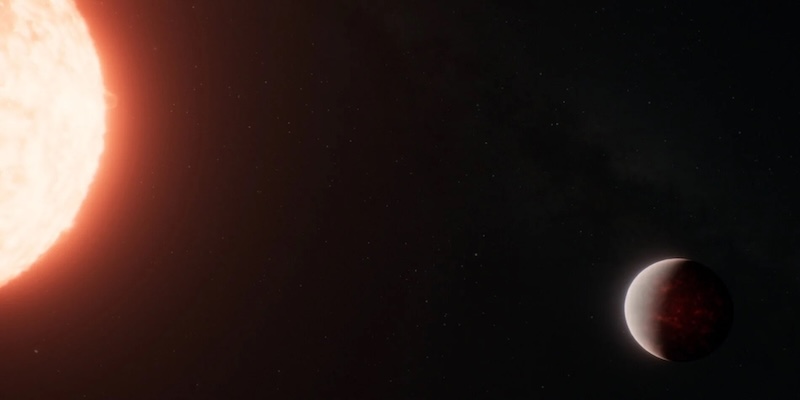
- Lava worlds are rocky exoplanets that orbit so close to their stars that intense heat can melt rock on their surfaces. Scientists had expected that they would lose their atmospheres due to the intense radiation from their stars.
- But it turns out some lava-worlds do have atmospheres, even thick ones! How is that possible?
- A new model from researchers at Stanford University shows that gases slowly escaping from below the planets’ surfaces can keep their atmospheres sustained.
Science news, night sky events and beautiful photos, all in one place. Click here to subscribe to our free daily newsletter.
Some lava-world exoplanets have atmospheres
Exoplanets that orbit very close to their stars are always in danger of losing their atmospheres. That’s because the radiation and stellar winds from the stars can erode the atmospheres until there’s little to nothing left. Some of these planets are rocky lava-worlds; the intense heat from the nearby star has melted rock on their surfaces. Scientists expect such planets to be airless. But some of them do still have their atmospheres, even thick atmospheres.
How is that possible? A new study, led by researchers at Stanford University in California, suggests an explanation. The researchers said on August 25, 2026, that gases slowly escaping from below the planets’ surfaces might replenish the gases that have been lost. The researchers published their peer-reviewed results in The Astrophysical Journal Letters on August 25, 2026.
That escape of gas into space is called outgassing. According to the new study, these atmospheres could last for billions of years.
Sandbar, shoreline, valley
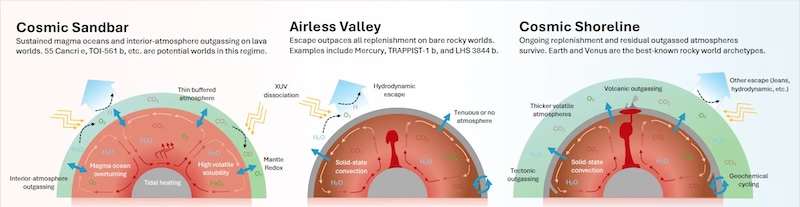
According to the new model, these lava worlds exist on a kinda of cosmic sandbar. What does that mean?
Prior to this new study, astronomers began speaking of a cosmic shoreline. They mean it to imply the boundary region in a distant solar system – at a particular distance from the central star – beyond which rocky exoplanets can retain atmospheres. Think of the shoreline as the dividing line between “has air” and “airless.”
Between this shoreline and the hotter sandbar, planets can lose their atmospheres and fail to replenish them. Astronomers refer that region of a distant solar system as an airless valley.
But now comes the cosmic sandbar: the unexpectedly hot region where some lava worlds can maintain atmospheres because gases released from their molten interiors replenish what stellar radiation strips away.
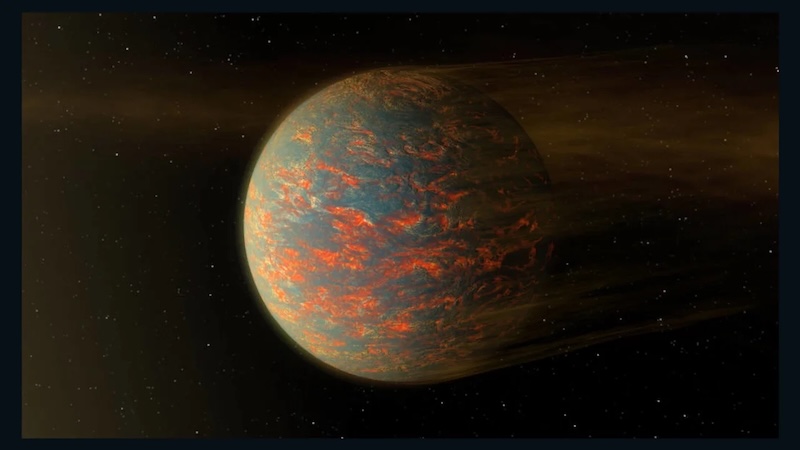
55 Cancri e is a good example. It’s a super-Earth almost eight times the mass of Earth. It orbits its star about 20 times closer than Mercury orbits the sun. Yet is has a thick atmosphere. The James Webb Space Telescope discovered that atmosphere – the first found on a rocky exoplanet – in 2024.
astrobiology.com/2026/08/26/w… #astrobiology #exoplanet
— Astrobiology (@astrobiology.bsky.social) 2026-08-26T19:39:24.014Z
Continuous magmatic outgassing allows ultra-hot lava worlds to defy the cosmic shoreline theory and sustain thick atmospheres despite intense stellar radiation. www.labroots.com/trending/spa…
— Labroots Earth & Environmental Sciences (@earth-lr.bsky.social) 2026-08-26T18:32:12.623Z
The ‘cosmic sandbar’
The research team has proposed a new region around stars called the “cosmic sandbar.” It is an extension of the “cosmic shoreline,” which is analogous to shorelines on Earth between land and water. For stars, it represents the boundary where a planet can keep or lose its atmosphere. In our solar system, Earth and Venus are on the cosmic shoreline. They remain cool enough that radiation from the sun doesn’t burn off their atmospheres.
But there’s a catch. Some lava-worlds are closer to their stars than that cosmic shoreline boundary. So how do they maintain their atmospheres?
The researchers have called this region the cosmic sandbar. It is analogous to the sandy ridges that form offshore in oceans. As lead author Barron Nguyen at the Stanford Doerr School of Sustainability explained it:
These lava-worlds have pointed to something being wrong with the cosmic shoreline boundary, but we’ve found a way for them to preserve their atmospheres by proposing a new regime beyond it.
Co-author Laura Schaefer added:
Where the shoreline boundary is between airless worlds and those capable of sustaining an atmosphere has been a major open question in planetary science. The new model expands our understanding of this boundary and the factors that go into determining where it lies for specific stars and planets.
The ‘airless valley’
There’s also another region called the “airless valley.” That’s between the shoreline and the sandbar. The planets are close enough to their stars for their atmospheres to be stripped away, but then they cool off too quickly after formation for those atmospheres to be replenished.

Follow the atmospheres
One of the major – and most exciting – aspects of studying exoplanets is the search for life. To do this, scientists “follow the atmospheres.” As a first step, they need to find rocky planets that have atmospheres. Then they can analyze those atmospheres for possible biosignatures, chemical fingerprints of living organisms. Nguyen said:
Scientists have been interested in figuring out which planets have atmospheres and which do not, because that’s the first step of looking at planetary habitability.
That’s why planets that do have atmospheres, despite being so close to their stars, is so interesting. It expands the range of planets that could be potentially habitable. Although in the case of lava-worlds, they are likely simply too hot for life. At least on the surface.
The cosmic shoreline might not be as definitive as previously thought when determining which exoplanets could be habitable. It’s not completely a lost cause though, either. Nguyen said:
A major takeaway from our study is that the cosmic shoreline isn’t a lost cause. There had been some pessimism about it because of these lava worlds, but now we know there’s a broader set of parameters that can enable a planet to generate and maintain an atmosphere.
Scientists also reported finding a atmosphere on another lava-world, TOI-561 b, earlier this year. It is a super-Earth 560 light-years away.
Bottom line: A new study from researchers at Stanford University helps explain how hot lava-world exoplanets orbiting close to their stars can maintain their atmospheres.
Source: An Evolving Cosmic Shoreline and Sandbar Bounding the Rocky Airless Valley
Via Stanford University
Read more: Possible atmosphere on rocky exoplanet found for 1st time
Read more: Atmosphere on lava planet is an exciting surprise