Science news, night sky events and beautiful photos, all in one place. Click here to subscribe to our free daily newsletter.
BepiColombo mission to arrive at Mercury in November
Today, on September 3, 2026, ESA’s BepiColombo spacecraft is moving one crucial step closer to entering Mercury’s orbit.
Bepicolombo launched to space way back October 20, 2018, from Kourou, French Guiana. The spacecraft has spent eight years maneuvering into position so that it can orbit Mercury, the closest planet to the sun. Orbiting Mercury is a true engineering challenge, because the spacecraft picks up speed as it nears the massive sun. But it must slow down to enter Mercury’s orbit and not fly straight past.
So, during its journey, BepiColombo has made flybys of Earth, Venus and Mercury to help put on the brakes. And on September 3, 2026, Bepicolombo’s Mercury Transfer Module (the spacecraft’s propulsion unit) will separate from the science orbiters, Mercury Planetary Orbiter (MPO) and Mercury Magnetospheric Orbiter (MMO). These two spacecraft will then enter orbit around Mercury on November 21, 2026.
On December 9-10, the two orbiters will separate from each other. Finally, science operations will begin in April 2027.
BepiColombo’s flybys
BepiColombo has made one Earth flyby, two Venus flybys, and six Mercury flybys since its launch in 2018. Click the links below to learn more about the flybys.
April 10, 2020: 1st Earth flyby
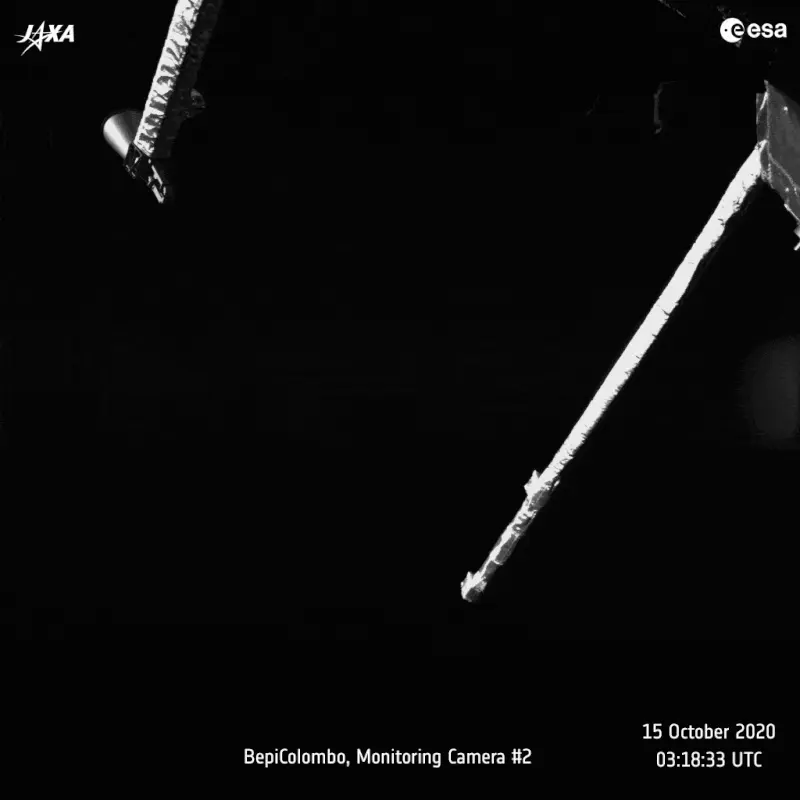
October 15, 2020: 1st Venus flyby
August 10, 2021: 2nd Venus flyby
October 1, 2021: 1st Mercury flyby
June 23, 2022: 2nd Mercury flyby
June 20, 2023: 3rd Mercury flyby
September 4, 2024: 4th Mercury flyby
December 1, 2024: 5th Mercury flyby
January 8, 2025: 6th Mercury flyby
What scientists hope to learn at Mercury
Mercury is currently the least-understood planet in the inner solar system. In fact, before BepiColombo, the only spacecraft to have visited Mercury were NASA’s Mariner 10 and MESSENGER missions.
Now, scientists hope to solve five mysteries with BepiColombo:
- Where did Mercury come from?
- Is there really water on Mercury?
- Is Mercury dead or alive?
- Why is Mercury so dark?
- Why does Mercury have a magnetic field?
To answer these questions, BepiColombo will spend at least one year orbiting Mercury. The mission will use its high-resolution instruments to learn about the mineralogical and elemental composition of Mercury’s surface. Plus, it will scan polar regions for ice. BepiColombo will look for anything that looks like it has changed on Mercury since MESSENGER visited 10 years earlier. And the two orbiters will travel through different areas of the planet’s magnetosphere to measure how it changes and interacts with the sun.
Bottom line: The BepiColombo mission has been maneuvering its way into orbit around Mercury for eight years. On September 3, it will release two orbiters in Mercury orbit.
Via ESA
Read more: Mercury images from final flyby of BepiColombo!
Read more: Mercury lives on? Strange streaks hint at active world