Don’t miss the next unmissable night sky event. Sign up to EarthSky’s free newsletter for daily night sky updates.
Mercury is shrinking up to 30% more than expected
Astronomers have long known that Mercury is shrinking. In the few billion years since it was born in a series of fiery collisions, the planet has cooled and begun to shrink.
But on September 10, 2026, an international team of researchers said that the closest planet to the sun seems to have shrunk up to 30% more than they expected.
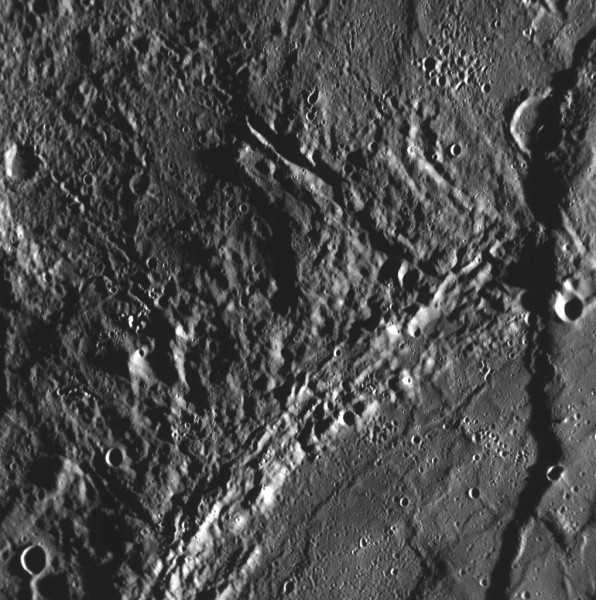
The signs of the planet’s shriveling are written right on its face in the form of wrinkles. Scientists call these wrinkles shortening structures. But craters and debris scattered across its surface from impacts have likely obscured even more evidence of its shrinking.
The researchers published their peer-reviewed study in the journal Geophysical Research Letters on September 10, 2026.
Cooling and shrinking
Our solar system began forming around 4.5 billion years ago. Mercury formed from planetesimals smashing together and heating up its interior. Then, over time, the planet cooled. Meanwhile, it was pelted with smaller material that left its mark on the planet’s surface.
This left Mercury with craters and debris from impacts, along with scarps and ridges from the cooling and shrinking. The new study, led by Gaku Nishiyama of the German Aerospace Center (DLR) Institute of Space Research, looked at how much shrinking Mercury might have undergone since its formation. This information can tell us more about Mercury’s interior and evolution. Nishiyama said:
More shrinking means Mercury could have a larger metal core, less light elements like silicon mixed into the metal core, or a higher starting temperature.
Mapping Mercury’s surface
The impact debris obscures the view of previous shrinkage and scarps on Mercury. So the researchers created a detailed map of Mercury’s surface to track the lumpiness. What they found was that the areas that were lumpiest show the fewest wrinkles. The team believes this is largely impact debris hiding evidence of older wrinkles and shrinkage. Nishiyama said:
It made us think that there’s a process obscuring shortening structures.
The press release described it as newly lain gravel covering up old ruts in a road.
Cooling should shrink Mercury uniformly. So the researchers then estimated how much shrinkage likely occurred planetwide based on the less obscured scarps. They then found the missing scarps could amount to 10% to 30% more shrinkage than previously estimated. The previous estimates of Mercury’s shrinkage were around 2.5 to 10 miles (4 to 16 km) in diameter. The new estimate puts it closer to 14.5 miles (23 km). Nishiyama said:
30% is a little bit surprising, but the corrected amount of contraction actually makes sense to me.
Or maybe Mercury is shrinking even more than that?
Nishiyama said they could still be underestimating the amount of shrinkage on the closest planet to the sun. The team used data from the MESSENGER mission, which explored Mercury until 2015. But in just a couple of months, the BepiColombo mission will begin probing Mercury at even higher resolution. Maybe the new data will reveal Mercury has shrunk even more than the new estimates suggest. Stay tuned!
Bottom line: A new study shows Mercury is shrinking more than scientists first thought. The planet might have already shrunk up to 30% more than they expected.
Source: Underestimation of Planetary Contraction Due To Obscuration by Surface Roughness: The Case of Mercury
Via AGU
Read more: BepiColombo mission 1 step closer to Mercury today
Read more: Mercury’s sodium tail is now appearing in special filters