- Saturn’s moon Enceladus has a salty subsurface ocean. Could it support life?
- Two new studies suggest that the ocean is even more life-friendly than previously thought.
- The first study shows that it is easier to determine the constituents of the ocean than previously assumed. The second suggests that microbial life could comfortably survive in the ocean.
Science news, night sky events and beautiful photos, all in one place. Click here to subscribe to our free daily newsletter.
Life on Enceladus?
Saturn’s moon Enceladus is one of the most promising places to search for life elsewhere in our solar system. In fact, continued study of data from the Cassini spacecraft has shown that its subsurface ocean is likely habitable. And now, two new studies suggest the chance of finding life on Enceladus is greater than previously thought.
Researchers from Freie Universität Berlin in Germany said on September 25, 2026, that Enceladus might not only be even more supportive of life, but future returning spacecraft could find evidence of it easier than first presumed.
The first study shows how it is easier to determine the composition of the ocean than previous studies showed, including identifying biological material. And the second study indicates that some kinds of microorganisms could survive more easily in the ocean than previously thought.
The researchers published both of the two new peer-reviewed papers in Science Advances on September 25, 2026. You can read them here and here.
Components of the oceanic spray
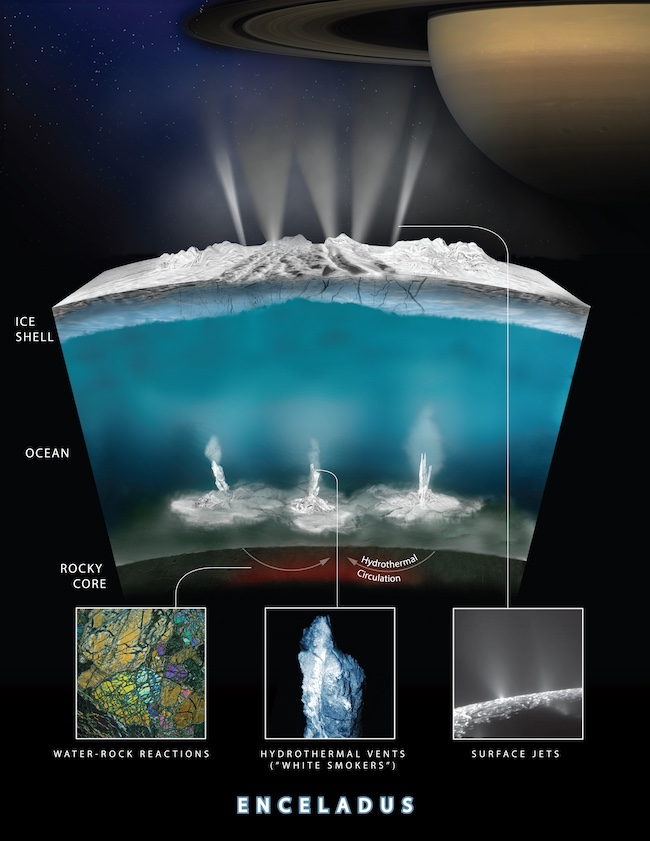
The first study focuses on the oceanic spray that reaches space. The water vapor comes from the subsurface ocean, moving up through cracks in the icy crust. It then bursts out into space, with no atmosphere to speak of to affect it.
Previously, scientists thought that the droplets in the vapor froze instantly when they reached space. But the new study suggests that they freeze slowly. And due to the slowness, most components of the spray separate from each other. Even within a single droplet, salts and organic molecules will move to different spots within it. This includes dissolved salts such as sodium chloride (table salt), which separates from sodium carbonate.
While traveling up through the cracks, the droplets reach speeds of up to 620 mph (1,000 km/h). If a droplet hits the wall of the crack, it smashes into fragments only a few micrometers in size. And that’s a good thing for us. Frank Postberg, a planetary scientist at Freie Universität Berlin who led the study, explained:
Enceladus actually does a lot of the work for us in preparing samples for analysis that usually take a lot of effort in chemical labs on Earth. The oceanic constituents are separated from each other and simultaneously concentrated into individual ice particles.
Easier to find evidence of life on Enceladus
The study found that the frozen grains form through a two-stage process. Larger, salty droplets first freeze slowly inside icy vents/cracks beneath the moon’s surface. This segregates their mineral content. Only later, in space, do they shatter into the smaller, chemically pure fragments observed by Cassini.
All of this separation makes it easier to identify the composition of individual fragments or molecules. And that makes it easier to identify ones that might be associated with life on Enceladus as potential biosignatures (chemical signatures of life). Biological material might be found in just a small fraction of the spray particles.
In addition, they would also be more highly concentrated and in a relatively pure form. That’s an ideal scenario for identifying them during an analysis of the particles.
Postberg calls this great news, saying:
That is great news in the search for life. Future spacecrafts will have to analyze many individual ice particles in the plume. But if they come across one with microbial material in it, they could identify biosignatures in the particle relatively easy with already available technology.

Microorganisms in Enceladus’ ocean could survive
The second study examined how microorganisms could survive in Enceladus’ salty ocean.
The ocean has little oxygen, a very high concentration of carbonate and is very alkaline (with pH values of 10 or 11). The researchers recreated those conditions in their lab. They even simulated the hydrothermal vents thought to exist on the ocean floor.
Then, the team added a methane-producing archaeon — a type of simple organism — called Methanothermococcus okinawensis. It lives near hydrothermal vents on ocean floors on Earth. It also doesn’t need oxygen, only hydrogen and carbon dioxide.
So what happened? The organisms, surprisingly, continued to grow. That’s the opposite of a control group of the microorganisms in an optimum laboratory medium at a high pH, with no dissolved carbon dioxide. Those microbes died.
In the Enceladus simulation, they produced methane using hydrogen generated by water-rock reactions. They even adapted their metabolism to deal with the low amounts of carbon dioxide. As one of the authors, Nozair Khawaja at Freie Universität Berlin, noted:
This was really a surprise to us. This was an experiment for which we did not expect such a successful outcome.
Postberg added:
On Enceladus the specific geochemical conditions might allow one of the oldest known metabolic systems on Earth to work, even in very alkaline environments. While that doesn’t mean that there is life on Saturn’s moon, our first study shows that — in the event that there is — future space missions might have a good chance of finding traces if they analyze individual ice grains from Enceladus’ plume.
The new studies show that the case for possible life on Enceladus has become stronger. Until we can return with new missions, we won’t know for sure if anything actually does live there, but the prospects are exciting.
Bottom line: Is there life on Enceladus? Two new studies show that the chances for life in the ocean of this Saturn moon are even greater than once thought.
Source: Cassini CDA Observes Compositional Segregation of Enceladus’ Ice Grains from Slow Freezing and Fragmentation of Oceanic Spray.
Source: Enceladus-Like Geochemistry Fuels Methanogenesis under Extreme CO2-Limitation.
Via Freie Universität Berlin
Read more: Simulation of Enceladus’ ocean shows strong potential for life
Read more: Do the organics in Enceladus’ ocean point to habitability?