- Could black holes have planets? New research says yes, they could.
- New simulations suggest massive planets could form in the outer dusty regions around supermassive black holes.
- The planets could form through a similar mechanism to how planets form around stars.
Science news, night sky events and beautiful photos, all in one place. Click here to subscribe to our free daily newsletter.
Supermassive black holes could have planets
Astronomers have found thousands of planets orbiting other stars. They’ve even found some rogue planets, or planets without a star. Now, fascinating new research says more planets could be lurking elsewhere. They could, the study says, be forming around black holes.
Astrophysicists Bhupendra Mishra and Wladimir Lyra discussed the possibility on a SETI livestream on September 21, 2026. They revealed that massive planets could form in the dusty regions around supermassive black holes, similarly to how planets form around stars.
The simulations suggest these planet-mass objects could start around the mass of Jupiter and then keep growing. And, incredibly, a single active black hole could spawn millions of planets at a time.
The new peer-reviewed paper was originally published in The Astrophysical Journal on June 29, 2026.
Watch a recording of the SETI Live livestream.
A birthplace for planets?
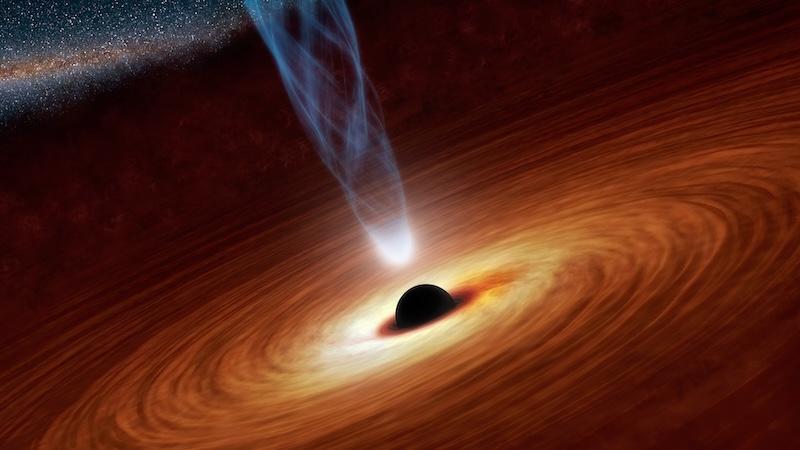
Scientists think supermassive black holes can be found in the central regions of almost all large galaxies. This study focuses on supermassive black holes that are actively feeding on the gas and dust around them. These incredibly violent objects are known as active galactic nuclei, or AGNs.
When these AGNs pull in matter to devour, the gas and dust start to collect and move around the black hole in a blazingly hot accretion disk. These are similar to the accretion disks that form around stars and create planets.
Noticing this, astrophysicist Barry McKernan — a co-author of the new study — asked Lyra whether the processes that form planets around stars could also occur around an active galactic nucleus.
They found that it could happen, at least theoretically. This is because the same physics should underly the process even in the different environments. If so, black holes could have planets.
The scales are vastly different though. A supermassive black hole could be a million times more massive than the sun. And baby planets forming around it could start out with the mass of Jupiter, our solar system’s biggest planet.
They would also form farther out from the black hole, in the dusty outer region of the disk. That is analogous to the outer region of our solar system, where comets form.
How would planets form?
So just how would one of these massive planets form? The researchers say the process would be similar to the way planets in regular solar systems do: from colliding dust. Dust grains would accumulate in increasingly dense concentrations. That’s the beginning of a baby planet.
Streaming instability — when drag on solid particles within a disk of gas and dust causes them to spontaneously clump — is the process behind this accumulation.
It’s even possible that some of them could grow beyond the planet stage and become brown dwarfs. These “failed stars” are larger than typical planets, but not massive enough to sustain nuclear fusion and shine like stars.
And, incredibly, some of those could keep growing until they became true stars.
How long would they last?
But some black hole planets might face a dire fate. Gravity from the black hole could move some of them inward. The temperatures in that region closer to the black would be far too hot. The planets would disintegrate. This, in turn, would create more dust.
That said, there could be a lot of planets to go round. The researchers estimated that a million planets could form during a single active episode of an active galactic nucleus. One of these bursts is typically about 2 million years long. And a black hole can go through many of these periods in its lifetime. Add that up over billions of years, and the number of planets formed from a black hole could be immense.
Can black hole planets be detected?
Right now, we can’t directly detect any of these planets, if they exist. That will require new methods. The black holes are too massive to use the radial velocity technique, which detects the slight movement of a star caused by an orbiting planet.
The transit method — when a planet passes in front of its star as seen from Earth — might work, but the planets, big as they are, would be vanishingly small compared to the accretion disk of dust around the black hole. And that would be the only background light source available, since the black hole itself doesn’t emit light.
Gravitational microlensing could also work. But you would need several planets around the same black hole to produce a strong enough lensing signal, along with a favorable alignment. In gravitational microlensing, the mass of the planet distorts the spacetime around it, which astronomers can detect.
It would also be difficult to discern a planet from all the other noise that is around a supermassive black hole.
Pretty much the last place in the universe I’d expect to find planets is in the incredibly violent and radiation-laden accretion disks around supermassive black holes.And yet… maybe? ? ?www.scientificamerican.com/article/plan…[thanks to @saavikford.bsky.social for a convo about this]? ?
— Phil Plait (@philplait.bsky.social) 2026-06-05T15:47:17.511Z
Is planet the best description?
Even though the underlying physics is similar, these planets still form in a very different environment than those that form around stars. So should we call them planets? The peer-review team for the paper actually objected to calling them planets. So Lyra suggested the term “blanets.”
But that term hasn’t come into use yet, so they are still just calling them planetary-mass objects.

Could black hole planets have moons?
If black holes can have planets orbiting them, then it’s natural to wonder if those objects could have moons. The researchers say that these worlds would be more likely to form as binaries. That is, two bodies of similar mass orbiting each other, rather than one body having a smaller body orbiting it as a moon. There are binary asteroids and minor planets like this in our solar system.
Angular momentum could cause this to happen. When the planets are first forming, angular momentum would produce binary systems in which two objects orbit one another. The same process occurs in the Kuiper Belt in our solar system. In fact, astronomers have discovered a growing number of binary objects there.
What about life?
Could any of these hypothetical planets support life? We don’t know, but it’s not impossible. The simulations suggest that they would have energy, even though black holes don’t emit light like a star. The energy would come from hot gas in the black hole’s accretion disk.
It’s fun to ponder what kind of light might be possible on such worlds. And what would it be like to stand on one of them and look at the glowing accretion disk swirling around the black hole.
Bottom line: New simulations by two astrophysicists suggest that supermassive black holes could have planets orbiting them, much like planets orbit stars.
Source: Active Galactic Nucleus Tori: Potential Birthplace to Millions of Planets
Via SETI Institute
Read more: Do black holes have hidden hair? Scientists are searching
Read more: A first! 3 supermassive black holes discovered in 1 galaxy