- NASA wants to search for caves on the moon. How will it search? And where?
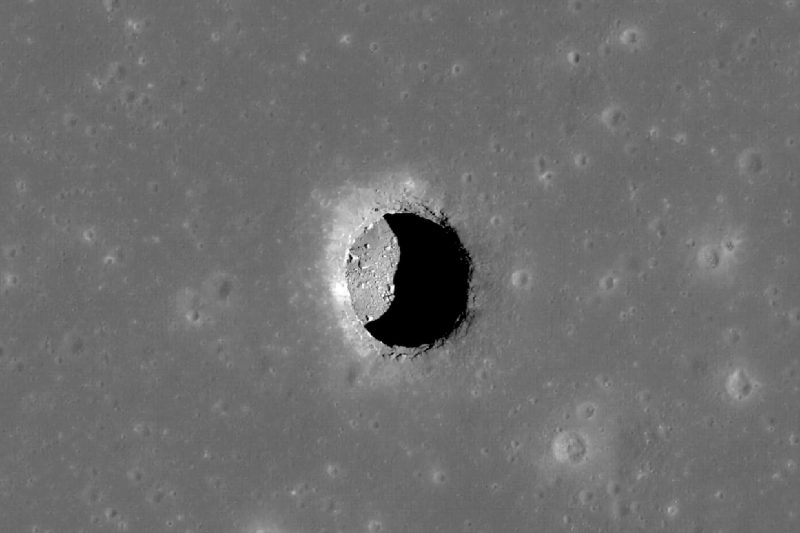
- A new mission named GIMLI will land and examine a volcanic pit — the Marius Hills Pit — in Oceanus Procellarum. It’s one of 300 such pits known on the moon.
- GIMLI will use radar and other instruments to probe beneath the surface, looking for evidence of a lava tube-type cave.
Science news, night sky events and beautiful photos, all in one place. Click here to subscribe to our free daily newsletter.
Searching for caves on the moon
Are there caves on the moon? We don’t know for sure yet, but evidence has been growing that they’re there.
Now, NASA has announced a new mission to search for moon caves. It’s called GIMLI for Geophysical Instruments for Marius Lunar pit Investigation. The plan is to land the mission at the volcanic Marius Hills Pit in Oceanus Procellarum (“Ocean of Storms”), a vast, dark lava plain or lunar mare (“sea”) located on the western edge of the moon’s near side.
NASA announced it had selected the new mission on September 30, 2026. Brooks Mendenhall described it in Astronomy magazine on October 9. An official targeted launch or arrival date for the GIMLI payload hasn’t yet been announced.
Fun fact: the mission is named after J.R.R. Tolkien’s cave-loving dwarf Gimli in The Lord of the Rings!
The Marius Hills Pit is — often called the Marius Hills “hole” — is a steep-sided circular opening located within the Marius Hills volcanic region. GIMLI will peer down into the pit to see if it opens into a lava tube-type cave below the lunar surface. The pit is about 90 meters (295 feet) across. It’s approximately 50 meters (164 feet) deep.
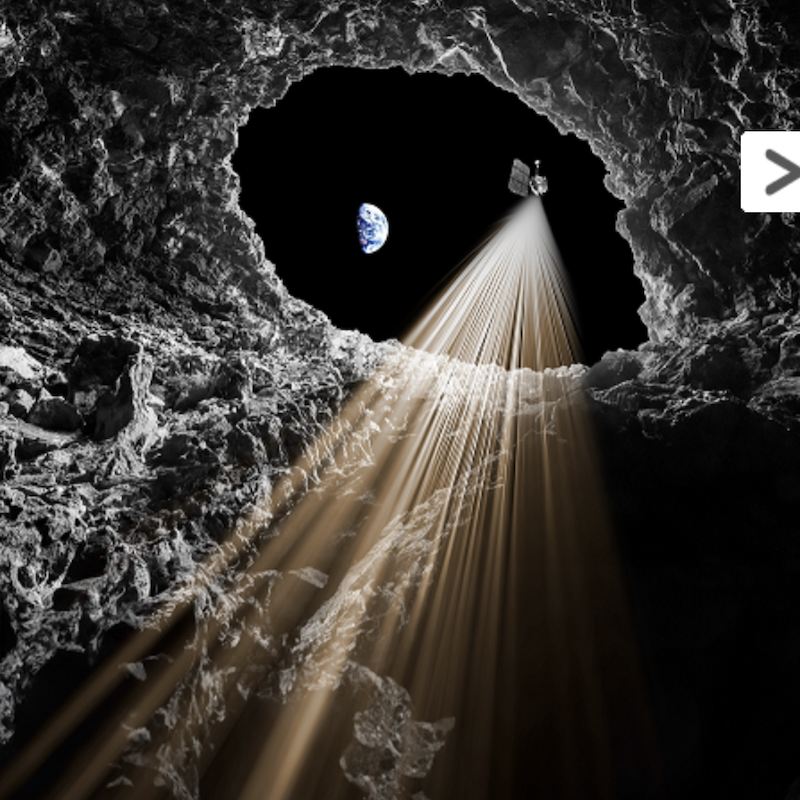
And it could be a skylight, an opening in the roof of a lava tube, scientists believe.
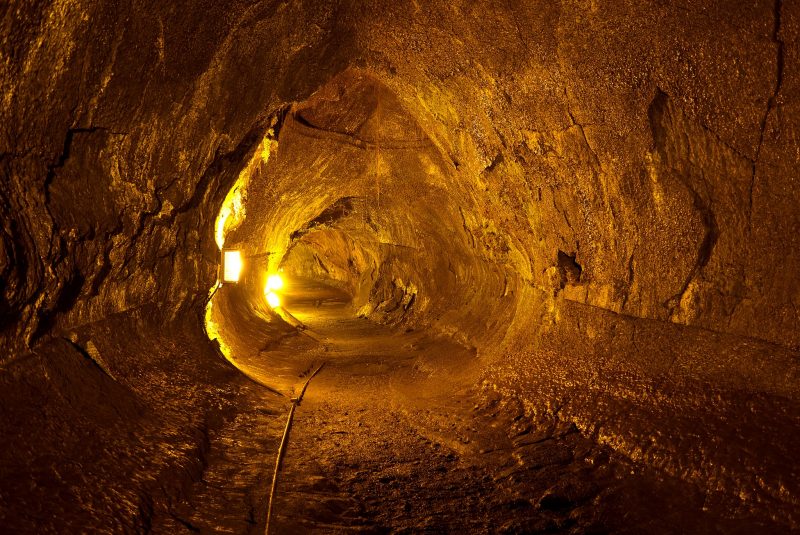
On Earth, lava tubes form when the outer layer of a lava flow cools down while molten rock keeps moving beneath it. Later, the lava flow eventually stops. Then, when the lava drains away, it leaves behind a hollow channel or tunnel.
The mission was selected as part of the Payloads and Research Investigations on the Surface of the Moon (PRISM) program.
Science first
It will be exciting to see GIMLI land and to watch as it starts peering down into the pit. But the science will come first, according to Nicky Fox, associate administrator of NASA’s Science Mission Directorate. She said:
NASA Science is building the ultimate interplanetary survival guide to ensure that science goes first to the lunar surface to provide our future astronaut crews with the vital information, resources and safety precautions needed ahead of time to survive the night on the moon.
How GIMLI will search for caves on the moon
GIMLI won’t enter the pit itself. Instead, it’ll use a suite of instruments to scan below the surface.
For example, it’ll use the Norwegian Space Agency’s ground-penetrating radar. Plus, a gravimeter — a specialized scientific instrument used to measure local variations in a gravitational field — will help look for places in the pit where empty lava chambers might exist. And seismic sensors will measure sound waves moving through the ground. And there will be cameras, too, of course.
Notably, this kind of subsurface scanning hasn’t been done on the lunar surface in decades. GIMLI’s principal investigator Than Putzig at the Planetary Science Institute said it:
… has essentially not been done since the Apollo astronauts.
That’s a long time, since the 1970s.
Why confirming a lava tube would be exciting
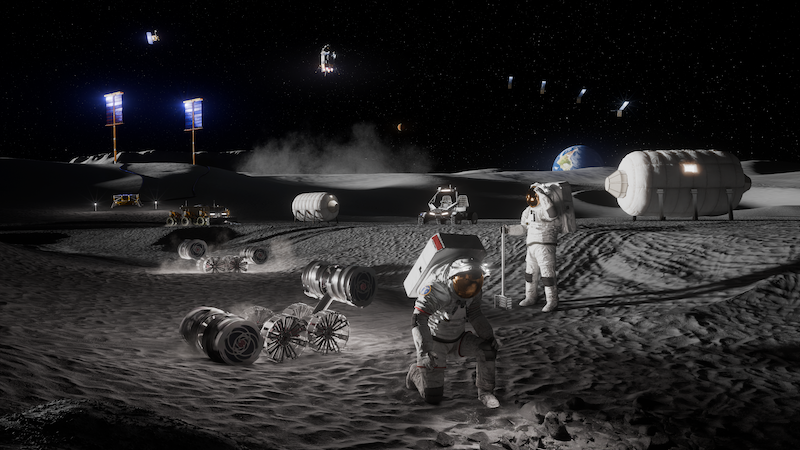
There are two reasons why confirming a lava tune on the moon would be exciting and important. Most intriguingly, it could offer protection to future astronauts. It could help shield them from the dangers of radiation from the sun, micro-meteoroids and extreme temperatures.
And for scientists the planned GIMLI mission is an unprecedented opportunity to study a lava tube somewhere other than Earth. Scientists believe this moon cave would record the history of past volcanic activity on the moon. As Gareth Morgan at the Planetary Science Institute explained:
Confirming a substantial lava tube would give us an insight into how volcanism operated on the moon. Lava tubes are a common feature of basaltic volcanism on Earth, so identifying them on the moon means we could use knowledge of such terrestrial caves to better understand lunar history.
And even if GIMLI doesn’t find any caves, it could still determine how the pit formed. It would find more clues about the geologic and volcanic history of the moon overall.
What’s the evidence for lava tubes on the moon?
We know there are lava tubes on both Earth, Mars and Venus, so what about the moon?
Earthly lava tubes only get to about 100 feet (30 meters) across. But on the moon — with its weaker gravity — lava tubes might be larger. In fact, scientists estimate they could reach 1,260 feet (385 meters) across.
Scientists have found nearly 300 pits like Marius Hills Pit on the moon so far. Do any of them lead to subsurface lava tubes? These are the places to go when searching for caves on the moon.
NASA’s Lunar Reconnaissance Orbiter used radar to investigate one of those pits, in Mare Tranquillitatis, in 2024. The data suggested a possible lava tube about 100 feet long.
The Marius Hills Pit is another good contender. Radar data from the Kaguya orbiter plus gravity measurements from NASA’s GRAIL mission pointed strongly to a void beneath the surface.
Other PRISM selections
NASA officially released its first PRISM call for proposals on February 14, 2020. The other two PRISM selections include the Lunar Environment Monitoring Station – South Pole (LEMS-SP) and the Depth Imager with Spectral and Color Optics (DISCO).
LEMS-SP is an autonomous instrument suite. It is a a long-term environmental and hazard monitoring station. It will monitor falling micro-meteoroids and track the abundance of volatiles. Those are materials that can easily change into gas, that drift into the moon’s thin outer layer of gases.
Plus, it can also detect seismic activity, ie. moonquakes, with a short-period seismometer.
No, DISCO won’t play music on the moon. But it will search for ice below the surface in micro-cold traps. In addition, it will study how the lunar surface behaves, from how rocket exhaust disturbs the ground to how stable it is for mobility.
All of this will help NASA design the first moon base at the south pole. Fox said:
These PRISM selections will directly help NASA minimize risks to our astronauts while maximizing our agency goals as we set up humanity’s first lunar outpost in preparation for sending the first astronauts to Mars.
Bottom line: NASA is searching for caves on the moon. A new mission, GIMLI, will land at the volcanic Marius Hills Pit to look for a subsurface lava tube. Will it find one?
Via NASA.
Via Astronomy.
Read more: 1st lunar lava tube discovered by NASA moon orbiter
Read more: Moon caves and pits are a comfy 63 degrees