Solar activity probably triggered 20 to 25 explosions in a US Navy minefield near Hon La, North Vietnam, on August 4, 1972, according to declassified naval records revisited in a 2018 paper. An aircrew saw the blasts spread across about 3.2 km (2 miles) of water in roughly 30 seconds.
Nearby, 25 to 30 patches of muddy water suggested that other mines might already have detonated. Several destroyers also reported feeling underwater shocks. The 20 to 25 explosions were one aircrew’s observed burst, within an episode that affected minefields elsewhere along the coast.
The mines in that field had been in place for at least four weeks. Their earliest self-destruct setting was still 30 days away. Investigators considered whether an overflying aircraft or a chain reaction from an initial blast could explain what the crew had seen.
From unexplained explosions to a solar explanation
The weapons were Destructors, aircraft bombs adapted for use as mines. They formed part of the port-mining campaign launched as Operation Pocket Money in May 1972 to restrict shipping into North Vietnam. Their magnetic sensors responded to changes associated with a passing steel vessel. A geomagnetic disturbance could also produce changes great enough, and lasting long enough, to trigger those sensors.
On August 15, the commander of the US Pacific Fleet requested an analysis of whether solar storms had caused the detonations. Investigators gathered magnetic observations and met researchers near Boulder, Colorado, where the National Oceanic and Atmospheric Administration monitored space weather.
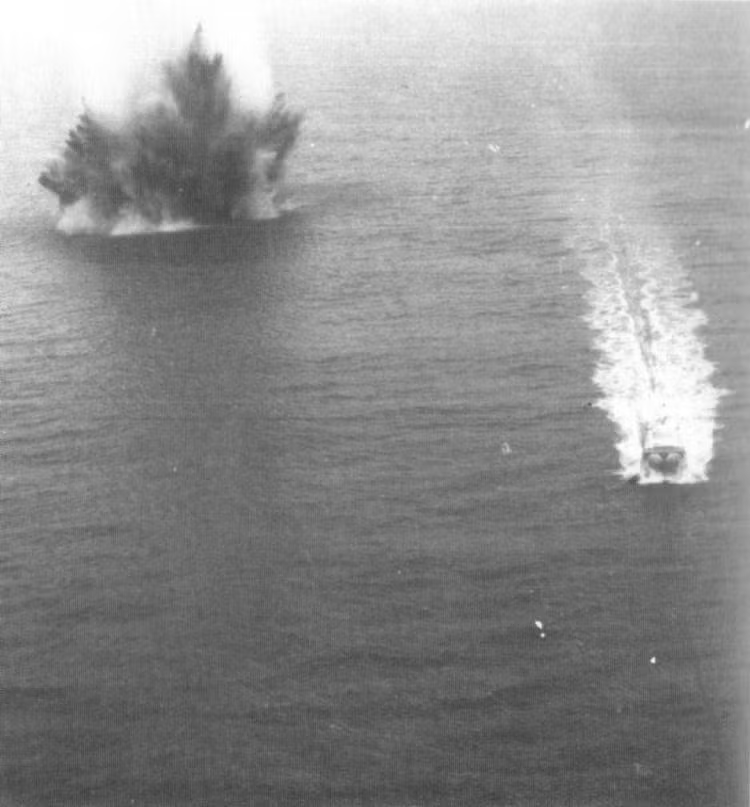
On September 5, Naval Ordnance Systems Command advised the fleet that there was “a high degree of probability” that the early-August solar activity had detonated all the sensitive-setting Destructors and some set to lower sensitivity in North Vietnamese waters. The assessment concerned minefields across North Vietnamese waters, beyond the explosions witnessed off Hon La.
Decades later, a colleague’s memory of uniformed Navy visitors to solar researchers helped lead University of Colorado Boulder space physicist Delores Knipp back to the records. Her team’s 2018 paper in Space Weather brought the naval investigation together with measurements of the storm.
According to Colorado University newspaper Boulder Today, Knipp’s interest in the 1972 storm began with a chance conversation with a colleague, who at the time was working as a postdoctoral fellow at the precursor to the National Oceanic and Atmospheric Administration’s Space Weather Prediction Center.
“He remembered there being a group of Navy men in uniform and a couple of folks in dark suits who were visiting his boss,” Knipp said.
Her colleague didn’t know what transpired in that meeting, but he knew it had something to do with the military implications of a recent solar storm.
Knipee soon discovered a naval document declassified sometime around 1990, which discussed the spontaneous detonations of dozens, and maybe more, sea mines in Asia. Those mines had been part of a Vietnam War campaign called “Operation Pocket Money.”
To her surprise, the report linked those detonations to solar activity.
“I started reading this report, and I said, ‘Wow, this really happened,’” Knipp said.
She and her colleagues wanted to know more. They tracked down a series of reports from scientists in the U.S., Japan and Europe that, Knipp said, had been filed away and mostly forgotten.
According to those documents, ground-based observatories recorded four solar flares, or ejections of energy from the Sun, between August 2 and 4. The third one was gigantic, and likely produced an event called a coronal mass ejection.
“That’s when we knew that something wicked this way comes,” Knipp said. told CU Boulder Today in 2018.
An ultra-fast eruption reached Earth
The Sun produced a series of major eruptions between August 2 and 4. Earlier ejections may have cleared the interplanetary path for a much faster coronal mass ejection (CME), a cloud of plasma carrying its own magnetic field.
Solar flares are bursts of electromagnetic radiation. The 2018 reconstruction associated the fast CME with a flare whose visible-light emission peaked at 06:21 UTC on August 4. The disturbance’s shock reached Earth about 14.6 hours later at 20:54 UTC, compressing Earth’s magnetic field.
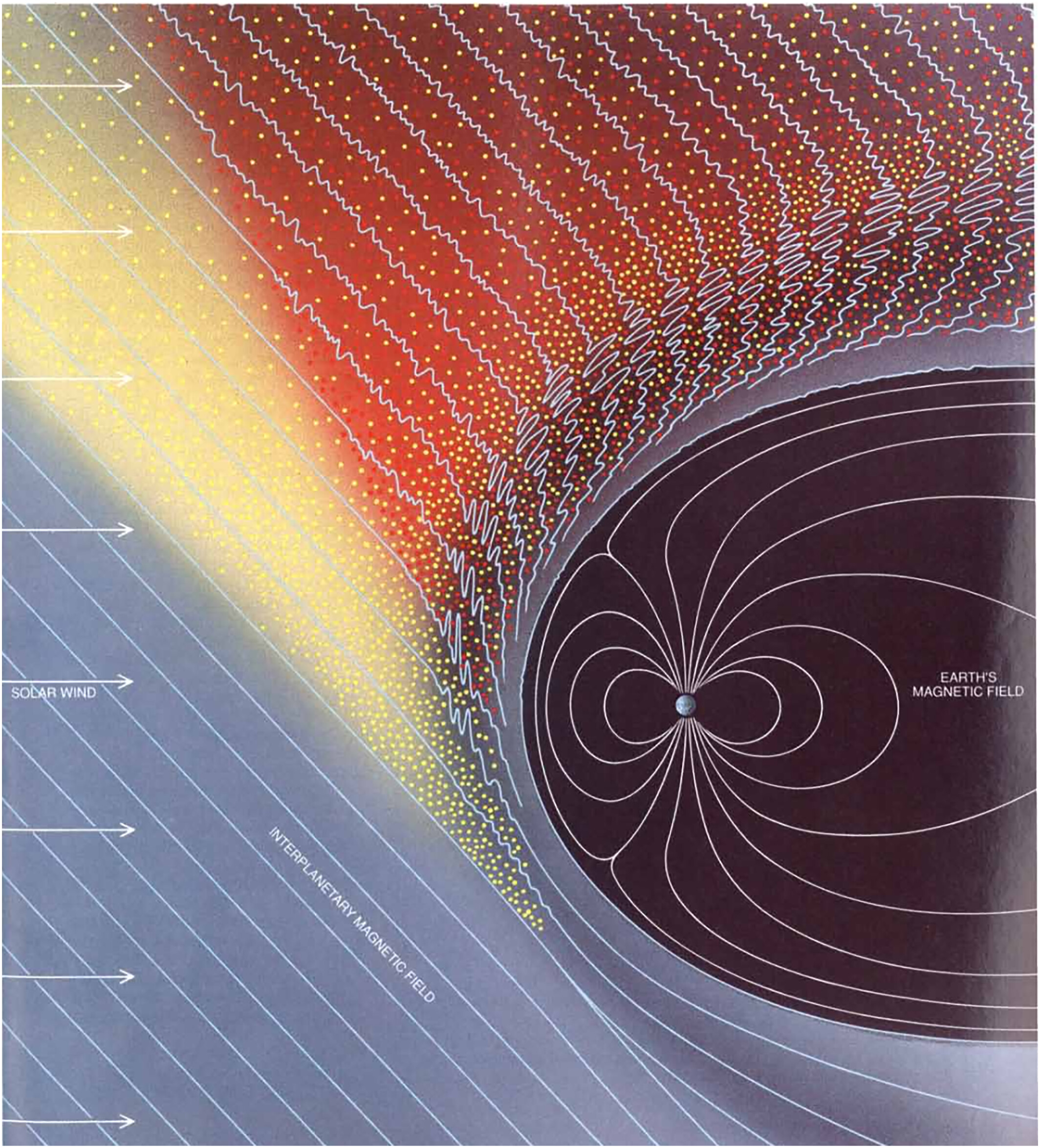
Later, a 2024 review identified the event as the fastest recorded Sun-to-Earth transit. Slower CMEs can take several days to arrive, according to NOAA.
The hourly Disturbance Storm Time (Dst) index reached −125 nanotesla (nT) on August 5, according to the final Kyoto record. Dst averages observations from low-latitude magnetometers over an hour.
That broad measure could obscure the rapid, local magnetic swings relevant to a mine’s sensors.
At the Manila observatory, the magnetic field changed at a rate of about 168 nT per minute around 22:40 UTC on August 4. Knipp’s team suggested that one or more magnetic spikes after 22:30 UTC could have triggered the mines.
The Navy provides August 4 as the date of the explosions, but the 2018 researchers had neither an exact clock time nor the mines’ trigger thresholds. Their proposed connection to a particular magnetic pulse therefore remains an inference.
From sea mines to power grids and Apollo
The same period of solar activity produced energetic particles that would have threatened a poorly shielded lunar crew. The eruptions fell between Apollo 16 and Apollo 17. NASA describes them as a near miss for lunar explorers, who could have experienced high radiation levels had a mission been underway.
Changing magnetic fields also induce electric currents in long conductors. During the August 1972 storms, power systems in North America reported disturbances, and an AT&T communications cable linking Illinois and Iowa suffered an outage. These were different technological responses to the same disturbed space environment.
For the Navy, the response included reseeding depleted minefields and accelerating the replacement of mines that relied on magnetic signals alone. The newer weapons required a seismic signal as well as a magnetic one. Requiring both signals reduced their vulnerability to changes in Earth’s magnetic field.
What is known, and what remains uncertain?
| Recorded detail | Evidence |
| One observed burst | 20 to 25 in about 30 seconds, observed by one aircrew near Hon La on August 4, 1972. |
| Other surface signs | 25 to 30 muddy patches indicating possible additional detonations. |
| Solar transit | An estimated 14.6 hours. The associated shock reached Earth at 20:54 UTC on August 4. |
| Navy assessment | A high degree of probability that early-August solar activity had detonated magnetic mines, reported on September 5. |
| Timing limit | The 2018 researchers did not have the exact clock time of the mine explosions or their trigger thresholds. |
The observations describe one burst of explosions, with signs of other detonations elsewhere. The evidence supports a probable solar cause while leaving the match to a particular magnetic pulse unresolved.
References:
1 The Mining of North Vietnam, 8 May 1972 to 14 January 1973. “Sun Spot Incident,” pp. 3-63–3-65 – Texas Tech University Vietnam Archive
2 Knipp, D. J., Fraser, B. J., Shea, M. A., & Smart, D. F. (2018). On the little-known consequences of the 4 August 1972 ultra-fast coronal mass ejecta: Facts, commentary, and call to action. Space Weather, 16, 1635–1643.
3 A 1972 solar storm triggered a Vietnam War mystery – CU Boulder Today – November 12, 2018.
4 Tsurutani, B. T., Sen, A., Hajra, R., Lakhina, G. S., Horne, R. B., & Hada, T. (2024). Review of the August 1972 and March 1989 (Allen) space weather events: Can we learn anything new from them? Journal of Geophysical Research: Space Physics, 129, e2024JA032622.
5 Hourly Equatorial Dst Values (FINAL), August 1972 – World Data Center for Geomagnetism, Kyoto – August 1972