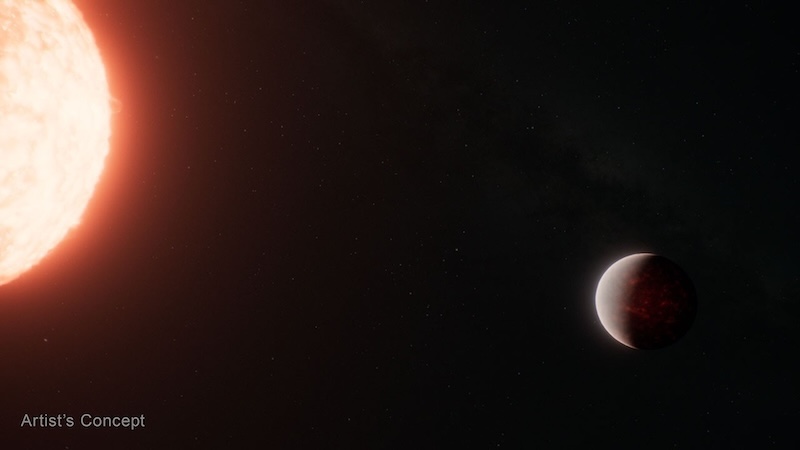
- The super-Earth exoplanet TOI-561 b is hot and its surface is likely covered by molten lava. An atmosphere for this lava planet was an unexpected discovery.
- Additional observations using the Webb space telescope have re-confirmed the existence of this world’s dense atmosphere.
- The new observations also show that the atmosphere of TOI-561 b is highly reflective, with clouds or haze.
The 2027 lunar calendar from EarthSky is now available! See the moon’s phase for every day of the year. Get yours now!
Surprising atmosphere of lava planet TOI-561 b re-confirmed by Webb
Last December, scientists at the Carnegie Institution for Science in Washington, D.C. said rocky exoplanet TOI-561 b was a scorching hot super-Earth — a lava planet — with a thick atmosphere. It was a surprise, because scientists had thought it was too small and too close to its star to hold an atmosphere.
TOI-561 b is located some 280.5 light-years from Earth, in the direction of our constellation Sextans. It orbits extremely near its host star, completing a single orbit (a full “year”) in under 10.5 hours. Surface temperatures are estimated to be over 2,000 K (around 3,100°F / 1,700°C). At these extreme temperatures, rock melts, creating a global ocean of molten lava on its dayside.
Now we have an update on this fascinating world. Some of the same researchers that conducted the earlier study — led this time by the University of Montreal in Canada — said on October 27, 2026, that they used the James Webb Space Telescope to re-observe TOI-561 b. Their observations showed that there are clouds or haze in the atmosphere of this world. They also suggest it reflects much of the heat coming from the planet’s star back into space.
The researchers published their peer-reviewed findings in The Astronomical Journal on September 29, 2026.
And Evan Gough wrote about the latest observations for Universe Today on October 27, 2026.
A surprising atmosphere
TOI-561 b is what scientists call an ultra-short period (USP) planet. Even though it is a super-Earth, scientists thought that it was too small — and hot — to hold on to any atmosphere, due to being so close to its star.
But it seems that TOI-561 b does have an atmosphere, and a thick one at that. The paper states:
Ultrashort period (USP) rocky planets are expected to be depleted of any substantial gaseous envelope due to the intense irradiation they receive from their host star, making the recent detection of an atmosphere around TOI-561 b particularly surprising. That finding was based on the planet’s bulk density and dayside emission spectrum, but full-orbit phase-curve observations offer a more comprehensive way to constrain the presence and characteristics of a planet’s atmosphere.
The atmosphere of the lava planet is highly reflective
The researchers used Webb to observe TOI-561 b for 37 hours. That worked out to seeing three orbits of the planet, at 10.5 hours per orbit. That is good, because the more orbits that can be observed, the better for gathering data.
The previous observations had also shown that TOI-561 b has an atmosphere. How did the researchers determine this?
The dayside of the planet was a lot cooler than expected. That shouldn’t be the case if the planet had no atmosphere.
There were two possible explanations. Either heat was being reflected back into space or the atmosphere transported it to the nightside. But the results showed the nightside wasn’t warm enough. The researchers estimated that about 3/4 of the planet’s heat must be reflected into space. The paper states:
We conclude from the GCM simulations that heat redistribution alone cannot match the observed dayside fluxes or amplitude of the phase curve, and a high-albedo source (Ab = 0.6) indicative of clouds or haze.
Co-author Lisa Dang is the project lead at the University of Waterloo, Ontario, Canada. She explained:
We measured how the planet’s brightness and heat changed throughout its orbit. This technique, known as a phase curve, revealed that the planet reflects a significant amount of light from its star, and that heat is being redistributed around the planet instead of only on the sunlit side. Together, these point to the presence of an atmosphere.
Multiple kinds of clouds
The researchers said that clouds or haze are likely reflecting the heat. Silicon dioxide (SiO2) and magnesium metasilicate (MgSiO3) are two of the most likely compositions of the clouds. The paper states that:
… multiple possible cloud species can form on the dayside, including MgSiO3 and SiO2.
Challenging current theories
The findings are surprising, and they also challenge current theories about rocky ultra-short period planets. Dang said:
Our discovery challenges current theories. We would expect a heavily irradiated rocky planet like TOI-561 b to have lost its atmosphere billions of years ago. Instead, the evidence suggests it still has a significant atmosphere today.
And the paper states:
Atmospheric-escape theory suggests that strongly irradiated super-Earths should be devoid of any volatile envelopes. This is particularly astonishing given that the current JWST census of rocky exoplanets has been interpreted as suggestive of a population of bare-rock planets …
It’s also notable that TOI-561 b orbits a sun-like star. Most ultra-short period planets orbit red dwarfs. And red dwarfs are known for their bursts of deadly radiation. That radiation can strip the atmospheres off planets that are too close.
Yet TOI-561 b receives more radiation from its star than typical red dwarfs. And it still has an atmosphere! How is that possible?
How is the atmosphere of lava planet TOI-561 b possible?
The researchers aren’t sure how TOI-561 b has been able to keep its atmosphere. But they have ideas.
It might have started out with an even much thicker primordial atmosphere, perhaps as a sub-Neptune (larger than a super-Earth). The radiation might have indeed stripped away most or all of that atmosphere. So what’s left now is a secondary atmosphere.
It’s also possible that the planet originated much farther out from its star than where it is now. That would be when the star was still young. At that time, it emitted even more radiation.
When the planet migrated closer to the star, the star was already “calming down” and emitting less radiation. As a result, the remaining atmosphere was spared from destruction.
Or it could be that the answer lies in both scenarios.
But there’s another possibility, too. The planet “consumed” its original atmosphere. In other words, the atmosphere became trapped in the interior of the planet.
Co-author Anjali Piette, Assistant Professor in Astronomy at the University of Birmingham, said:
Our discovery challenges current theories. We would expect a heavily irradiated rocky planet like TOI-561 b to have lost its atmosphere billions of years ago. Instead, the evidence suggests it still has a significant atmosphere today. This raises major questions such as whether the planet started with an unusually large supply of gases or if the ocean of molten rock covering its surface acts as a planet-wide volcano that is constantly feeding its atmosphere.
Venus or Io?
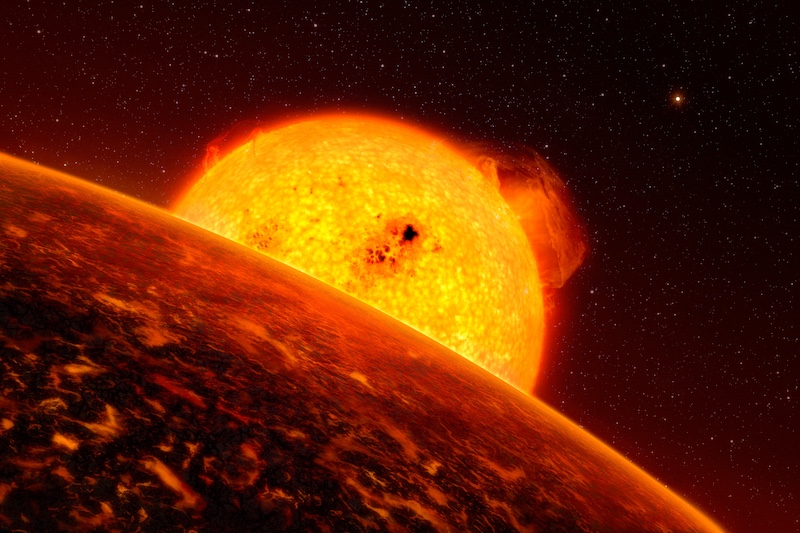
The researchers want to know if TOI-561 b is more similar to Venus or Jupiter’s volcanic moon Io. Dang said:
The next big question we will seek to answer is whether TOI-561 b’s atmosphere resembles Venus or an extreme version of lo. Observing the planet at longer wavelengths with the JWST could give us insights and help explain how a planet this hot has held on to an atmosphere for billions of years.
The unexpected atmosphere of lava world TOI-561 b was a big surprise to astronomers. But it will also provide valuable data for studying other rocky super-Earth planets. How many other also have atmospheres, and what kind?
Bottom line: More recent observations of hot super-Earth TOI-561 b by the Webb space telescope show again that the lava planet’s surprising atmosphere does exist. And it’s very reflective.
Source: A Highly Reflective Atmosphere on the Lava World TOI-561b Revealed by JWST/NIRSpec Phase Curves
Via University of Birmingham
Via Universe Today
Read more: How do lava-world exoplanets keep their atmospheres?
Read more: Juno measures fiery Io’s subsurface temperature for 1st time