EarthSky’s famous lunar calendar is now available. Beautiful blue and silver poster shows every day’s moon phase for 2027. Order yours today!
Mountain-sized asteroid to pass close to Earth on August 7, 2027
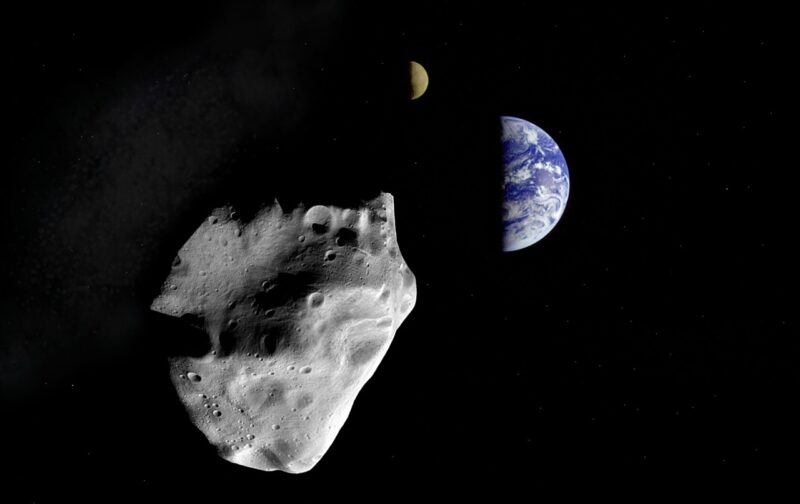
A space rock around 800 to 1,800 meters wide (about 0.5 to 1.1 miles) is set to soar close by Earth on August 7, 2027.
The asteroid — named 1999 AN10 — has been labelled potentially hazardous by NASA, but there is no chance of it impacting Earth in 2027. It will safely pass us in August with a separation of about 389,855 kilometers (242,240 miles), or roughly the same distance away as the moon.
If the asteroid is not going to hit us, why is it labeled a potentially hazardous asteroid? A potentially hazardous asteroid is any space rock that comes as close as 0.05 astronomical units (AU) from Earth and that’s larger than 140 meters (460 feet) in diameter. The label reflects the potential that at some point in the future — if this large space rock gets nudged by another passing object — its orbit could be altered in a way that would cause it to hit Earth. Currently, 1999 AN10 has a zero chance of hitting Earth during its 2027 flyby.
So this isn’t something to be scared of. But it is something to get excited about! The asteroid is so big and will come so close that you’ll be able to spot it with binoculars as it glides by. 1999 AN10 will peak around magnitude 7.3 as it passes through the night sky over North and South America. Its closest approach is at 7:12:05 UTC on August 7, 2027. That would be 2:12:05 am CDT on August 7 for the Americas.
Overnight on August 7, 2027, asteroid 1999 AN10 will pass through the constellations Taurus, Aries, Pisces and Pegasus.
Will asteroid 1999 AN10 hit the moon?
If the asteroid will pass about 1 lunar distance from Earth, does that mean it could hit the moon? How close will it get to the moon?
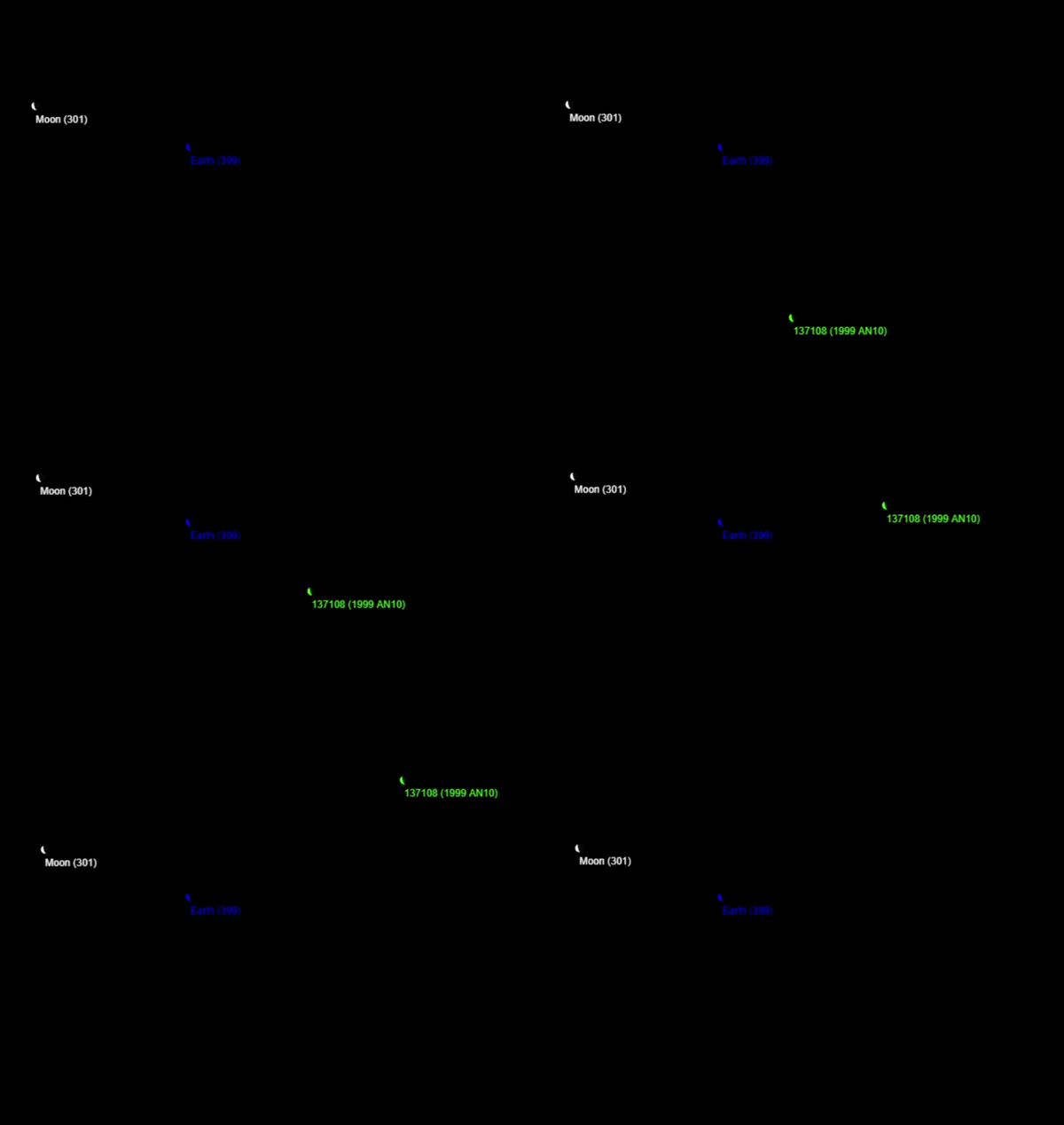
Well, moon lovers, don’t worry. The closest the asteroid will come to the moon is 763,391 km, or 474,349 miles. That’s about twice as far as it will get from Earth! So, as you might have guessed, it means the asteroid will pass Earth on the opposite side to the moon at that time.
More about potentially hazardous asteroids
Astronomers discovered 1999 AN10 on January 13, 1999, at the Lincoln Laboratory Experimental Test Site in New Mexico. It’s an Apollo-class asteroid, meaning its orbit crosses Earth’s orbit around the sun.
The asteroid travels around the sun once every 643 days, following an elongated orbit that takes it from inside Earth’s orbit to well beyond Mars’ orbit.
It’s a potentially hazardous asteroid because of its large size. NASA says any impactor larger than 1 to 2 kilometers (.6 to 1.2 miles) in size would have worldwide effects. It could blast massive amounts of dust into the atmosphere, dimming sunlight for months and threatening global civilization.
Astronomers have cataloged roughly 2,500 known potentially hazardous asteroids. But they estimate that’s only about half of the population. However, they believe they have found 90% of the biggest potentially hazardous asteroids.
Other notable potentially hazardous asteroids
99942 Apophis
- Close approach: April 13, 2029
- Distance: About 32,000 km (20,000 miles) above Earth’s surface
- Size: Approximately 375 meters (1,230 feet)
Apophis will pass closer to Earth than many geostationary satellites. Scientists once worried about a possible future collision, but additional observations ruled out an impact risk for at least 100 years. NASA’s OSIRIS-APEX spacecraft will study it after the encounter.
101955 Bennu
- Potential impact date: September 24, 2182
- Size: About 500 meters (1/3 mile) wide
- Impact odds: Approximately 1 in 2,700 for that date, according to NASA’s 2021 orbital analysis.
NASA’s OSIRIS-REx mission collected a sample from Bennu and returned it to Earth in 2023. Scientists are studying the sample to learn about the early solar system.
2001 WN5
- Close approach: June 26, 2028
- Distance: About 248,700 km (154,500 miles) from Earth’s center
- Size: Approximately 940 meters (0.58 mile)
This asteroid will pass inside the moon’s orbit. It will be a bit brighter than 1999 AN10, peaking at magnitude 6.7.
1997 XF11
- Closest approach: October 26, 2028
- Distance: About 929,000 km (577,000 miles) from Earth
- Size: Approximately 700 meters (0.43 mile)
This asteroid attracted considerable attention after its discovery in 1997. Early calculations suggested a possible future collision. Better observations ruled that out.
Read more:
Apophis: From scary asteroid to a rare science opportunity
11,000 new asteroids! Astronomers call it ‘tip of iceberg’
This active asteroid has grown a tail! What happened?
Bottom line: Asteroid 1999 AN10, which might be a mile wide, will pass Earth on August 7, 2027, about 1 lunar distance away. The encounter poses no danger.