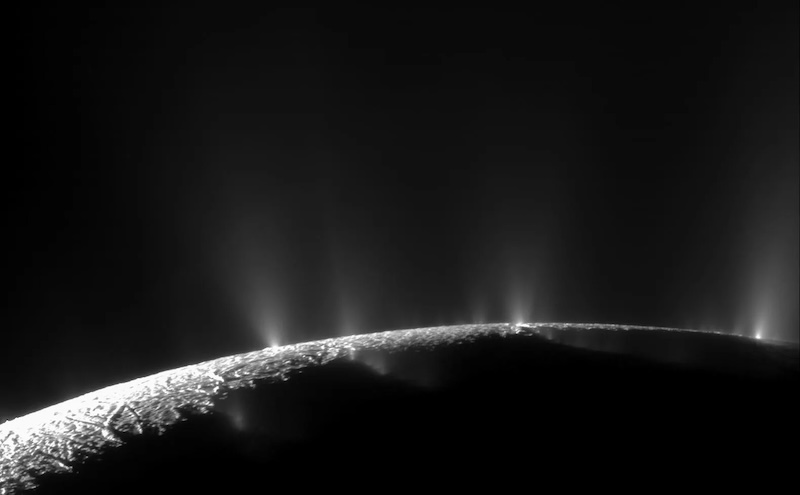
- Jupiter’s moon Europa has a global ocean beneath its icy crust. Does it have water vapor plumes too, like Saturn’s moon Enceladus?
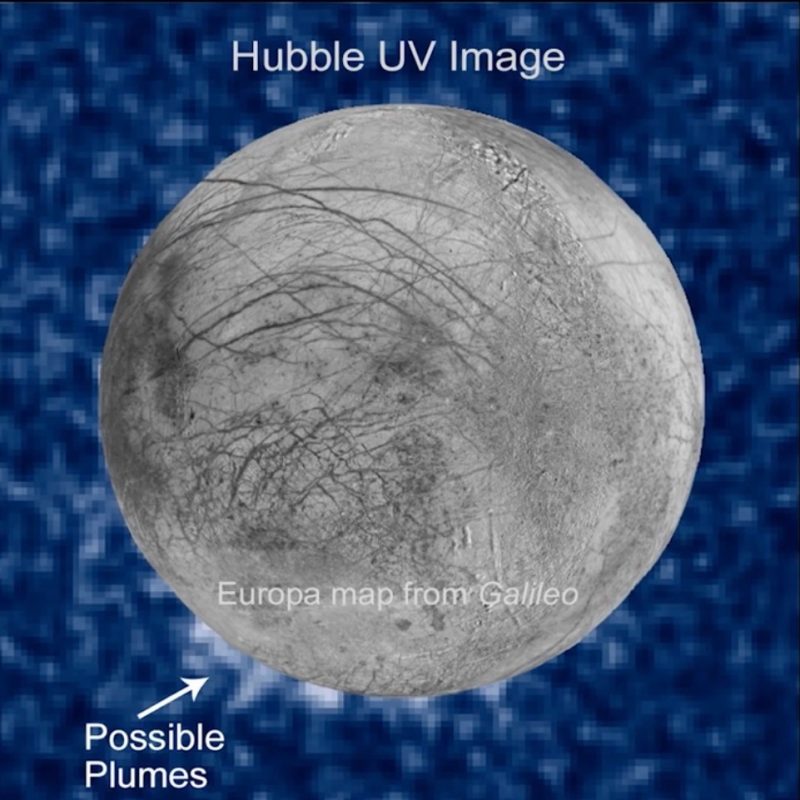
- Previous observations by the Hubble Space Telescope hinted at plumes, although smaller than those on Enceladu. But the plumes might not be there after all, a new study from SwRI says.
- Plumes aren’t at all ruled out by the study, though. The data for their existence just isn’t as concrete as before.
You deserve a daily dose of good news. For the latest in science and the night sky, click here to subscribe to our free daily newsletter.
Europa’s water vapor plumes: real or not?
Do plumes of water vapor blast from Jupiter’s moon Europa, like they do from Saturn’s moon Enceladus? Scientists have debated this for years.
Some previous observations by the Hubble Space Telescope hinted these plumes were there, but smaller and more sporadic than the ones on Enceladus. But now, a new study casts doubt the plumes being there at all.
Researchers from the Southwest Research Institute (SwRI) said on May 18, 2026, that the evidence for the plumes isn’t as strong as it once was.
The new study examines 14 years of Hubble observations using its Imaging Spectrograph (HST/STIS). Those observations focused on Europa’s Lyman-alpha emissions, a specific wavelength of ultraviolet light emitted and scattered by hydrogen atoms.
The researchers published their new peer-reviewed paper in Astronomy & Astrophysics on May 5, 2026.
SwRI in the news: New data casts doubt on the existence of vapor plumes on Europaow.ly/IW5750Z2c8Q
— Southwest Research Institute (@swri.org) 2026-05-20T18:02:38.988Z
Difficulties in interpreting the data
There was some difficulty in interpreting the data from the original Hubble observations going back to 2014. It had to do with exactly where Europa was in the images. Co-author Kurt Retherford at SwRI explained:
One of the difficulties in interpreting the data back then was determining where to place Europa within its context. The way Hubble works left some uncertainty in terms of placement relative to the center of the image. If Europa’s placement was off even just by a pixel or two, it could affect how the data gets interpreted.
Plumes not ruled out
Lead author Lorenz Roth at the KTH Royal Institute of Technology in Sweden added:
Our reanalysis took our original 99.9% confidence in the plumes’ existence and reduced it to less than 90% confidence. That’s simply not enough evidence to support the certainty of claims we made at the time.
So the previous confidence level has dropped enough that the researchers can’t say for sure the plumes are there. But they are not ruled out, either. It’s just that the evidence isn’t concrete anymore. Retherford said:
The description of the phenomena just doesn’t hold up the same way anymore. The new data has made us reconsider the strength of the previous paper’s conclusion regarding water vapor plumes. The recent analysis also provides improved information about the neutral hydrogen atom component of Europa’s escaping atmosphere, originating from its water ice surface.

Europa Clipper
We will likely have to wait for NASA’s Europa Clipper to arrive at Europa in April 2030 to know for sure whether Europa has plumes or not. Clipper will make multiple close flybys of Europa, studying its surface and interior in more detail than ever before. It will try to determine if Jupiter’s moon actually is habitable. And it will be able to detect any plumes … if they are there.
Bottom line: New observations from the Hubble Space Telescope suggest that Europa’s water vapor plumes are less likely than previously thought. But they don’t rule them out.
Source: Europa’s Lyman-a emissions from HST/STIS observations
Via SwRI
Read more: Seeking Europa’s water plumes with Clipper
Read more: Possible water plumes spotted on Europa