Science news, night sky events and beautiful photos, all in one place. Click here to subscribe to EarthSky’s free daily newsletter.
Neptune’s rings confirmed August 22, 1989
By the late 1980s, astronomers suspected that there are rings around Neptune, our solar system’s outermost major planet. After all, the next planet inward, Uranus, has rings (found in 1977). So does Jupiter (found in 1979) and Saturn (first glimpsed through early telescopes in the 1600s).
Then, watching from Earth in 1984, astronomers recorded extra blinks before and after Neptune passed in front of a distant star. That added to the evidence that Neptune had at least a partial ring system. But it was NASA’s Voyager 2 spacecraft that provided the first photographic proof of the existence of Neptune’s rings on August 22, 1989.
At the time, the spacecraft was a few days out from its closest encounter with the planet on August 25, 1989. As Neptune began looming large in Voyager’s cameras, the spacecraft photographed a faint but continuous ring system encircling the planet. The images of Neptune’s rings confirmed astronomers’ long-held suspicions.
Names for Neptunian rings
Today, Voyager 2 remains the only earthly spacecraft to have encountered Neptune. But since Voyager’s 1989 flyby, the Hubble Space Telescope, the James Webb Space Telescope, and Earth-based telescopes have imaged the two brightest rings of Neptune. Astronomers named those two Neptunian rings Adams and Le Verrier. They’re named for John Couch Adams and Urbain Jean Joseph Le Verrier, whose independent calculations helped find Neptune’s position in the sky – and thus led to its discovery – in 1846.
There are also three more rings around Neptune: Galle, Lassell, Arago. So moving outward from near the planet, the main rings are Galle, Leverrier, Lassell, Arago, and Adams.
Peculiar ring arcs
Today, we know that Neptune has at least five main rings. Plus, it has four prominent ring arcs. The arcs are peculiar clumps of dust. Astronomers struggled to understand their existence, because the laws of motion predict these arcs should spread out into a uniform ring over short timescales. Scientists now believe the gravitational effects of Galatea, a moon just inward from the ring, confine the arcs.
Also, four of the prominent arcs have names. Astronomers call them Liberté (Liberty), Egalité (Equality), Fraternité (Fraternity), and Courage. They’re located in the outermost ring, Adams.
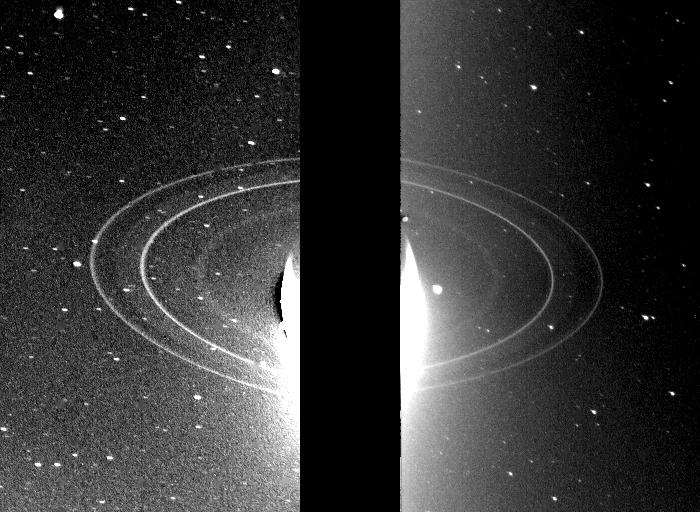
Bottom line: NASA’s Voyager 2 spacecraft confirmed the discovery of Neptune’s rings on August 22, 1989, when it took images of a faint, continuous ring system around the planet.
Read more: Webb sees Neptune’s rings and moons